

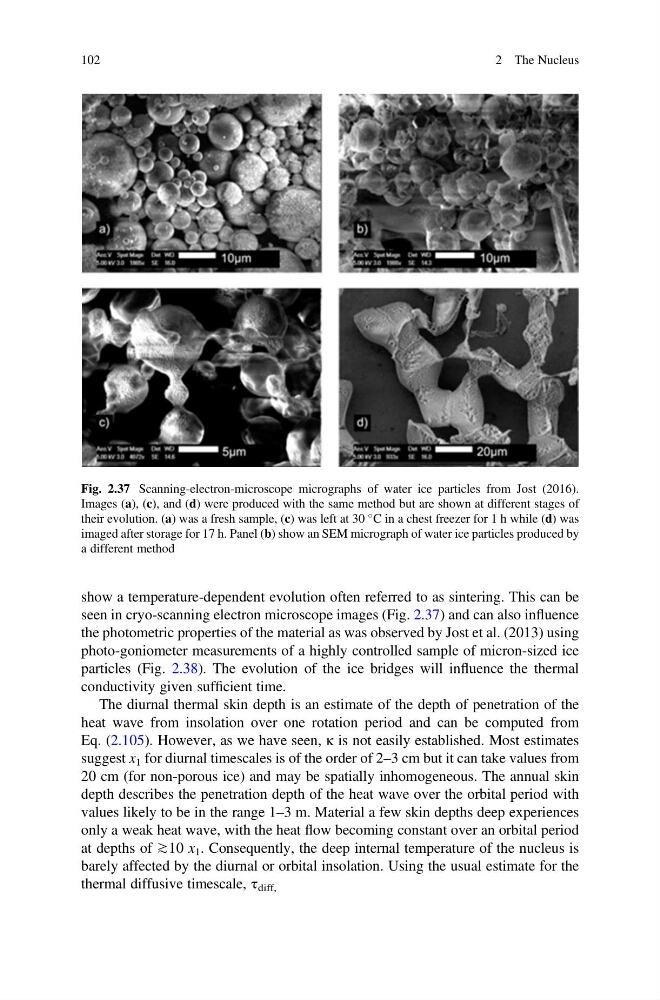
show a temperature-dependent evolution often referred to as sintering. This can be
seen in cryo-scanning electron microscope images (Fig. 2.37) and can also influence
the photometric properties of the material as was observed by Jost et al. (2013) using
photo-goniometer measurements of a highly controlled sample of micron-sized ice
particles (Fig. 2.38). The evolution of the ice bridges will influence the thermal
conductivity given sufficient time.
The diurnal thermal skin depth is an estimate of the depth of penetration of the
heat wave from insolation over one rotation period and can be computed from
Eq. (2.105). However, as we have seen, κ is not easily established. Most estimates
suggest x 1 for diurnal timescales is of the order of 2–3 cm but it can take values from
20 cm (for non-porous ice) and may be spatially inhomogeneous. The annual skin
depth describes the penetration depth of the heat wave over the orbital period with
values likely to be in the range 1–3 m. Material a few skin depths deep experiences
only a weak heat wave, with the heat flow becoming constant over an orbital period
at depths of ≳10 x 1 . Consequently, the deep internal temperature of the nucleus is
barely affected by the diurnal or orbital insolation. Using the usual estimate for the
thermal diffusive timescale, τ diff,
Fig. 2.37 Scanning-electron-microscope micrographs of water ice particles from Jost (2016).
Images (a), (c), and (d) were produced with the same method but are shown at different stages of
their evolution. (a) was a fresh sample, (c) was left at 30
C in a chest freezer for 1 h while (d) was
imaged after storage for 17 h. Panel (b) show an SEM micrograph of water ice particles produced by
a different method
102
2 The Nucleus
seen in cryo-scanning electron microscope images (Fig. 2.37) and can also influence
the photometric properties of the material as was observed by Jost et al. (2013) using
photo-goniometer measurements of a highly controlled sample of micron-sized ice
particles (Fig. 2.38). The evolution of the ice bridges will influence the thermal
conductivity given sufficient time.
The diurnal thermal skin depth is an estimate of the depth of penetration of the
heat wave from insolation over one rotation period and can be computed from
Eq. (2.105). However, as we have seen, κ is not easily established. Most estimates
suggest x 1 for diurnal timescales is of the order of 2–3 cm but it can take values from
20 cm (for non-porous ice) and may be spatially inhomogeneous. The annual skin
depth describes the penetration depth of the heat wave over the orbital period with
values likely to be in the range 1–3 m. Material a few skin depths deep experiences
only a weak heat wave, with the heat flow becoming constant over an orbital period
at depths of ≳10 x 1 . Consequently, the deep internal temperature of the nucleus is
barely affected by the diurnal or orbital insolation. Using the usual estimate for the
thermal diffusive timescale, τ diff,
Fig. 2.37 Scanning-electron-microscope micrographs of water ice particles from Jost (2016).
Images (a), (c), and (d) were produced with the same method but are shown at different stages of
their evolution. (a) was a fresh sample, (c) was left at 30
C in a chest freezer for 1 h while (d) was
imaged after storage for 17 h. Panel (b) show an SEM micrograph of water ice particles produced by
a different method
102
2 The Nucleus