

thin, inert, insulating layer so that the gas emission is throttled by the thermal inertia
of the inert surface layer and has to pass through this surface layer to escape. In this
case, the emitting (sub-) surface area can be (much) larger than the eaf. This has the
attractive implication that ices would be more homogeneously distributed in the
sub-surface.
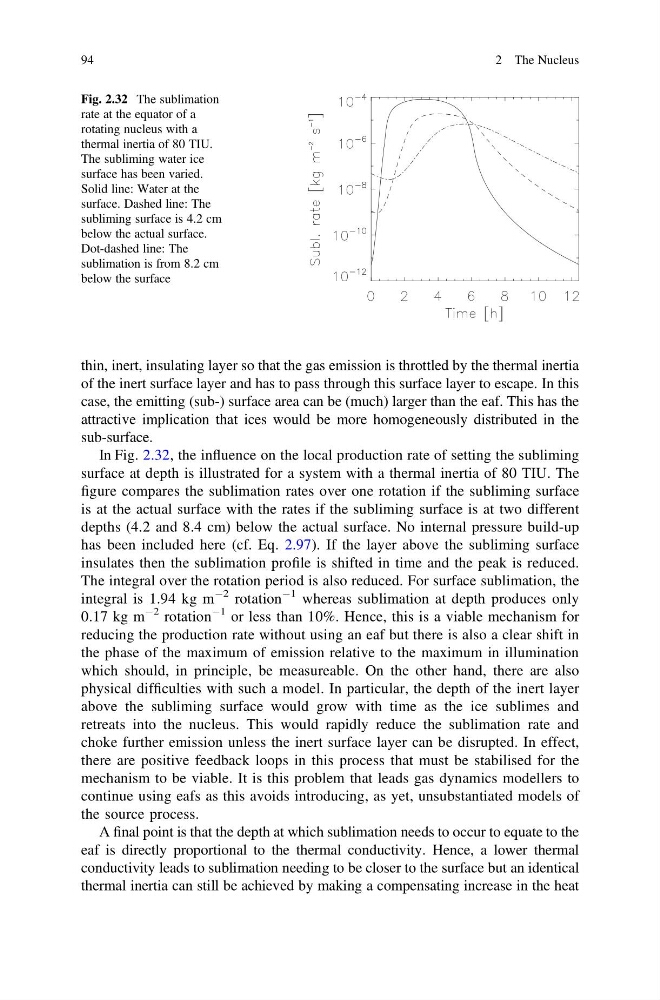
In Fig. 2.32, the influence on the local production rate of setting the subliming
surface at depth is illustrated for a system with a thermal inertia of 80 TIU. The
figure compares the sublimation rates over one rotation if the subliming surface
is at the actual surface with the rates if the subliming surface is at two different
depths (4.2 and 8.4 cm) below the actual surface. No internal pressure build-up
has been included here (cf. Eq. 2.97). If the layer above the subliming surface
insulates then the sublimation profile is shifted in time and the peak is reduced.
The integral over the rotation period is also reduced. For surface sublimation, the
integral is 1.94 kg m
À2 rotation
À1 whereas sublimation at depth produces only
0.17 kg m
À2 rotation
À1 or less than 10%. Hence, this is a viable mechanism for
reducing the production rate without using an eaf but there is also a clear shift in
the phase of the maximum of emission relative to the maximum in illumination
which should, in principle, be measureable. On the other hand, there are also
physical difficulties with such a model. In particular, the depth of the inert layer
above the subliming surface would grow with time as the ice sublimes and
retreats into the nucleus. This would rapidly reduce the sublimation rate and
choke further emission unless the inert surface layer can be disrupted. In effect,
there are positive feedback loops in this process that must be stabilised for the
mechanism to be viable. It is this problem that leads gas dynamics modellers to
continue using eafs as this avoids introducing, as yet, unsubstantiated models of
the source process.
A final point is that the depth at which sublimation needs to occur to equate to the
eaf is directly proportional to the thermal conductivity. Hence, a lower thermal
conductivity leads to sublimation needing to be closer to the surface but an identical
thermal inertia can still be achieved by making a compensating increase in the heat
Fig. 2.32 The sublimation
rate at the equator of a
rotating nucleus with a
thermal inertia of 80 TIU.
The subliming water ice
surface has been varied.
Solid line: Water at the
surface. Dashed line: The
subliming surface is 4.2 cm
below the actual surface.
Dot-dashed line: The
sublimation is from 8.2 cm
below the surface
94
2 The Nucleus
of the inert surface layer and has to pass through this surface layer to escape. In this
case, the emitting (sub-) surface area can be (much) larger than the eaf. This has the
attractive implication that ices would be more homogeneously distributed in the
sub-surface.
In Fig. 2.32, the influence on the local production rate of setting the subliming
surface at depth is illustrated for a system with a thermal inertia of 80 TIU. The
figure compares the sublimation rates over one rotation if the subliming surface
is at the actual surface with the rates if the subliming surface is at two different
depths (4.2 and 8.4 cm) below the actual surface. No internal pressure build-up
has been included here (cf. Eq. 2.97). If the layer above the subliming surface
insulates then the sublimation profile is shifted in time and the peak is reduced.
The integral over the rotation period is also reduced. For surface sublimation, the
integral is 1.94 kg m
À2 rotation
À1 whereas sublimation at depth produces only
0.17 kg m
À2 rotation
À1 or less than 10%. Hence, this is a viable mechanism for
reducing the production rate without using an eaf but there is also a clear shift in
the phase of the maximum of emission relative to the maximum in illumination
which should, in principle, be measureable. On the other hand, there are also
physical difficulties with such a model. In particular, the depth of the inert layer
above the subliming surface would grow with time as the ice sublimes and
retreats into the nucleus. This would rapidly reduce the sublimation rate and
choke further emission unless the inert surface layer can be disrupted. In effect,
there are positive feedback loops in this process that must be stabilised for the
mechanism to be viable. It is this problem that leads gas dynamics modellers to
continue using eafs as this avoids introducing, as yet, unsubstantiated models of
the source process.
A final point is that the depth at which sublimation needs to occur to equate to the
eaf is directly proportional to the thermal conductivity. Hence, a lower thermal
conductivity leads to sublimation needing to be closer to the surface but an identical
thermal inertia can still be achieved by making a compensating increase in the heat
Fig. 2.32 The sublimation
rate at the equator of a
rotating nucleus with a
thermal inertia of 80 TIU.
The subliming water ice
surface has been varied.
Solid line: Water at the
surface. Dashed line: The
subliming surface is 4.2 cm
below the actual surface.
Dot-dashed line: The
sublimation is from 8.2 cm
below the surface
94
2 The Nucleus