

capacity or the material density (or both). This is important because it implies that
simply knowing the thermal inertia does not give you the depth of any sub-surface
sublimation front. You must also establish either the thermal conductivity of the inert
layer or its total heat capacity (cf. Shi et al. 2016).
The thicker and denser the inert layer, the more resistance to the gas flow. This
builds an internal gas pressure within the layer that slows the sublimation from the
sub-surface sublimation front and Eq. (2.97) cannot, in general, be ignored. This
process, however, needs to be calculated with a gas dynamics calculation. But here
again, although this limits the depth at which sublimation can occur and still match
the eaf, it does not avoid that fact that, without separate knowledge of the thermal
conductivity and the total heat capacity, the modelled depth of the sublimation front
will be non-unique.
2.9.3.2 Volume Absorption, Solid-State Greenhouse Effect,
and Porosity
The mathematical description of the thermal balance can be extended to include the
influence of a large number of additional phenomena. We shall look at some of these
effects which might be significant in real cases.
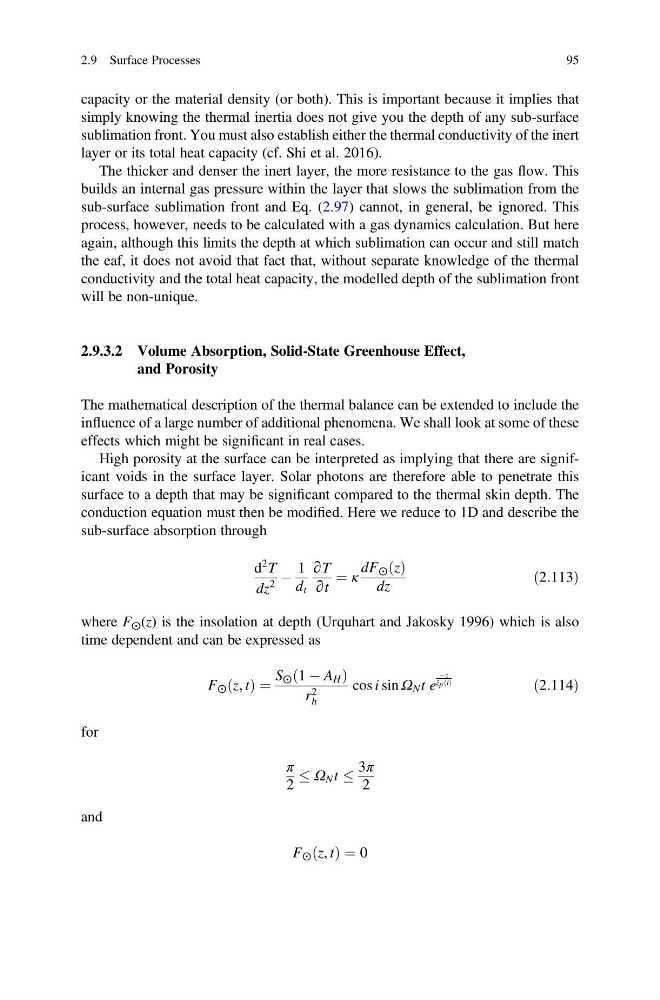
High porosity at the surface can be interpreted as implying that there are significant voids in the surface layer. Solar photons are therefore able to penetrate this
surface to a depth that may be significant compared to the thermal skin depth. The
conduction equation must then be modified. Here we reduce to 1D and describe the
sub-surface absorption through
d
2 T
dz
2
À
1
d t
∂T
∂t
¼ κ
dF ⨀ z
ð Þ
dz
ð2:113Þ
where F ⨀ (z) is the insolation at depth (Urquhart and Jakosky 1996) which is also
time dependent and can be expressed as
F ⨀ z, t
ð Þ ¼
S ⨀ 1 À A H
ð
Þ
r 2
h
cos i sin Ω N t e
Àz
ξ p i
ð Þ
ð2:114Þ
for
π
2
Ω N t
3π
2
and
F ⨀ z, t
ð Þ ¼ 0
2.9 Surface Processes
95
simply knowing the thermal inertia does not give you the depth of any sub-surface
sublimation front. You must also establish either the thermal conductivity of the inert
layer or its total heat capacity (cf. Shi et al. 2016).
The thicker and denser the inert layer, the more resistance to the gas flow. This
builds an internal gas pressure within the layer that slows the sublimation from the
sub-surface sublimation front and Eq. (2.97) cannot, in general, be ignored. This
process, however, needs to be calculated with a gas dynamics calculation. But here
again, although this limits the depth at which sublimation can occur and still match
the eaf, it does not avoid that fact that, without separate knowledge of the thermal
conductivity and the total heat capacity, the modelled depth of the sublimation front
will be non-unique.
2.9.3.2 Volume Absorption, Solid-State Greenhouse Effect,
and Porosity
The mathematical description of the thermal balance can be extended to include the
influence of a large number of additional phenomena. We shall look at some of these
effects which might be significant in real cases.
High porosity at the surface can be interpreted as implying that there are significant voids in the surface layer. Solar photons are therefore able to penetrate this
surface to a depth that may be significant compared to the thermal skin depth. The
conduction equation must then be modified. Here we reduce to 1D and describe the
sub-surface absorption through
d
2 T
dz
2
À
1
d t
∂T
∂t
¼ κ
dF ⨀ z
ð Þ
dz
ð2:113Þ
where F ⨀ (z) is the insolation at depth (Urquhart and Jakosky 1996) which is also
time dependent and can be expressed as
F ⨀ z, t
ð Þ ¼
S ⨀ 1 À A H
ð
Þ
r 2
h
cos i sin Ω N t e
Àz
ξ p i
ð Þ
ð2:114Þ
for
π
2
Ω N t
3π
2
and
F ⨀ z, t
ð Þ ¼ 0
2.9 Surface Processes
95