

gives an equation under the assumption that re-radiation is negligible (appropriate
for an active comet) as
R N ¼ r h
ffiffiffiffiffiffiffiffiffiffiffiffiffiffiffiffiffiffiffiffiffiffiffiffiffiffi
Q g L S
πS ⨀ 1 À A H
ð
Þ
s
ð2:112Þ
where Q g is the gas production rate in [kg s
À1 ] and L S is the latent heat of sublimation
in [J kg
À1 ]. It was immediately apparent from the Halley fly-bys that this equation
substantially underestimates the radii of cometary nuclei and its use, in combination
with observations of the brightness of nuclei at high heliocentric distance, also led to
huge overestimates in albedos prior to the Halley encounters (Keller 1990). Keller
et al. (1987) concluded that 10% of the surface of 1P/Halley was active
(cf discussion in Sect. 2.4) and this has led to the concept of an effective active
fraction (eaf) which describes, empirically, the outgassing rate of a surface as a
fraction of the free sublimation rate. By using the eaf, it is not necessary to
understand the actual physics of the emission. While this is unsatisfactory, it
nonetheless avoids actually having to specify the physics of the gas emission
process.
One can envisage two simple cases as possible extremes. One possibility is that
the surface may be composed of a mixture of ice and non-volatile material in the
ratio of the eaf so that the ratio of the emitting surface to the non-volatile surface
really does correspond to the eaf. Alternatively, the volatile material may be below a
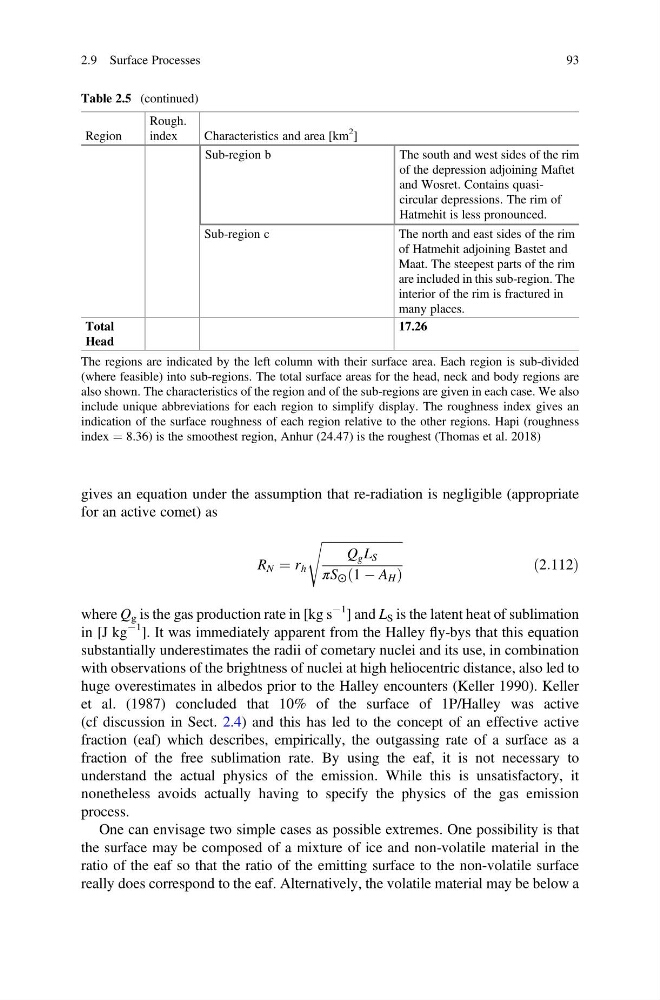
Table 2.5 (continued)
Region
Rough.
index
Characteristics and area [km
2
]
Sub-region b
The south and west sides of the rim
of the depression adjoining Maftet
and Wosret. Contains quasicircular depressions. The rim of
Hatmehit is less pronounced.
Sub-region c
The north and east sides of the rim
of Hatmehit adjoining Bastet and
Maat. The steepest parts of the rim
are included in this sub-region. The
interior of the rim is fractured in
many places.
Total
Head
17.26
The regions are indicated by the left column with their surface area. Each region is sub-divided
(where feasible) into sub-regions. The total surface areas for the head, neck and body regions are
also shown. The characteristics of the region and of the sub-regions are given in each case. We also
include unique abbreviations for each region to simplify display. The roughness index gives an
indication of the surface roughness of each region relative to the other regions. Hapi (roughness
index ¼ 8.36) is the smoothest region, Anhur (24.47) is the roughest (Thomas et al. 2018)
2.9 Surface Processes
93
for an active comet) as
R N ¼ r h
ffiffiffiffiffiffiffiffiffiffiffiffiffiffiffiffiffiffiffiffiffiffiffiffiffiffi
Q g L S
πS ⨀ 1 À A H
ð
Þ
s
ð2:112Þ
where Q g is the gas production rate in [kg s
À1 ] and L S is the latent heat of sublimation
in [J kg
À1 ]. It was immediately apparent from the Halley fly-bys that this equation
substantially underestimates the radii of cometary nuclei and its use, in combination
with observations of the brightness of nuclei at high heliocentric distance, also led to
huge overestimates in albedos prior to the Halley encounters (Keller 1990). Keller
et al. (1987) concluded that 10% of the surface of 1P/Halley was active
(cf discussion in Sect. 2.4) and this has led to the concept of an effective active
fraction (eaf) which describes, empirically, the outgassing rate of a surface as a
fraction of the free sublimation rate. By using the eaf, it is not necessary to
understand the actual physics of the emission. While this is unsatisfactory, it
nonetheless avoids actually having to specify the physics of the gas emission
process.
One can envisage two simple cases as possible extremes. One possibility is that
the surface may be composed of a mixture of ice and non-volatile material in the
ratio of the eaf so that the ratio of the emitting surface to the non-volatile surface
really does correspond to the eaf. Alternatively, the volatile material may be below a
Table 2.5 (continued)
Region
Rough.
index
Characteristics and area [km
2
]
Sub-region b
The south and west sides of the rim
of the depression adjoining Maftet
and Wosret. Contains quasicircular depressions. The rim of
Hatmehit is less pronounced.
Sub-region c
The north and east sides of the rim
of Hatmehit adjoining Bastet and
Maat. The steepest parts of the rim
are included in this sub-region. The
interior of the rim is fractured in
many places.
Total
Head
17.26
The regions are indicated by the left column with their surface area. Each region is sub-divided
(where feasible) into sub-regions. The total surface areas for the head, neck and body regions are
also shown. The characteristics of the region and of the sub-regions are given in each case. We also
include unique abbreviations for each region to simplify display. The roughness index gives an
indication of the surface roughness of each region relative to the other regions. Hapi (roughness
index ¼ 8.36) is the smoothest region, Anhur (24.47) is the roughest (Thomas et al. 2018)
2.9 Surface Processes
93