

A dimensionless quantity which relates this time to the rotation period (through
the angular velocity) and called the thermal parameter is then given by
Θ ¼
Γ
ffiffiffiffiffiffi ffi
Ω N
p
εσT
3
ð2:109Þ
In the absence of sublimation, objects with the same value of Θ should exhibit
similar thermal properties (Spencer et al. 1989). As Θ approaches 100, the temperature at constant latitude on the object becomes isothermal.
We can now combine these elements to show how the temperature varies with
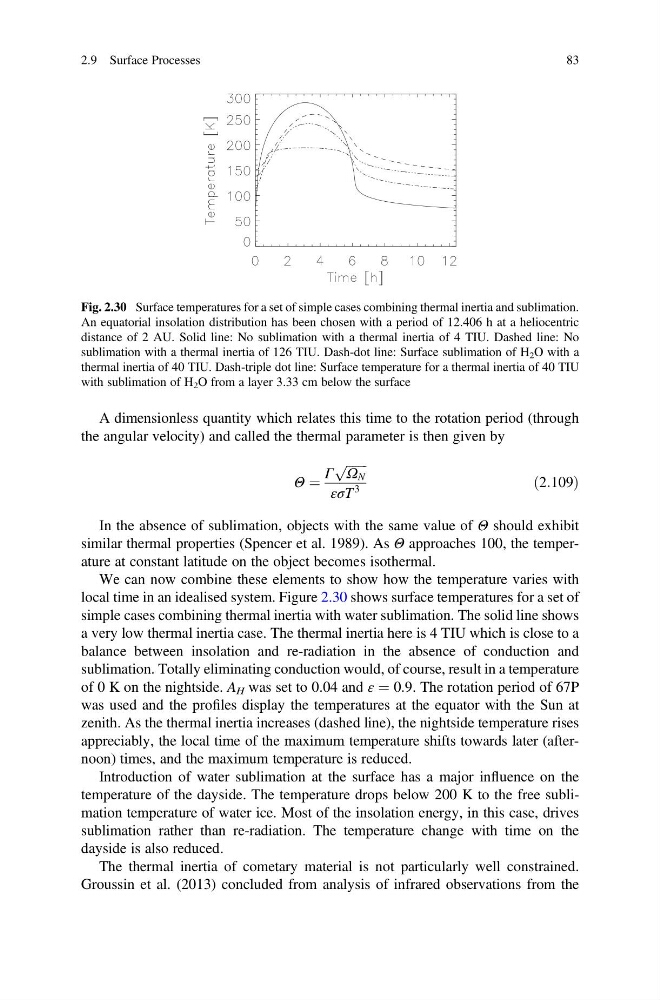
local time in an idealised system. Figure 2.30 shows surface temperatures for a set of
simple cases combining thermal inertia with water sublimation. The solid line shows
a very low thermal inertia case. The thermal inertia here is 4 TIU which is close to a
balance between insolation and re-radiation in the absence of conduction and
sublimation. Totally eliminating conduction would, of course, result in a temperature
of 0 K on the nightside. A H was set to 0.04 and ε ¼ 0.9. The rotation period of 67P
was used and the profiles display the temperatures at the equator with the Sun at
zenith. As the thermal inertia increases (dashed line), the nightside temperature rises
appreciably, the local time of the maximum temperature shifts towards later (afternoon) times, and the maximum temperature is reduced.
Introduction of water sublimation at the surface has a major influence on the
temperature of the dayside. The temperature drops below 200 K to the free sublimation temperature of water ice. Most of the insolation energy, in this case, drives
sublimation rather than re-radiation. The temperature change with time on the
dayside is also reduced.
The thermal inertia of cometary material is not particularly well constrained.
Groussin et al. (2013) concluded from analysis of infrared observations from the
Fig. 2.30 Surface temperatures for a set of simple cases combining thermal inertia and sublimation.
An equatorial insolation distribution has been chosen with a period of 12.406 h at a heliocentric
distance of 2 AU. Solid line: No sublimation with a thermal inertia of 4 TIU. Dashed line: No
sublimation with a thermal inertia of 126 TIU. Dash-dot line: Surface sublimation of H 2 O with a
thermal inertia of 40 TIU. Dash-triple dot line: Surface temperature for a thermal inertia of 40 TIU
with sublimation of H 2 O from a layer 3.33 cm below the surface
2.9 Surface Processes
83
the angular velocity) and called the thermal parameter is then given by
Θ ¼
Γ
ffiffiffiffiffiffi ffi
Ω N
p
εσT
3
ð2:109Þ
In the absence of sublimation, objects with the same value of Θ should exhibit
similar thermal properties (Spencer et al. 1989). As Θ approaches 100, the temperature at constant latitude on the object becomes isothermal.
We can now combine these elements to show how the temperature varies with
local time in an idealised system. Figure 2.30 shows surface temperatures for a set of
simple cases combining thermal inertia with water sublimation. The solid line shows
a very low thermal inertia case. The thermal inertia here is 4 TIU which is close to a
balance between insolation and re-radiation in the absence of conduction and
sublimation. Totally eliminating conduction would, of course, result in a temperature
of 0 K on the nightside. A H was set to 0.04 and ε ¼ 0.9. The rotation period of 67P
was used and the profiles display the temperatures at the equator with the Sun at
zenith. As the thermal inertia increases (dashed line), the nightside temperature rises
appreciably, the local time of the maximum temperature shifts towards later (afternoon) times, and the maximum temperature is reduced.
Introduction of water sublimation at the surface has a major influence on the
temperature of the dayside. The temperature drops below 200 K to the free sublimation temperature of water ice. Most of the insolation energy, in this case, drives
sublimation rather than re-radiation. The temperature change with time on the
dayside is also reduced.
The thermal inertia of cometary material is not particularly well constrained.
Groussin et al. (2013) concluded from analysis of infrared observations from the
Fig. 2.30 Surface temperatures for a set of simple cases combining thermal inertia and sublimation.
An equatorial insolation distribution has been chosen with a period of 12.406 h at a heliocentric
distance of 2 AU. Solid line: No sublimation with a thermal inertia of 4 TIU. Dashed line: No
sublimation with a thermal inertia of 126 TIU. Dash-dot line: Surface sublimation of H 2 O with a
thermal inertia of 40 TIU. Dash-triple dot line: Surface temperature for a thermal inertia of 40 TIU
with sublimation of H 2 O from a layer 3.33 cm below the surface
2.9 Surface Processes
83