

(e.g. Turcotte and Schubert 2002). However, for real applications, we rapidly reach
situations where only numerical solutions are possible. It is, however, normally
sufficient to work in 1D if a plane-parallel approximation can be assumed (which is
often the case) although full 3D solutions for conduction have been applied to
cometary nuclei in the past (Guilbert-Lepoutre and Jewitt 2011) to study effects of
local inhomogeneity.
The amount of heat conducted into the interior during the day and returned to the
surface at night is an important quantity for calculations of sublimation rates of
volatile (and especially highly volatile) species. Hence, these calculations are of
considerable interest.
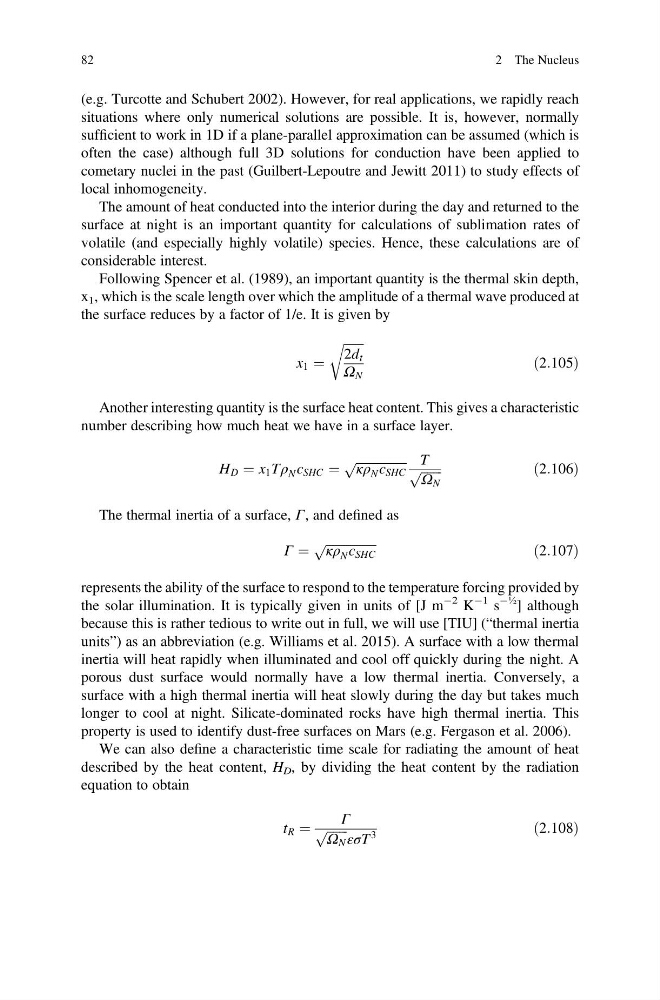
Following Spencer et al. (1989), an important quantity is the thermal skin depth,
x 1 , which is the scale length over which the amplitude of a thermal wave produced at
the surface reduces by a factor of 1/e. It is given by
x 1 ¼
ffiffiffiffiffiffi ffi
2d t
Ω N
r
ð2:105Þ
Another interesting quantity is the surface heat content. This gives a characteristic
number describing how much heat we have in a surface layer.
H D ¼ x 1 Tρ N c SHC ¼
ffiffiffiffiffiffiffiffiffiffiffiffiffiffiffiffi ffi
κρ N c SHC
p
T
ffiffiffiffiffiffi ffi
Ω N
p
ð2:106Þ
The thermal inertia of a surface, Γ, and defined as
Γ ¼
ffiffiffiffiffiffiffiffiffiffiffiffiffiffiffiffi ffi
κρ N c SHC
p
ð2:107Þ
represents the ability of the surface to respond to the temperature forcing provided by
the solar illumination. It is typically given in units of [J m
À2 K
À1 s
À½ ] although
because this is rather tedious to write out in full, we will use [TIU] (“thermal inertia
units”) as an abbreviation (e.g. Williams et al. 2015). A surface with a low thermal
inertia will heat rapidly when illuminated and cool off quickly during the night. A
porous dust surface would normally have a low thermal inertia. Conversely, a
surface with a high thermal inertia will heat slowly during the day but takes much
longer to cool at night. Silicate-dominated rocks have high thermal inertia. This
property is used to identify dust-free surfaces on Mars (e.g. Fergason et al. 2006).
We can also define a characteristic time scale for radiating the amount of heat
described by the heat content, H D , by dividing the heat content by the radiation
equation to obtain
t R ¼
Γ
ffiffiffiffiffiffi ffi
Ω N
p εσT
3
ð2:108Þ
82
2 The Nucleus
situations where only numerical solutions are possible. It is, however, normally
sufficient to work in 1D if a plane-parallel approximation can be assumed (which is
often the case) although full 3D solutions for conduction have been applied to
cometary nuclei in the past (Guilbert-Lepoutre and Jewitt 2011) to study effects of
local inhomogeneity.
The amount of heat conducted into the interior during the day and returned to the
surface at night is an important quantity for calculations of sublimation rates of
volatile (and especially highly volatile) species. Hence, these calculations are of
considerable interest.
Following Spencer et al. (1989), an important quantity is the thermal skin depth,
x 1 , which is the scale length over which the amplitude of a thermal wave produced at
the surface reduces by a factor of 1/e. It is given by
x 1 ¼
ffiffiffiffiffiffi ffi
2d t
Ω N
r
ð2:105Þ
Another interesting quantity is the surface heat content. This gives a characteristic
number describing how much heat we have in a surface layer.
H D ¼ x 1 Tρ N c SHC ¼
ffiffiffiffiffiffiffiffiffiffiffiffiffiffiffiffi ffi
κρ N c SHC
p
T
ffiffiffiffiffiffi ffi
Ω N
p
ð2:106Þ
The thermal inertia of a surface, Γ, and defined as
Γ ¼
ffiffiffiffiffiffiffiffiffiffiffiffiffiffiffiffi ffi
κρ N c SHC
p
ð2:107Þ
represents the ability of the surface to respond to the temperature forcing provided by
the solar illumination. It is typically given in units of [J m
À2 K
À1 s
À½ ] although
because this is rather tedious to write out in full, we will use [TIU] (“thermal inertia
units”) as an abbreviation (e.g. Williams et al. 2015). A surface with a low thermal
inertia will heat rapidly when illuminated and cool off quickly during the night. A
porous dust surface would normally have a low thermal inertia. Conversely, a
surface with a high thermal inertia will heat slowly during the day but takes much
longer to cool at night. Silicate-dominated rocks have high thermal inertia. This
property is used to identify dust-free surfaces on Mars (e.g. Fergason et al. 2006).
We can also define a characteristic time scale for radiating the amount of heat
described by the heat content, H D , by dividing the heat content by the radiation
equation to obtain
t R ¼
Γ
ffiffiffiffiffiffi ffi
Ω N
p εσT
3
ð2:108Þ
82
2 The Nucleus