

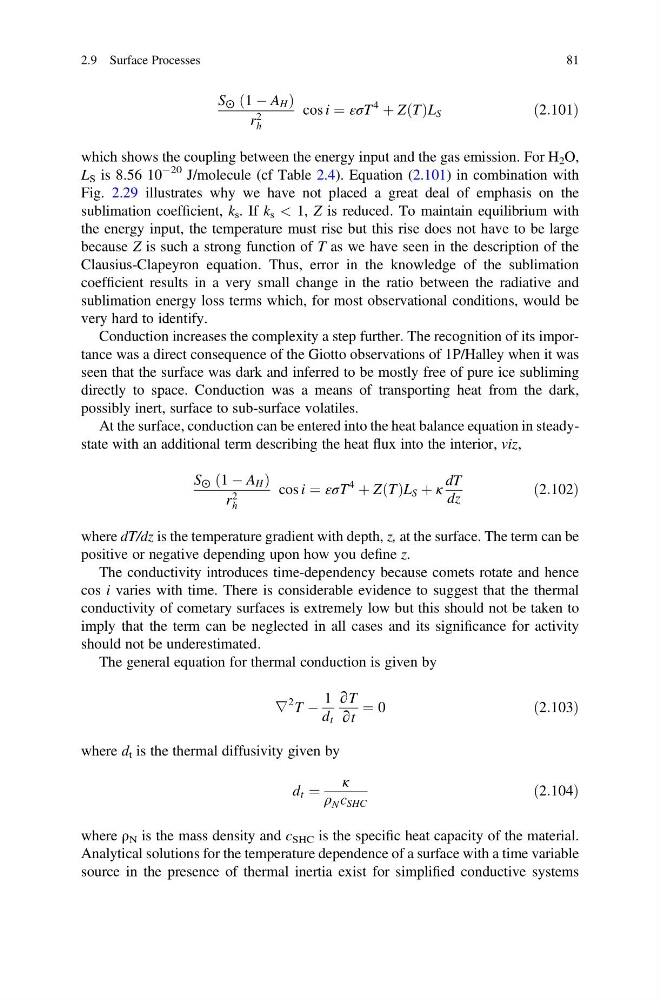
S ⨀ 1 À A H
ð
Þ
r 2
h
cos i ¼ εσT
4
þ Z T
ð ÞL S
ð2:101Þ
which shows the coupling between the energy input and the gas emission. For H 2 O,
L S is 8.56 10
À20 J/molecule (cf Table 2.4). Equation (2.101) in combination with
Fig. 2.29 illustrates why we have not placed a great deal of emphasis on the
sublimation coefficient, k s . If k s < 1, Z is reduced. To maintain equilibrium with
the energy input, the temperature must rise but this rise does not have to be large
because Z is such a strong function of T as we have seen in the description of the
Clausius-Clapeyron equation. Thus, error in the knowledge of the sublimation
coefficient results in a very small change in the ratio between the radiative and
sublimation energy loss terms which, for most observational conditions, would be
very hard to identify.
Conduction increases the complexity a step further. The recognition of its importance was a direct consequence of the Giotto observations of 1P/Halley when it was
seen that the surface was dark and inferred to be mostly free of pure ice subliming
directly to space. Conduction was a means of transporting heat from the dark,
possibly inert, surface to sub-surface volatiles.
At the surface, conduction can be entered into the heat balance equation in steadystate with an additional term describing the heat flux into the interior, viz,
S ⨀ 1 À A H
ð
Þ
r 2
h
cos i ¼ εσT
4
þ Z T
ð ÞL S þ κ
dT
dz
ð2:102Þ
where dT/dz is the temperature gradient with depth, z, at the surface. The term can be
positive or negative depending upon how you define z.
The conductivity introduces time-dependency because comets rotate and hence
cos i varies with time. There is considerable evidence to suggest that the thermal
conductivity of cometary surfaces is extremely low but this should not be taken to
imply that the term can be neglected in all cases and its significance for activity
should not be underestimated.
The general equation for thermal conduction is given by
∇
2 T À
1
d t
∂T
∂t
¼ 0
ð2:103Þ
where d t is the thermal diffusivity given by
d t ¼
κ
ρ N c SHC
ð2:104Þ
where ρ N is the mass density and c SHC is the specific heat capacity of the material.
Analytical solutions for the temperature dependence of a surface with a time variable
source in the presence of thermal inertia exist for simplified conductive systems
2.9 Surface Processes
81
ð
Þ
r 2
h
cos i ¼ εσT
4
þ Z T
ð ÞL S
ð2:101Þ
which shows the coupling between the energy input and the gas emission. For H 2 O,
L S is 8.56 10
À20 J/molecule (cf Table 2.4). Equation (2.101) in combination with
Fig. 2.29 illustrates why we have not placed a great deal of emphasis on the
sublimation coefficient, k s . If k s < 1, Z is reduced. To maintain equilibrium with
the energy input, the temperature must rise but this rise does not have to be large
because Z is such a strong function of T as we have seen in the description of the
Clausius-Clapeyron equation. Thus, error in the knowledge of the sublimation
coefficient results in a very small change in the ratio between the radiative and
sublimation energy loss terms which, for most observational conditions, would be
very hard to identify.
Conduction increases the complexity a step further. The recognition of its importance was a direct consequence of the Giotto observations of 1P/Halley when it was
seen that the surface was dark and inferred to be mostly free of pure ice subliming
directly to space. Conduction was a means of transporting heat from the dark,
possibly inert, surface to sub-surface volatiles.
At the surface, conduction can be entered into the heat balance equation in steadystate with an additional term describing the heat flux into the interior, viz,
S ⨀ 1 À A H
ð
Þ
r 2
h
cos i ¼ εσT
4
þ Z T
ð ÞL S þ κ
dT
dz
ð2:102Þ
where dT/dz is the temperature gradient with depth, z, at the surface. The term can be
positive or negative depending upon how you define z.
The conductivity introduces time-dependency because comets rotate and hence
cos i varies with time. There is considerable evidence to suggest that the thermal
conductivity of cometary surfaces is extremely low but this should not be taken to
imply that the term can be neglected in all cases and its significance for activity
should not be underestimated.
The general equation for thermal conduction is given by
∇
2 T À
1
d t
∂T
∂t
¼ 0
ð2:103Þ
where d t is the thermal diffusivity given by
d t ¼
κ
ρ N c SHC
ð2:104Þ
where ρ N is the mass density and c SHC is the specific heat capacity of the material.
Analytical solutions for the temperature dependence of a surface with a time variable
source in the presence of thermal inertia exist for simplified conductive systems
2.9 Surface Processes
81