

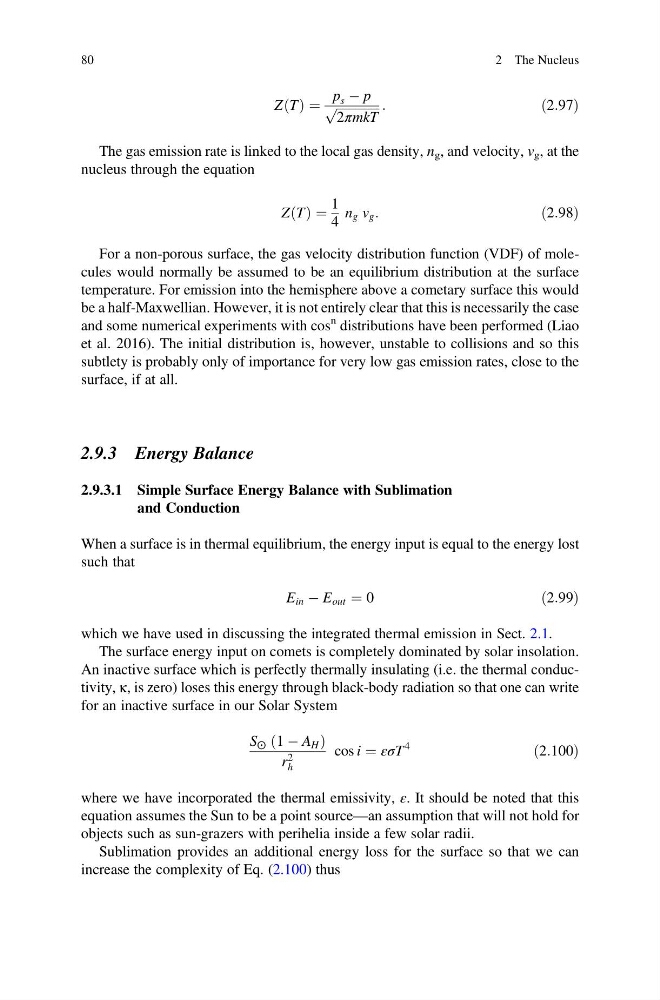
Z T
ð Þ ¼
p s À p
ffiffiffiffiffiffiffiffiffiffiffiffiffiffi
2πmkT
p
:
ð2:97Þ
The gas emission rate is linked to the local gas density, n g , and velocity, v g , at the
nucleus through the equation
Z T
ð Þ ¼
1
4
n g v g :
ð2:98Þ
For a non-porous surface, the gas velocity distribution function (VDF) of molecules would normally be assumed to be an equilibrium distribution at the surface
temperature. For emission into the hemisphere above a cometary surface this would
be a half-Maxwellian. However, it is not entirely clear that this is necessarily the case
and some numerical experiments with cos
n distributions have been performed (Liao
et al. 2016). The initial distribution is, however, unstable to collisions and so this
subtlety is probably only of importance for very low gas emission rates, close to the
surface, if at all.
2.9.3 Energy Balance
2.9.3.1 Simple Surface Energy Balance with Sublimation
and Conduction
When a surface is in thermal equilibrium, the energy input is equal to the energy lost
such that
E in À E out ¼ 0
ð2:99Þ
which we have used in discussing the integrated thermal emission in Sect. 2.1.
The surface energy input on comets is completely dominated by solar insolation.
An inactive surface which is perfectly thermally insulating (i.e. the thermal conductivity, κ, is zero) loses this energy through black-body radiation so that one can write
for an inactive surface in our Solar System
S ⨀ 1 À A H
ð
Þ
r 2
h
cos i ¼ εσT
4
ð2:100Þ
where we have incorporated the thermal emissivity, ε. It should be noted that this
equation assumes the Sun to be a point source—an assumption that will not hold for
objects such as sun-grazers with perihelia inside a few solar radii.
Sublimation provides an additional energy loss for the surface so that we can
increase the complexity of Eq. (2.100) thus
80
2 The Nucleus
ð Þ ¼
p s À p
ffiffiffiffiffiffiffiffiffiffiffiffiffiffi
2πmkT
p
:
ð2:97Þ
The gas emission rate is linked to the local gas density, n g , and velocity, v g , at the
nucleus through the equation
Z T
ð Þ ¼
1
4
n g v g :
ð2:98Þ
For a non-porous surface, the gas velocity distribution function (VDF) of molecules would normally be assumed to be an equilibrium distribution at the surface
temperature. For emission into the hemisphere above a cometary surface this would
be a half-Maxwellian. However, it is not entirely clear that this is necessarily the case
and some numerical experiments with cos
n distributions have been performed (Liao
et al. 2016). The initial distribution is, however, unstable to collisions and so this
subtlety is probably only of importance for very low gas emission rates, close to the
surface, if at all.
2.9.3 Energy Balance
2.9.3.1 Simple Surface Energy Balance with Sublimation
and Conduction
When a surface is in thermal equilibrium, the energy input is equal to the energy lost
such that
E in À E out ¼ 0
ð2:99Þ
which we have used in discussing the integrated thermal emission in Sect. 2.1.
The surface energy input on comets is completely dominated by solar insolation.
An inactive surface which is perfectly thermally insulating (i.e. the thermal conductivity, κ, is zero) loses this energy through black-body radiation so that one can write
for an inactive surface in our Solar System
S ⨀ 1 À A H
ð
Þ
r 2
h
cos i ¼ εσT
4
ð2:100Þ
where we have incorporated the thermal emissivity, ε. It should be noted that this
equation assumes the Sun to be a point source—an assumption that will not hold for
objects such as sun-grazers with perihelia inside a few solar radii.
Sublimation provides an additional energy loss for the surface so that we can
increase the complexity of Eq. (2.100) thus
80
2 The Nucleus