

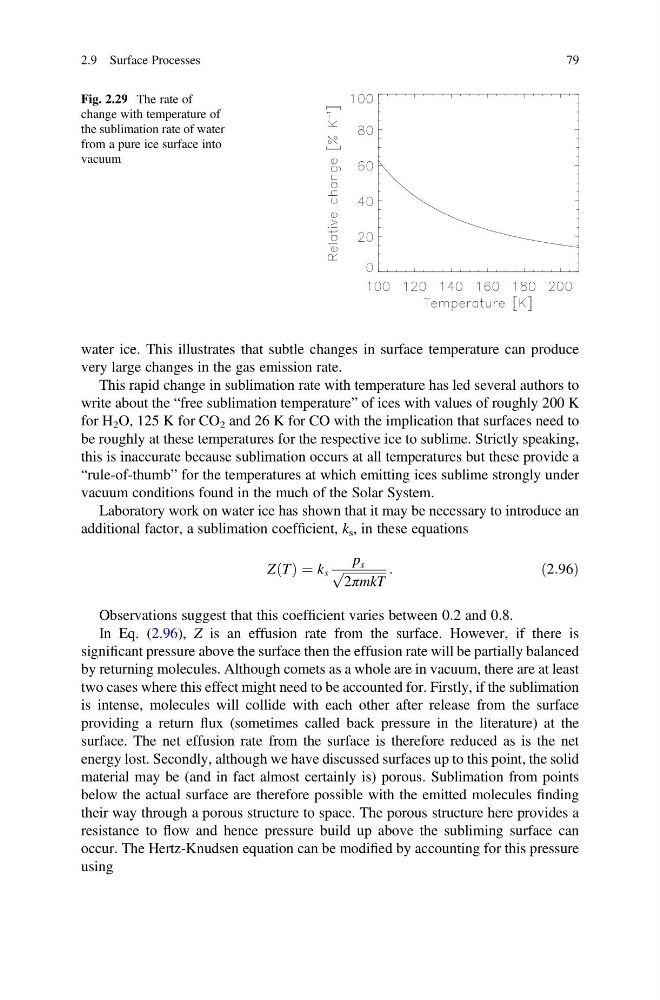
water ice. This illustrates that subtle changes in surface temperature can produce
very large changes in the gas emission rate.
This rapid change in sublimation rate with temperature has led several authors to
write about the “free sublimation temperature” of ices with values of roughly 200 K
for H 2 O, 125 K for CO 2 and 26 K for CO with the implication that surfaces need to
be roughly at these temperatures for the respective ice to sublime. Strictly speaking,
this is inaccurate because sublimation occurs at all temperatures but these provide a
“rule-of-thumb” for the temperatures at which emitting ices sublime strongly under
vacuum conditions found in the much of the Solar System.
Laboratory work on water ice has shown that it may be necessary to introduce an
additional factor, a sublimation coefficient, k s , in these equations
Z T
ð Þ ¼ k s
p s
ffiffiffiffiffiffiffiffiffiffiffiffiffiffi
2πmkT
p
:
ð2:96Þ
Observations suggest that this coefficient varies between 0.2 and 0.8.
In Eq. (2.96), Z is an effusion rate from the surface. However, if there is
significant pressure above the surface then the effusion rate will be partially balanced
by returning molecules. Although comets as a whole are in vacuum, there are at least
two cases where this effect might need to be accounted for. Firstly, if the sublimation
is intense, molecules will collide with each other after release from the surface
providing a return flux (sometimes called back pressure in the literature) at the
surface. The net effusion rate from the surface is therefore reduced as is the net
energy lost. Secondly, although we have discussed surfaces up to this point, the solid
material may be (and in fact almost certainly is) porous. Sublimation from points
below the actual surface are therefore possible with the emitted molecules finding
their way through a porous structure to space. The porous structure here provides a
resistance to flow and hence pressure build up above the subliming surface can
occur. The Hertz-Knudsen equation can be modified by accounting for this pressure
using
Fig. 2.29 The rate of
change with temperature of
the sublimation rate of water
from a pure ice surface into
vacuum
2.9 Surface Processes
79
very large changes in the gas emission rate.
This rapid change in sublimation rate with temperature has led several authors to
write about the “free sublimation temperature” of ices with values of roughly 200 K
for H 2 O, 125 K for CO 2 and 26 K for CO with the implication that surfaces need to
be roughly at these temperatures for the respective ice to sublime. Strictly speaking,
this is inaccurate because sublimation occurs at all temperatures but these provide a
“rule-of-thumb” for the temperatures at which emitting ices sublime strongly under
vacuum conditions found in the much of the Solar System.
Laboratory work on water ice has shown that it may be necessary to introduce an
additional factor, a sublimation coefficient, k s , in these equations
Z T
ð Þ ¼ k s
p s
ffiffiffiffiffiffiffiffiffiffiffiffiffiffi
2πmkT
p
:
ð2:96Þ
Observations suggest that this coefficient varies between 0.2 and 0.8.
In Eq. (2.96), Z is an effusion rate from the surface. However, if there is
significant pressure above the surface then the effusion rate will be partially balanced
by returning molecules. Although comets as a whole are in vacuum, there are at least
two cases where this effect might need to be accounted for. Firstly, if the sublimation
is intense, molecules will collide with each other after release from the surface
providing a return flux (sometimes called back pressure in the literature) at the
surface. The net effusion rate from the surface is therefore reduced as is the net
energy lost. Secondly, although we have discussed surfaces up to this point, the solid
material may be (and in fact almost certainly is) porous. Sublimation from points
below the actual surface are therefore possible with the emitted molecules finding
their way through a porous structure to space. The porous structure here provides a
resistance to flow and hence pressure build up above the subliming surface can
occur. The Hertz-Knudsen equation can be modified by accounting for this pressure
using
Fig. 2.29 The rate of
change with temperature of
the sublimation rate of water
from a pure ice surface into
vacuum
2.9 Surface Processes
79