

cometary nucleus before the Giotto encounter that subsequently led Keller to suggest
that nuclei were more like icy dirtballs. Nonetheless, the question remained whether
the tensile strength between these cometesimals after accretion (including any
modification as a result of the accretion process and subsequent evolution) was
sufficiently high that the nuclei could be considered structurally as one object.
The “icy-glue” conceptual model of Gombosi and Houpis (1986), for example,
had been imagined as a single solid structure in which separate chunks of
non-volatile material are cemented together by icy material forming an interior
that is homogeneous on a large scale but inhomogeneous on smaller scales.
Two observations place concepts of single solid nuclei in doubt. Firstly, the
lobate shapes seen at 103P/Hartley 2 and, in the even more extreme case of 67P,
strongly suggest that large sub-nuclei have come together at some stage to produce
the presently observed shapes. The recent observations of the KBO, (486958)
Arrokoth (formerly 2014 MU 69 ) by NASA’s New Horizons spacecraft is a further
demonstration of the need to consider bi-lobate structures as typical for primitive
bodies (Stern et al. 2019).
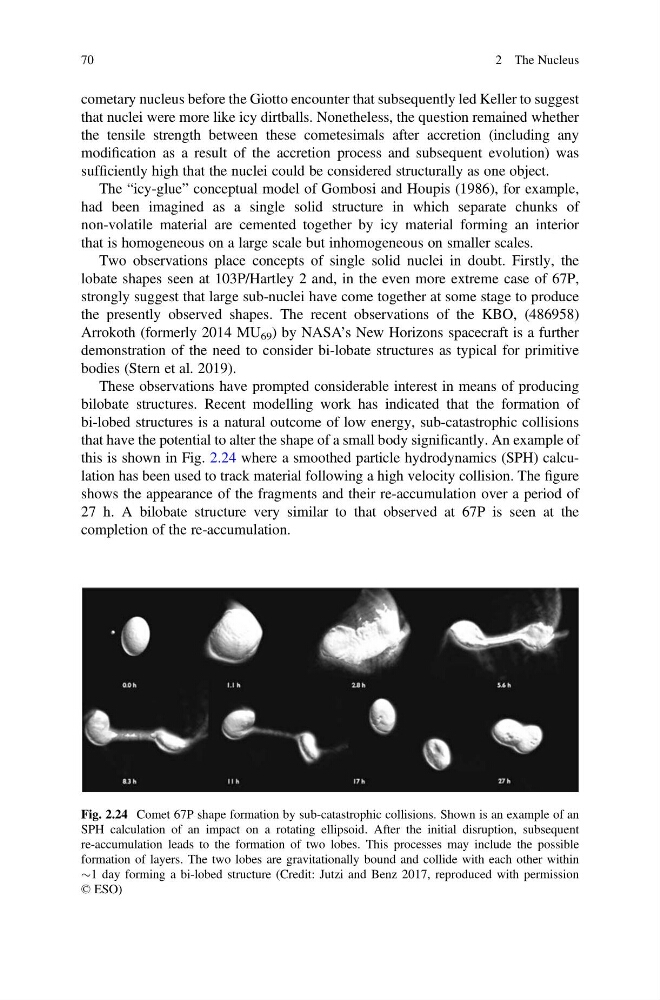
These observations have prompted considerable interest in means of producing
bilobate structures. Recent modelling work has indicated that the formation of
bi-lobed structures is a natural outcome of low energy, sub-catastrophic collisions
that have the potential to alter the shape of a small body significantly. An example of
this is shown in Fig. 2.24 where a smoothed particle hydrodynamics (SPH) calculation has been used to track material following a high velocity collision. The figure
shows the appearance of the fragments and their re-accumulation over a period of
27 h. A bilobate structure very similar to that observed at 67P is seen at the
completion of the re-accumulation.
Fig. 2.24 Comet 67P shape formation by sub-catastrophic collisions. Shown is an example of an
SPH calculation of an impact on a rotating ellipsoid. After the initial disruption, subsequent
re-accumulation leads to the formation of two lobes. This processes may include the possible
formation of layers. The two lobes are gravitationally bound and collide with each other within
$1 day forming a bi-lobed structure (Credit: Jutzi and Benz 2017, reproduced with permission
© ESO)
70
2 The Nucleus
that nuclei were more like icy dirtballs. Nonetheless, the question remained whether
the tensile strength between these cometesimals after accretion (including any
modification as a result of the accretion process and subsequent evolution) was
sufficiently high that the nuclei could be considered structurally as one object.
The “icy-glue” conceptual model of Gombosi and Houpis (1986), for example,
had been imagined as a single solid structure in which separate chunks of
non-volatile material are cemented together by icy material forming an interior
that is homogeneous on a large scale but inhomogeneous on smaller scales.
Two observations place concepts of single solid nuclei in doubt. Firstly, the
lobate shapes seen at 103P/Hartley 2 and, in the even more extreme case of 67P,
strongly suggest that large sub-nuclei have come together at some stage to produce
the presently observed shapes. The recent observations of the KBO, (486958)
Arrokoth (formerly 2014 MU 69 ) by NASA’s New Horizons spacecraft is a further
demonstration of the need to consider bi-lobate structures as typical for primitive
bodies (Stern et al. 2019).
These observations have prompted considerable interest in means of producing
bilobate structures. Recent modelling work has indicated that the formation of
bi-lobed structures is a natural outcome of low energy, sub-catastrophic collisions
that have the potential to alter the shape of a small body significantly. An example of
this is shown in Fig. 2.24 where a smoothed particle hydrodynamics (SPH) calculation has been used to track material following a high velocity collision. The figure
shows the appearance of the fragments and their re-accumulation over a period of
27 h. A bilobate structure very similar to that observed at 67P is seen at the
completion of the re-accumulation.
Fig. 2.24 Comet 67P shape formation by sub-catastrophic collisions. Shown is an example of an
SPH calculation of an impact on a rotating ellipsoid. After the initial disruption, subsequent
re-accumulation leads to the formation of two lobes. This processes may include the possible
formation of layers. The two lobes are gravitationally bound and collide with each other within
$1 day forming a bi-lobed structure (Credit: Jutzi and Benz 2017, reproduced with permission
© ESO)
70
2 The Nucleus