

2.8 Interior Structure
2.8.1 Large-Scale Structure
It might seem curious to address interior structure at this point because relatively
little is known of cometary interiors. However, conceptual ideas about the interior
have had a tendency to influence our interpretation of other data and hence it is
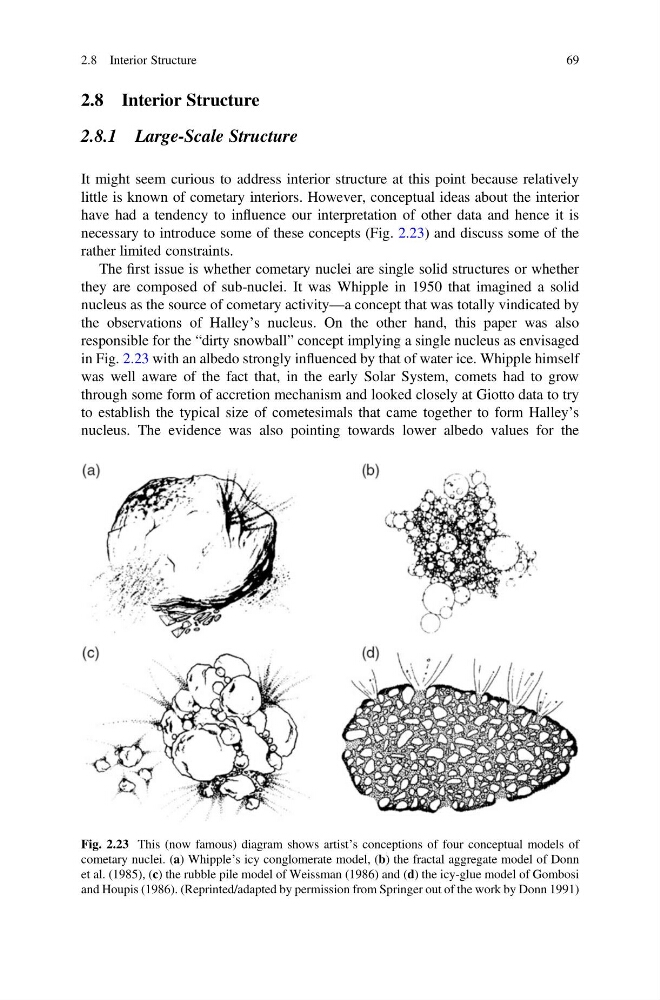
necessary to introduce some of these concepts (Fig. 2.23) and discuss some of the
rather limited constraints.
The first issue is whether cometary nuclei are single solid structures or whether
they are composed of sub-nuclei. It was Whipple in 1950 that imagined a solid
nucleus as the source of cometary activity—a concept that was totally vindicated by
the observations of Halley’s nucleus. On the other hand, this paper was also
responsible for the “dirty snowball” concept implying a single nucleus as envisaged
in Fig. 2.23 with an albedo strongly influenced by that of water ice. Whipple himself
was well aware of the fact that, in the early Solar System, comets had to grow
through some form of accretion mechanism and looked closely at Giotto data to try
to establish the typical size of cometesimals that came together to form Halley’s
nucleus. The evidence was also pointing towards lower albedo values for the
Fig. 2.23 This (now famous) diagram shows artist’s conceptions of four conceptual models of
cometary nuclei. (a) Whipple’s icy conglomerate model, (b) the fractal aggregate model of Donn
et al. (1985), (c) the rubble pile model of Weissman (1986) and (d) the icy-glue model of Gombosi
and Houpis (1986). (Reprinted/adapted by permission from Springer out of the work by Donn 1991)
2.8 Interior Structure
69
2.8.1 Large-Scale Structure
It might seem curious to address interior structure at this point because relatively
little is known of cometary interiors. However, conceptual ideas about the interior
have had a tendency to influence our interpretation of other data and hence it is
necessary to introduce some of these concepts (Fig. 2.23) and discuss some of the
rather limited constraints.
The first issue is whether cometary nuclei are single solid structures or whether
they are composed of sub-nuclei. It was Whipple in 1950 that imagined a solid
nucleus as the source of cometary activity—a concept that was totally vindicated by
the observations of Halley’s nucleus. On the other hand, this paper was also
responsible for the “dirty snowball” concept implying a single nucleus as envisaged
in Fig. 2.23 with an albedo strongly influenced by that of water ice. Whipple himself
was well aware of the fact that, in the early Solar System, comets had to grow
through some form of accretion mechanism and looked closely at Giotto data to try
to establish the typical size of cometesimals that came together to form Halley’s
nucleus. The evidence was also pointing towards lower albedo values for the
Fig. 2.23 This (now famous) diagram shows artist’s conceptions of four conceptual models of
cometary nuclei. (a) Whipple’s icy conglomerate model, (b) the fractal aggregate model of Donn
et al. (1985), (c) the rubble pile model of Weissman (1986) and (d) the icy-glue model of Gombosi
and Houpis (1986). (Reprinted/adapted by permission from Springer out of the work by Donn 1991)
2.8 Interior Structure
69