

This work also suggests that the “head and body” appearance of 67P is unstable
over the lifetime of the solar system (Jutzi and Benz 2017) and is the result of
multiple sub-catastrophic impacts experienced by the body after the formation of a
precursor object.
An alternative idea with a collision between two parent bodies of the sizes seen in
the head and the body of 67P is less attractive because the collision velocity must be
fairly low for the bodies to remain gravitationally interacting and not catastrophically
disrupted after the initial impact.
The second observation of importance was the remarkable break-up of comet D/
Shoemaker-Levy 9 in 1992 (Fig. 1.8) prior to the fragments impacting Jupiter itself
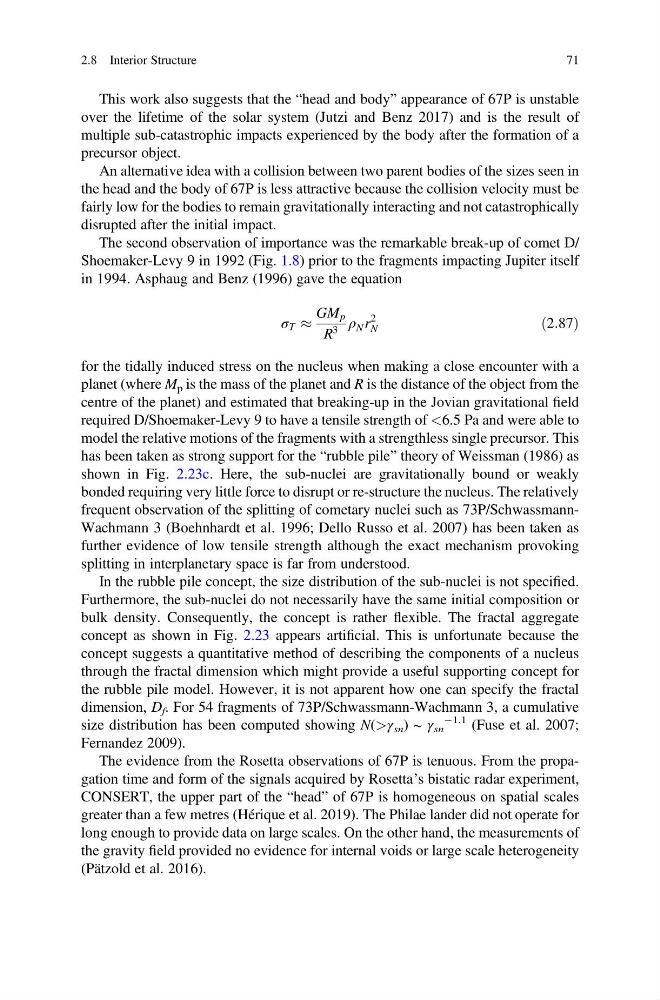
in 1994. Asphaug and Benz (1996) gave the equation
σ T %
GM p
R
3
ρ N r
2
N
ð2:87Þ
for the tidally induced stress on the nucleus when making a close encounter with a
planet (where M p is the mass of the planet and R is the distance of the object from the
centre of the planet) and estimated that breaking-up in the Jovian gravitational field
required D/Shoemaker-Levy 9 to have a tensile strength of <6.5 Pa and were able to
model the relative motions of the fragments with a strengthless single precursor. This
has been taken as strong support for the “rubble pile” theory of Weissman (1986) as
shown in Fig. 2.23c. Here, the sub-nuclei are gravitationally bound or weakly
bonded requiring very little force to disrupt or re-structure the nucleus. The relatively
frequent observation of the splitting of cometary nuclei such as 73P/SchwassmannWachmann 3 (Boehnhardt et al. 1996; Dello Russo et al. 2007) has been taken as
further evidence of low tensile strength although the exact mechanism provoking
splitting in interplanetary space is far from understood.
In the rubble pile concept, the size distribution of the sub-nuclei is not specified.
Furthermore, the sub-nuclei do not necessarily have the same initial composition or
bulk density. Consequently, the concept is rather flexible. The fractal aggregate
concept as shown in Fig. 2.23 appears artificial. This is unfortunate because the
concept suggests a quantitative method of describing the components of a nucleus
through the fractal dimension which might provide a useful supporting concept for
the rubble pile model. However, it is not apparent how one can specify the fractal
dimension, D f . For 54 fragments of 73P/Schwassmann-Wachmann 3, a cumulative
size distribution has been computed showing N(>γ sn ) ~ γ sn
À1.1 (Fuse et al. 2007;
Fernandez 2009).
The evidence from the Rosetta observations of 67P is tenuous. From the propagation time and form of the signals acquired by Rosetta’s bistatic radar experiment,
CONSERT, the upper part of the “head” of 67P is homogeneous on spatial scales
greater than a few metres (Hérique et al. 2019). The Philae lander did not operate for
long enough to provide data on large scales. On the other hand, the measurements of
the gravity field provided no evidence for internal voids or large scale heterogeneity
(Pätzold et al. 2016).
2.8 Interior Structure
71
over the lifetime of the solar system (Jutzi and Benz 2017) and is the result of
multiple sub-catastrophic impacts experienced by the body after the formation of a
precursor object.
An alternative idea with a collision between two parent bodies of the sizes seen in
the head and the body of 67P is less attractive because the collision velocity must be
fairly low for the bodies to remain gravitationally interacting and not catastrophically
disrupted after the initial impact.
The second observation of importance was the remarkable break-up of comet D/
Shoemaker-Levy 9 in 1992 (Fig. 1.8) prior to the fragments impacting Jupiter itself
in 1994. Asphaug and Benz (1996) gave the equation
σ T %
GM p
R
3
ρ N r
2
N
ð2:87Þ
for the tidally induced stress on the nucleus when making a close encounter with a
planet (where M p is the mass of the planet and R is the distance of the object from the
centre of the planet) and estimated that breaking-up in the Jovian gravitational field
required D/Shoemaker-Levy 9 to have a tensile strength of <6.5 Pa and were able to
model the relative motions of the fragments with a strengthless single precursor. This
has been taken as strong support for the “rubble pile” theory of Weissman (1986) as
shown in Fig. 2.23c. Here, the sub-nuclei are gravitationally bound or weakly
bonded requiring very little force to disrupt or re-structure the nucleus. The relatively
frequent observation of the splitting of cometary nuclei such as 73P/SchwassmannWachmann 3 (Boehnhardt et al. 1996; Dello Russo et al. 2007) has been taken as
further evidence of low tensile strength although the exact mechanism provoking
splitting in interplanetary space is far from understood.
In the rubble pile concept, the size distribution of the sub-nuclei is not specified.
Furthermore, the sub-nuclei do not necessarily have the same initial composition or
bulk density. Consequently, the concept is rather flexible. The fractal aggregate
concept as shown in Fig. 2.23 appears artificial. This is unfortunate because the
concept suggests a quantitative method of describing the components of a nucleus
through the fractal dimension which might provide a useful supporting concept for
the rubble pile model. However, it is not apparent how one can specify the fractal
dimension, D f . For 54 fragments of 73P/Schwassmann-Wachmann 3, a cumulative
size distribution has been computed showing N(>γ sn ) ~ γ sn
À1.1 (Fuse et al. 2007;
Fernandez 2009).
The evidence from the Rosetta observations of 67P is tenuous. From the propagation time and form of the signals acquired by Rosetta’s bistatic radar experiment,
CONSERT, the upper part of the “head” of 67P is homogeneous on spatial scales
greater than a few metres (Hérique et al. 2019). The Philae lander did not operate for
long enough to provide data on large scales. On the other hand, the measurements of
the gravity field provided no evidence for internal voids or large scale heterogeneity
(Pätzold et al. 2016).
2.8 Interior Structure
71