

grasses. At present, reeds can serve as a source of income for the settlers as it can be
used for handicraft material. However, some parts of the peat swamp, sizing
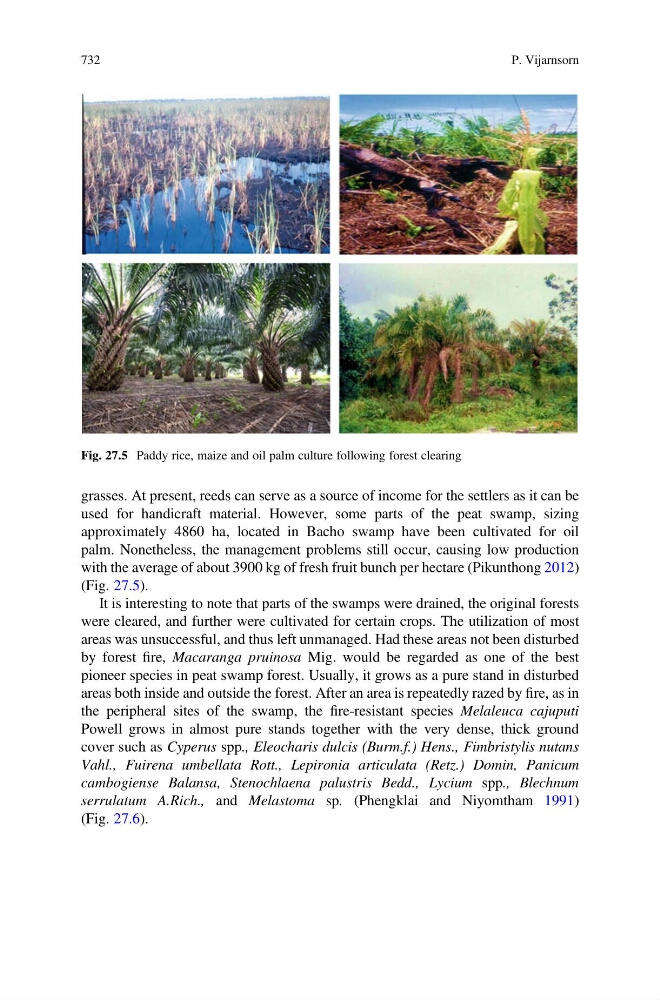
approximately 4860 ha, located in Bacho swamp have been cultivated for oil
palm. Nonetheless, the management problems still occur, causing low production
with the average of about 3900 kg of fresh fruit bunch per hectare (Pikunthong 2012)
(Fig. 27.5).
It is interesting to note that parts of the swamps were drained, the original forests
were cleared, and further were cultivated for certain crops. The utilization of most
areas was unsuccessful, and thus left unmanaged. Had these areas not been disturbed
by forest fire, Macaranga pruinosa Mig. would be regarded as one of the best
pioneer species in peat swamp forest. Usually, it grows as a pure stand in disturbed
areas both inside and outside the forest. After an area is repeatedly razed by fire, as in
the peripheral sites of the swamp, the fire-resistant species Melaleuca cajuputi
Powell grows in almost pure stands together with the very dense, thick ground
cover such as Cyperus spp., Eleocharis dulcis (Burm.f.) Hens., Fimbristylis nutans
Vahl., Fuirena umbellata Rott., Lepironia articulata (Retz.) Domin, Panicum
cambogiense Balansa, Stenochlaena palustris Bedd., Lycium spp., Blechnum
serrulatum A.Rich., and Melastoma sp. (Phengklai and Niyomtham 1991)
(Fig. 27.6).
Fig. 27.5 Paddy rice, maize and oil palm culture following forest clearing
732
P. Vijarnsorn