

Groundwater level in sago plantations at the distance of 1 m was an average
À29 cm. The lowest average GWL was À58 cm, at 10 m from the canal on the left
side. The average value of GWL fluctuated wildly on the left side of canal than that
of the right side.
22.3.1.2 Rubber Plantation
Peat depth in rubber plantations ranges from 190 cm to 393 cm and is categorized as
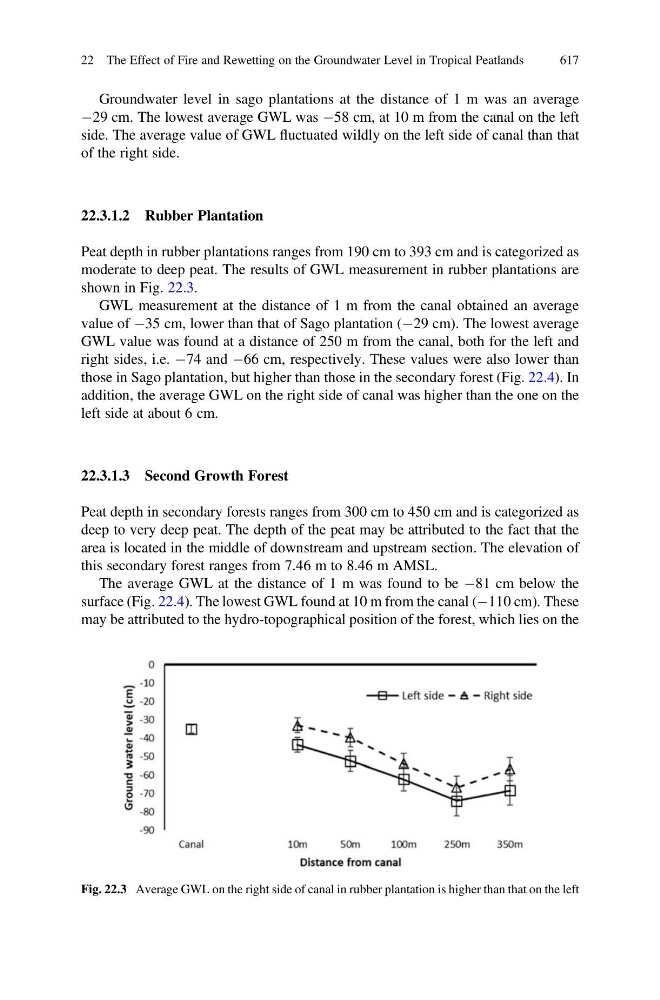
moderate to deep peat. The results of GWL measurement in rubber plantations are
shown in Fig. 22.3.
GWL measurement at the distance of 1 m from the canal obtained an average
value of À35 cm, lower than that of Sago plantation (À29 cm). The lowest average
GWL value was found at a distance of 250 m from the canal, both for the left and
right sides, i.e. À74 and À66 cm, respectively. These values were also lower than
those in Sago plantation, but higher than those in the secondary forest (Fig. 22.4). In
addition, the average GWL on the right side of canal was higher than the one on the
left side at about 6 cm.
22.3.1.3 Second Growth Forest
Peat depth in secondary forests ranges from 300 cm to 450 cm and is categorized as
deep to very deep peat. The depth of the peat may be attributed to the fact that the
area is located in the middle of downstream and upstream section. The elevation of
this secondary forest ranges from 7.46 m to 8.46 m AMSL.
The average GWL at the distance of 1 m was found to be À81 cm below the
surface (Fig. 22.4). The lowest GWL found at 10 m from the canal (À110 cm). These
may be attributed to the hydro-topographical position of the forest, which lies on the
Fig. 22.3 Average GWL on the right side of canal in rubber plantation is higher than that on the left
22 The Effect of Fire and Rewetting on the Groundwater Level in Tropical Peatlands
617
À29 cm. The lowest average GWL was À58 cm, at 10 m from the canal on the left
side. The average value of GWL fluctuated wildly on the left side of canal than that
of the right side.
22.3.1.2 Rubber Plantation
Peat depth in rubber plantations ranges from 190 cm to 393 cm and is categorized as
moderate to deep peat. The results of GWL measurement in rubber plantations are
shown in Fig. 22.3.
GWL measurement at the distance of 1 m from the canal obtained an average
value of À35 cm, lower than that of Sago plantation (À29 cm). The lowest average
GWL value was found at a distance of 250 m from the canal, both for the left and
right sides, i.e. À74 and À66 cm, respectively. These values were also lower than
those in Sago plantation, but higher than those in the secondary forest (Fig. 22.4). In
addition, the average GWL on the right side of canal was higher than the one on the
left side at about 6 cm.
22.3.1.3 Second Growth Forest
Peat depth in secondary forests ranges from 300 cm to 450 cm and is categorized as
deep to very deep peat. The depth of the peat may be attributed to the fact that the
area is located in the middle of downstream and upstream section. The elevation of
this secondary forest ranges from 7.46 m to 8.46 m AMSL.
The average GWL at the distance of 1 m was found to be À81 cm below the
surface (Fig. 22.4). The lowest GWL found at 10 m from the canal (À110 cm). These
may be attributed to the hydro-topographical position of the forest, which lies on the
Fig. 22.3 Average GWL on the right side of canal in rubber plantation is higher than that on the left
22 The Effect of Fire and Rewetting on the Groundwater Level in Tropical Peatlands
617