

slope between the higher burnt area and the lower area of rubber and sago plantation.
As a result, GWL was far below the surface.
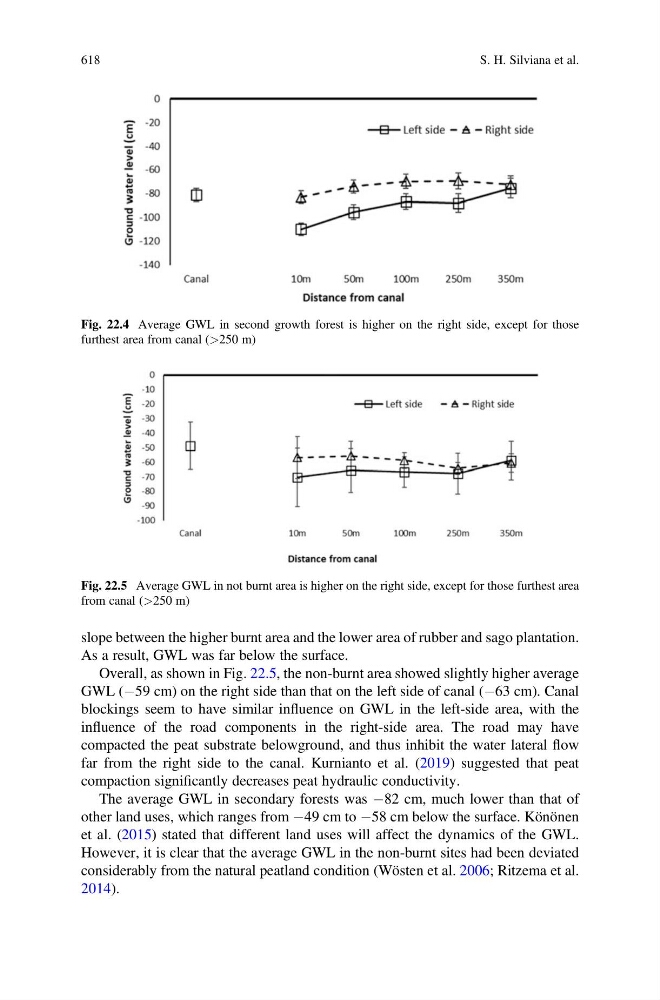
Overall, as shown in Fig. 22.5, the non-burnt area showed slightly higher average
GWL (À59 cm) on the right side than that on the left side of canal (À63 cm). Canal
blockings seem to have similar influence on GWL in the left-side area, with the
influence of the road components in the right-side area. The road may have
compacted the peat substrate belowground, and thus inhibit the water lateral flow
far from the right side to the canal. Kurnianto et al. (2019) suggested that peat
compaction significantly decreases peat hydraulic conductivity.
The average GWL in secondary forests was À82 cm, much lower than that of
other land uses, which ranges from À49 cm to À58 cm below the surface. Könönen
et al. (2015) stated that different land uses will affect the dynamics of the GWL.
However, it is clear that the average GWL in the non-burnt sites had been deviated
considerably from the natural peatland condition (Wösten et al. 2006; Ritzema et al.
2014).
Fig. 22.4 Average GWL in second growth forest is higher on the right side, except for those
furthest area from canal (>250 m)
Fig. 22.5 Average GWL in not burnt area is higher on the right side, except for those furthest area
from canal (>250 m)
618
S. H. Silviana et al.
As a result, GWL was far below the surface.
Overall, as shown in Fig. 22.5, the non-burnt area showed slightly higher average
GWL (À59 cm) on the right side than that on the left side of canal (À63 cm). Canal
blockings seem to have similar influence on GWL in the left-side area, with the
influence of the road components in the right-side area. The road may have
compacted the peat substrate belowground, and thus inhibit the water lateral flow
far from the right side to the canal. Kurnianto et al. (2019) suggested that peat
compaction significantly decreases peat hydraulic conductivity.
The average GWL in secondary forests was À82 cm, much lower than that of
other land uses, which ranges from À49 cm to À58 cm below the surface. Könönen
et al. (2015) stated that different land uses will affect the dynamics of the GWL.
However, it is clear that the average GWL in the non-burnt sites had been deviated
considerably from the natural peatland condition (Wösten et al. 2006; Ritzema et al.
2014).
Fig. 22.4 Average GWL in second growth forest is higher on the right side, except for those
furthest area from canal (>250 m)
Fig. 22.5 Average GWL in not burnt area is higher on the right side, except for those furthest area
from canal (>250 m)
618
S. H. Silviana et al.