

then cultivated with non-peatland commodities, which have more economic benefits.
However, they neglected the increasing fire susceptibility of drained peatlands.
The severe destruction caused by the wildfire in 2015 has increased awareness
and promoted corrective actions from the Indonesian government regarding peatland
management. The corrective actions have to accommodate the local people who
have been living in and utilizing the peatlands. This situation has encouraged the
practice of restoration in the rewetted peatlands according to its economic, social,
and ecological suitability for the peatland ecosystem. Restoration is a cultivation
technique for wetland ecosystems (Joosten et al. 2012; Wichtmann et al. 2016).
One of the corrective actions that have been commenced by the Indonesian
government was the issuance of the Government Regulation No. 57/2016, which
constitutes the revision of the Government Regulation No. 71/2014 on the protection
and management of peatland ecosystem. These policies regulate the peat water level
with height no less than 40 cm from the peat surface in the production function and
just below the surface in the protection function of the Peatland Hydrological Unit
(PHU). The presence of minimum land manipulation and the regulation on peat
water level are suitable for the development of restoration with adaptive commodities. Moreover, indigenous peatland commodities should be promoted in
restoration.
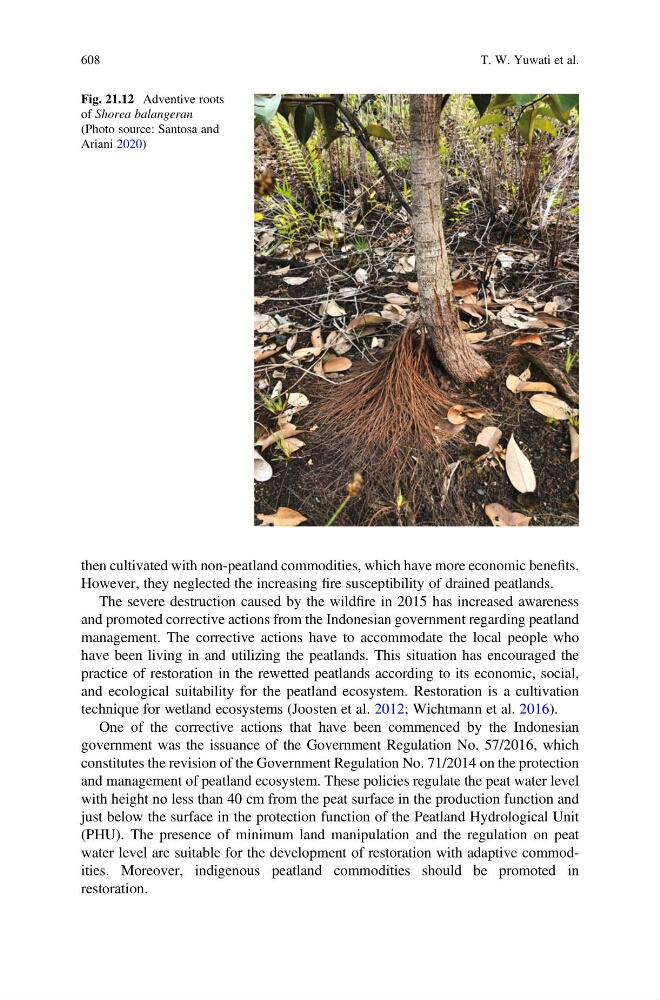
Fig. 21.12 Adventive roots
of Shorea balangeran
(Photo source: Santosa and
Ariani 2020)
608
T. W. Yuwati et al.
However, they neglected the increasing fire susceptibility of drained peatlands.
The severe destruction caused by the wildfire in 2015 has increased awareness
and promoted corrective actions from the Indonesian government regarding peatland
management. The corrective actions have to accommodate the local people who
have been living in and utilizing the peatlands. This situation has encouraged the
practice of restoration in the rewetted peatlands according to its economic, social,
and ecological suitability for the peatland ecosystem. Restoration is a cultivation
technique for wetland ecosystems (Joosten et al. 2012; Wichtmann et al. 2016).
One of the corrective actions that have been commenced by the Indonesian
government was the issuance of the Government Regulation No. 57/2016, which
constitutes the revision of the Government Regulation No. 71/2014 on the protection
and management of peatland ecosystem. These policies regulate the peat water level
with height no less than 40 cm from the peat surface in the production function and
just below the surface in the protection function of the Peatland Hydrological Unit
(PHU). The presence of minimum land manipulation and the regulation on peat
water level are suitable for the development of restoration with adaptive commodities. Moreover, indigenous peatland commodities should be promoted in
restoration.
Fig. 21.12 Adventive roots
of Shorea balangeran
(Photo source: Santosa and
Ariani 2020)
608
T. W. Yuwati et al.