

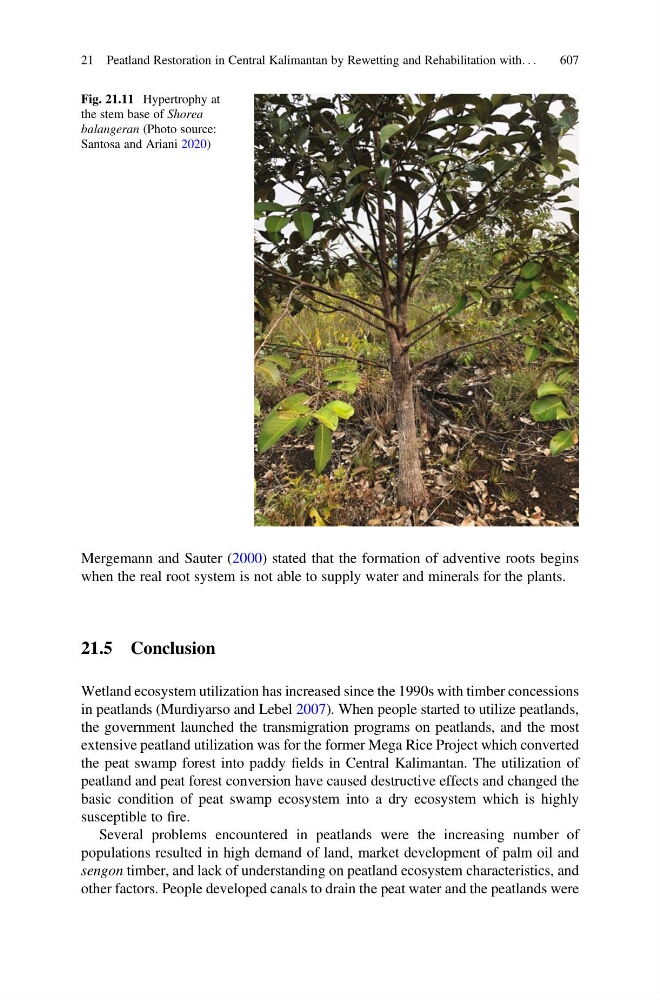
Mergemann and Sauter (2000) stated that the formation of adventive roots begins
when the real root system is not able to supply water and minerals for the plants.
21.5 Conclusion
Wetland ecosystem utilization has increased since the 1990s with timber concessions
in peatlands (Murdiyarso and Lebel 2007). When people started to utilize peatlands,
the government launched the transmigration programs on peatlands, and the most
extensive peatland utilization was for the former Mega Rice Project which converted
the peat swamp forest into paddy fields in Central Kalimantan. The utilization of
peatland and peat forest conversion have caused destructive effects and changed the
basic condition of peat swamp ecosystem into a dry ecosystem which is highly
susceptible to fire.
Several problems encountered in peatlands were the increasing number of
populations resulted in high demand of land, market development of palm oil and
sengon timber, and lack of understanding on peatland ecosystem characteristics, and
other factors. People developed canals to drain the peat water and the peatlands were
Fig. 21.11 Hypertrophy at
the stem base of Shorea
balangeran (Photo source:
Santosa and Ariani 2020)
21 Peatland Restoration in Central Kalimantan by Rewetting and Rehabilitation with. . .
607
when the real root system is not able to supply water and minerals for the plants.
21.5 Conclusion
Wetland ecosystem utilization has increased since the 1990s with timber concessions
in peatlands (Murdiyarso and Lebel 2007). When people started to utilize peatlands,
the government launched the transmigration programs on peatlands, and the most
extensive peatland utilization was for the former Mega Rice Project which converted
the peat swamp forest into paddy fields in Central Kalimantan. The utilization of
peatland and peat forest conversion have caused destructive effects and changed the
basic condition of peat swamp ecosystem into a dry ecosystem which is highly
susceptible to fire.
Several problems encountered in peatlands were the increasing number of
populations resulted in high demand of land, market development of palm oil and
sengon timber, and lack of understanding on peatland ecosystem characteristics, and
other factors. People developed canals to drain the peat water and the peatlands were
Fig. 21.11 Hypertrophy at
the stem base of Shorea
balangeran (Photo source:
Santosa and Ariani 2020)
21 Peatland Restoration in Central Kalimantan by Rewetting and Rehabilitation with. . .
607