

from the canal. In other words, water loss level in peatland during the dry season
could not be replaced by the additional water from high tide. Meanwhile, the
correlation values at Ulin area during dry season could not be identified since
there was a lack of measurement data and most of the canal was dried out.
20.4.4 Discussion
The principal aim of canal blocking is to reduce water runoff through the canal and to
retain water in the blocked canal so the surface water at the canal and its adjacent
groundwater level can be maintained, ensuring the peatland to stay wet and/or
sufficiently wet particularly during dry season (Ritzema et al. 2014; Dohong et al.
2017a, b).
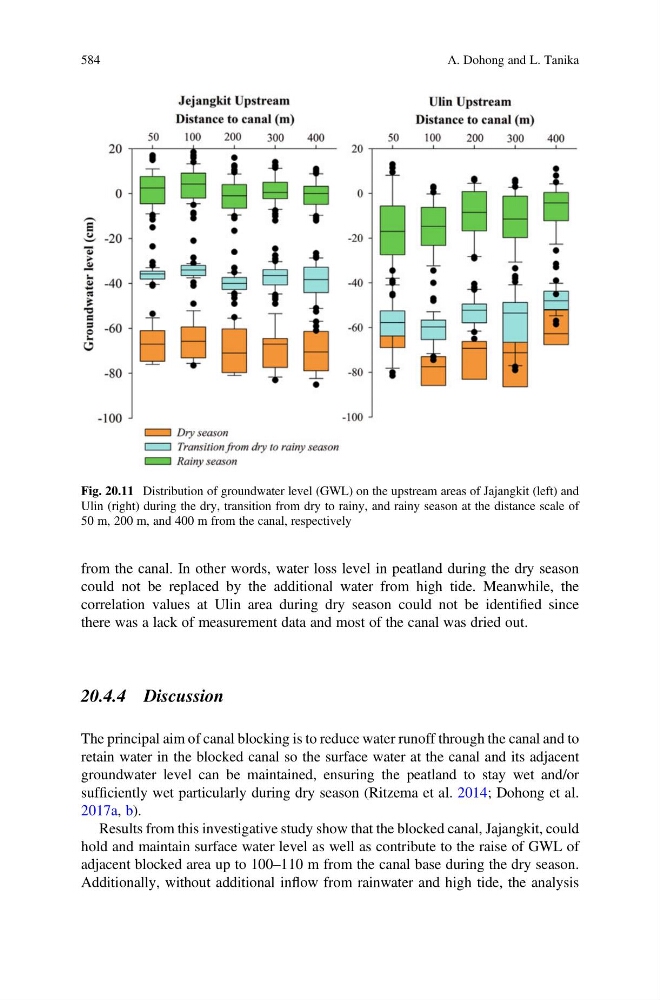
Results from this investigative study show that the blocked canal, Jajangkit, could
hold and maintain surface water level as well as contribute to the raise of GWL of
adjacent blocked area up to 100–110 m from the canal base during the dry season.
Additionally, without additional inflow from rainwater and high tide, the analysis
Fig. 20.11 Distribution of groundwater level (GWL) on the upstream areas of Jajangkit (left) and
Ulin (right) during the dry, transition from dry to rainy, and rainy season at the distance scale of
50 m, 200 m, and 400 m from the canal, respectively
584
A. Dohong and L. Tanika
could not be replaced by the additional water from high tide. Meanwhile, the
correlation values at Ulin area during dry season could not be identified since
there was a lack of measurement data and most of the canal was dried out.
20.4.4 Discussion
The principal aim of canal blocking is to reduce water runoff through the canal and to
retain water in the blocked canal so the surface water at the canal and its adjacent
groundwater level can be maintained, ensuring the peatland to stay wet and/or
sufficiently wet particularly during dry season (Ritzema et al. 2014; Dohong et al.
2017a, b).
Results from this investigative study show that the blocked canal, Jajangkit, could
hold and maintain surface water level as well as contribute to the raise of GWL of
adjacent blocked area up to 100–110 m from the canal base during the dry season.
Additionally, without additional inflow from rainwater and high tide, the analysis
Fig. 20.11 Distribution of groundwater level (GWL) on the upstream areas of Jajangkit (left) and
Ulin (right) during the dry, transition from dry to rainy, and rainy season at the distance scale of
50 m, 200 m, and 400 m from the canal, respectively
584
A. Dohong and L. Tanika