

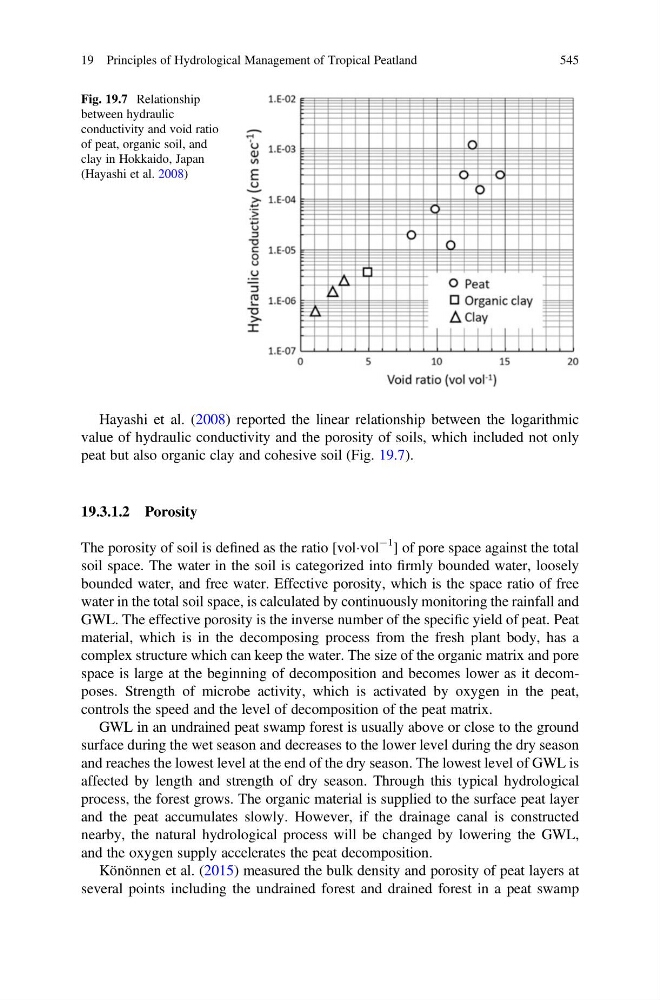
Hayashi et al. (2008) reported the linear relationship between the logarithmic
value of hydraulic conductivity and the porosity of soils, which included not only
peat but also organic clay and cohesive soil (Fig. 19.7).
19.3.1.2 Porosity
The porosity of soil is defined as the ratio [volÁvol
À1 ] of pore space against the total
soil space. The water in the soil is categorized into firmly bounded water, loosely
bounded water, and free water. Effective porosity, which is the space ratio of free
water in the total soil space, is calculated by continuously monitoring the rainfall and
GWL. The effective porosity is the inverse number of the specific yield of peat. Peat
material, which is in the decomposing process from the fresh plant body, has a
complex structure which can keep the water. The size of the organic matrix and pore
space is large at the beginning of decomposition and becomes lower as it decomposes. Strength of microbe activity, which is activated by oxygen in the peat,
controls the speed and the level of decomposition of the peat matrix.
GWL in an undrained peat swamp forest is usually above or close to the ground
surface during the wet season and decreases to the lower level during the dry season
and reaches the lowest level at the end of the dry season. The lowest level of GWL is
affected by length and strength of dry season. Through this typical hydrological
process, the forest grows. The organic material is supplied to the surface peat layer
and the peat accumulates slowly. However, if the drainage canal is constructed
nearby, the natural hydrological process will be changed by lowering the GWL,
and the oxygen supply accelerates the peat decomposition.
Könönnen et al. (2015) measured the bulk density and porosity of peat layers at
several points including the undrained forest and drained forest in a peat swamp
Fig. 19.7 Relationship
between hydraulic
conductivity and void ratio
of peat, organic soil, and
clay in Hokkaido, Japan
(Hayashi et al. 2008)
19 Principles of Hydrological Management of Tropical Peatland
545
value of hydraulic conductivity and the porosity of soils, which included not only
peat but also organic clay and cohesive soil (Fig. 19.7).
19.3.1.2 Porosity
The porosity of soil is defined as the ratio [volÁvol
À1 ] of pore space against the total
soil space. The water in the soil is categorized into firmly bounded water, loosely
bounded water, and free water. Effective porosity, which is the space ratio of free
water in the total soil space, is calculated by continuously monitoring the rainfall and
GWL. The effective porosity is the inverse number of the specific yield of peat. Peat
material, which is in the decomposing process from the fresh plant body, has a
complex structure which can keep the water. The size of the organic matrix and pore
space is large at the beginning of decomposition and becomes lower as it decomposes. Strength of microbe activity, which is activated by oxygen in the peat,
controls the speed and the level of decomposition of the peat matrix.
GWL in an undrained peat swamp forest is usually above or close to the ground
surface during the wet season and decreases to the lower level during the dry season
and reaches the lowest level at the end of the dry season. The lowest level of GWL is
affected by length and strength of dry season. Through this typical hydrological
process, the forest grows. The organic material is supplied to the surface peat layer
and the peat accumulates slowly. However, if the drainage canal is constructed
nearby, the natural hydrological process will be changed by lowering the GWL,
and the oxygen supply accelerates the peat decomposition.
Könönnen et al. (2015) measured the bulk density and porosity of peat layers at
several points including the undrained forest and drained forest in a peat swamp
Fig. 19.7 Relationship
between hydraulic
conductivity and void ratio
of peat, organic soil, and
clay in Hokkaido, Japan
(Hayashi et al. 2008)
19 Principles of Hydrological Management of Tropical Peatland
545