

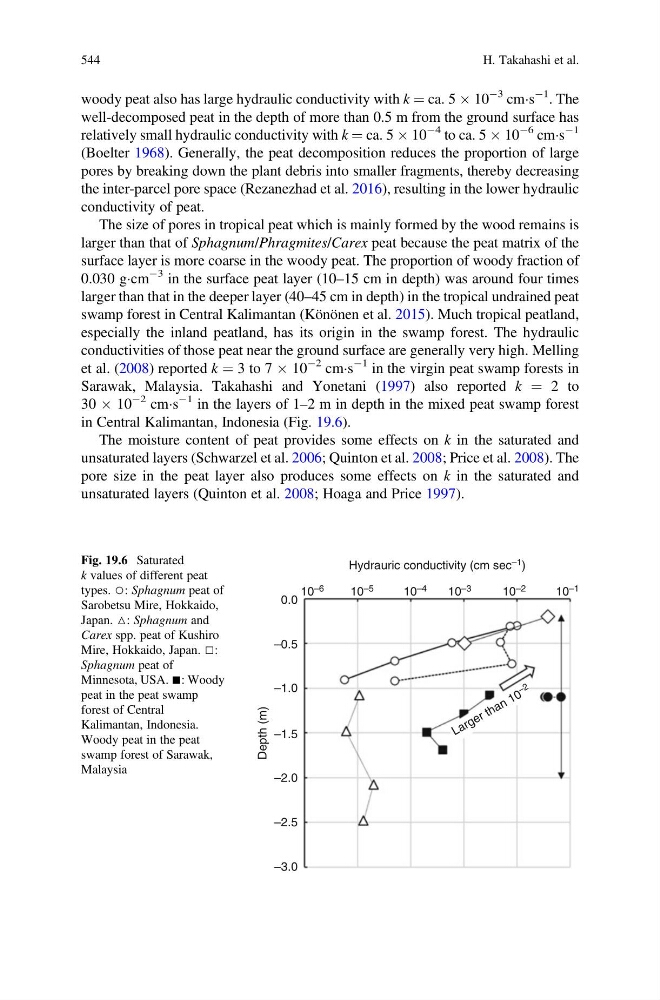
woody peat also has large hydraulic conductivity with k ¼ ca. 5 Â 10
À3 cmÁs
À1 . The
well-decomposed peat in the depth of more than 0.5 m from the ground surface has
relatively small hydraulic conductivity with k ¼ ca. 5 Â 10
À4 to ca. 5 Â 10
À6 cmÁs
À1
(Boelter 1968). Generally, the peat decomposition reduces the proportion of large
pores by breaking down the plant debris into smaller fragments, thereby decreasing
the inter-parcel pore space (Rezanezhad et al. 2016), resulting in the lower hydraulic
conductivity of peat.
The size of pores in tropical peat which is mainly formed by the wood remains is
larger than that of Sphagnum/Phragmites/Carex peat because the peat matrix of the
surface layer is more coarse in the woody peat. The proportion of woody fraction of
0.030 gÁcm
À3 in the surface peat layer (10–15 cm in depth) was around four times
larger than that in the deeper layer (40–45 cm in depth) in the tropical undrained peat
swamp forest in Central Kalimantan (Könönen et al. 2015). Much tropical peatland,
especially the inland peatland, has its origin in the swamp forest. The hydraulic
conductivities of those peat near the ground surface are generally very high. Melling
et al. (2008) reported k ¼ 3 to 7 Â 10
À2 cmÁs
À1 in the virgin peat swamp forests in
Sarawak, Malaysia. Takahashi and Yonetani (1997) also reported k ¼ 2 to
30 Â 10
À2 cmÁs
À1 in the layers of 1–2 m in depth in the mixed peat swamp forest
in Central Kalimantan, Indonesia (Fig. 19.6).
The moisture content of peat provides some effects on k in the saturated and
unsaturated layers (Schwarzel et al. 2006; Quinton et al. 2008; Price et al. 2008). The
pore size in the peat layer also produces some effects on k in the saturated and
unsaturated layers (Quinton et al. 2008; Hoaga and Price 1997).
Hydrauric conductivity (cm sec –1 )
L a r g e r t h a n 1 0
– 2
10 –6
0.0
–0.5
–1.0
–1.5
Depth (m)
–2.0
–2.5
–3.0
10 –5
10 –4
10 –3
10 –2
10 –1
Fig. 19.6 Saturated
k values of different peat
types. ○: Sphagnum peat of
Sarobetsu Mire, Hokkaido,
Japan. △: Sphagnum and
Carex spp. peat of Kushiro
Mire, Hokkaido, Japan. □:
Sphagnum peat of
Minnesota, USA. ■: Woody
peat in the peat swamp
forest of Central
Kalimantan, Indonesia.
Woody peat in the peat
swamp forest of Sarawak,
Malaysia
544
H. Takahashi et al.
À3 cmÁs
À1 . The
well-decomposed peat in the depth of more than 0.5 m from the ground surface has
relatively small hydraulic conductivity with k ¼ ca. 5 Â 10
À4 to ca. 5 Â 10
À6 cmÁs
À1
(Boelter 1968). Generally, the peat decomposition reduces the proportion of large
pores by breaking down the plant debris into smaller fragments, thereby decreasing
the inter-parcel pore space (Rezanezhad et al. 2016), resulting in the lower hydraulic
conductivity of peat.
The size of pores in tropical peat which is mainly formed by the wood remains is
larger than that of Sphagnum/Phragmites/Carex peat because the peat matrix of the
surface layer is more coarse in the woody peat. The proportion of woody fraction of
0.030 gÁcm
À3 in the surface peat layer (10–15 cm in depth) was around four times
larger than that in the deeper layer (40–45 cm in depth) in the tropical undrained peat
swamp forest in Central Kalimantan (Könönen et al. 2015). Much tropical peatland,
especially the inland peatland, has its origin in the swamp forest. The hydraulic
conductivities of those peat near the ground surface are generally very high. Melling
et al. (2008) reported k ¼ 3 to 7 Â 10
À2 cmÁs
À1 in the virgin peat swamp forests in
Sarawak, Malaysia. Takahashi and Yonetani (1997) also reported k ¼ 2 to
30 Â 10
À2 cmÁs
À1 in the layers of 1–2 m in depth in the mixed peat swamp forest
in Central Kalimantan, Indonesia (Fig. 19.6).
The moisture content of peat provides some effects on k in the saturated and
unsaturated layers (Schwarzel et al. 2006; Quinton et al. 2008; Price et al. 2008). The
pore size in the peat layer also produces some effects on k in the saturated and
unsaturated layers (Quinton et al. 2008; Hoaga and Price 1997).
Hydrauric conductivity (cm sec –1 )
L a r g e r t h a n 1 0
– 2
10 –6
0.0
–0.5
–1.0
–1.5
Depth (m)
–2.0
–2.5
–3.0
10 –5
10 –4
10 –3
10 –2
10 –1
Fig. 19.6 Saturated
k values of different peat
types. ○: Sphagnum peat of
Sarobetsu Mire, Hokkaido,
Japan. △: Sphagnum and
Carex spp. peat of Kushiro
Mire, Hokkaido, Japan. □:
Sphagnum peat of
Minnesota, USA. ■: Woody
peat in the peat swamp
forest of Central
Kalimantan, Indonesia.
Woody peat in the peat
swamp forest of Sarawak,
Malaysia
544
H. Takahashi et al.