

19.3.1 Water Balance in the Peat Layer and the Physical
Properties of Peat
Precipitation (both throughfall (F th ) and stemflow (F st )) from the atmosphere and the
inflow from the upstream (F in ) where the water potential is higher supply the water to
the peat layer. This water will be lost by the evaporation (E v ) and transpiration (T r )
through the root system and peat surface, the downward infiltration (I nfB ) through the
mineral soil layer underneath of peat layer, and outflow (F out ) to downstream where
the water potential is lower. This water balance (D w ) in the peat layer is shown in
Eq. (19.1).
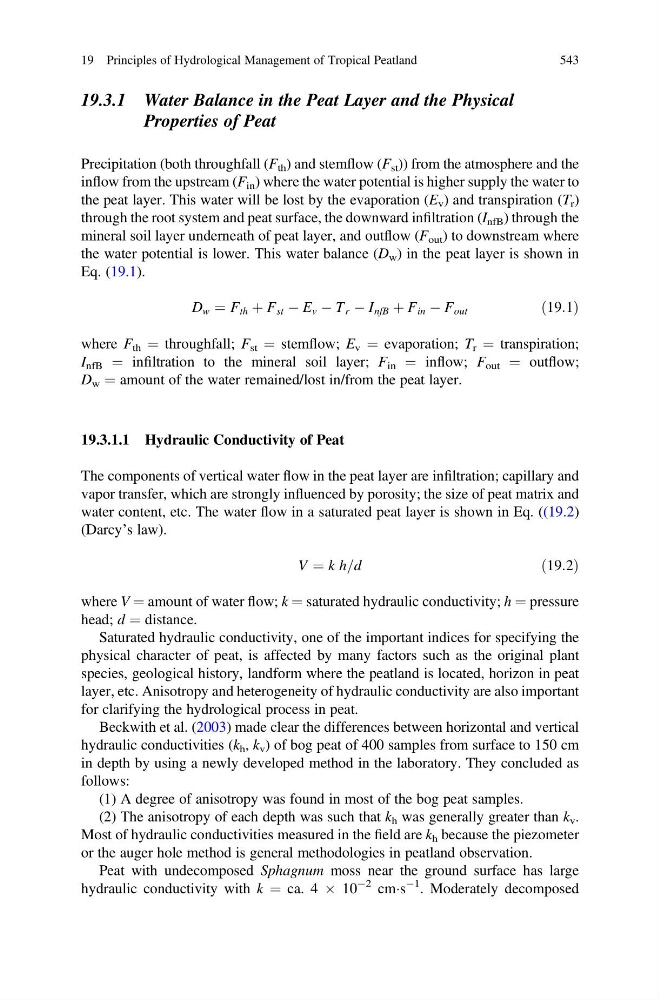
D w ¼ F th þ F st À E v À T r À I nfB þ F in À F out
ð19:1Þ
where F th ¼ throughfall; F st ¼ stemflow; E v ¼ evaporation; T r ¼ transpiration;
I nfB ¼ infiltration to the mineral soil layer; F in ¼ inflow; F out ¼ outflow;
D w ¼ amount of the water remained/lost in/from the peat layer.
19.3.1.1 Hydraulic Conductivity of Peat
The components of vertical water flow in the peat layer are infiltration; capillary and
vapor transfer, which are strongly influenced by porosity; the size of peat matrix and
water content, etc. The water flow in a saturated peat layer is shown in Eq. ((19.2)
(Darcy’s law).
V ¼ k h=d
ð19:2Þ
where V ¼ amount of water flow; k ¼ saturated hydraulic conductivity; h ¼ pressure
head; d ¼ distance.
Saturated hydraulic conductivity, one of the important indices for specifying the
physical character of peat, is affected by many factors such as the original plant
species, geological history, landform where the peatland is located, horizon in peat
layer, etc. Anisotropy and heterogeneity of hydraulic conductivity are also important
for clarifying the hydrological process in peat.
Beckwith et al. (2003) made clear the differences between horizontal and vertical
hydraulic conductivities (k h , k v ) of bog peat of 400 samples from surface to 150 cm
in depth by using a newly developed method in the laboratory. They concluded as
follows:
(1) A degree of anisotropy was found in most of the bog peat samples.
(2) The anisotropy of each depth was such that k h was generally greater than k v .
Most of hydraulic conductivities measured in the field are k h because the piezometer
or the auger hole method is general methodologies in peatland observation.
Peat with undecomposed Sphagnum moss near the ground surface has large
hydraulic conductivity with k ¼ ca. 4 Â 10
À2 cmÁs
À1 . Moderately decomposed
19 Principles of Hydrological Management of Tropical Peatland
543
Properties of Peat
Precipitation (both throughfall (F th ) and stemflow (F st )) from the atmosphere and the
inflow from the upstream (F in ) where the water potential is higher supply the water to
the peat layer. This water will be lost by the evaporation (E v ) and transpiration (T r )
through the root system and peat surface, the downward infiltration (I nfB ) through the
mineral soil layer underneath of peat layer, and outflow (F out ) to downstream where
the water potential is lower. This water balance (D w ) in the peat layer is shown in
Eq. (19.1).
D w ¼ F th þ F st À E v À T r À I nfB þ F in À F out
ð19:1Þ
where F th ¼ throughfall; F st ¼ stemflow; E v ¼ evaporation; T r ¼ transpiration;
I nfB ¼ infiltration to the mineral soil layer; F in ¼ inflow; F out ¼ outflow;
D w ¼ amount of the water remained/lost in/from the peat layer.
19.3.1.1 Hydraulic Conductivity of Peat
The components of vertical water flow in the peat layer are infiltration; capillary and
vapor transfer, which are strongly influenced by porosity; the size of peat matrix and
water content, etc. The water flow in a saturated peat layer is shown in Eq. ((19.2)
(Darcy’s law).
V ¼ k h=d
ð19:2Þ
where V ¼ amount of water flow; k ¼ saturated hydraulic conductivity; h ¼ pressure
head; d ¼ distance.
Saturated hydraulic conductivity, one of the important indices for specifying the
physical character of peat, is affected by many factors such as the original plant
species, geological history, landform where the peatland is located, horizon in peat
layer, etc. Anisotropy and heterogeneity of hydraulic conductivity are also important
for clarifying the hydrological process in peat.
Beckwith et al. (2003) made clear the differences between horizontal and vertical
hydraulic conductivities (k h , k v ) of bog peat of 400 samples from surface to 150 cm
in depth by using a newly developed method in the laboratory. They concluded as
follows:
(1) A degree of anisotropy was found in most of the bog peat samples.
(2) The anisotropy of each depth was such that k h was generally greater than k v .
Most of hydraulic conductivities measured in the field are k h because the piezometer
or the auger hole method is general methodologies in peatland observation.
Peat with undecomposed Sphagnum moss near the ground surface has large
hydraulic conductivity with k ¼ ca. 4 Â 10
À2 cmÁs
À1 . Moderately decomposed
19 Principles of Hydrological Management of Tropical Peatland
543