

19.3 Hydrology in the Vertical Geosphere
The water balance in the peat layer is roughly and directly measured by monitoring
GWL in the peatland. GWL in peatland is always fluctuating upward by rainfall and
downward by evapotranspiration and discharge. When it does not rain, GWL drops
stepwise day by day, because the discharge occurs through a day and the evapotranspiration occurs during daytime. The capillary force, air bobble, and suction
force by the root system in the peat layer also affect the fluctuations of GWL in
peatland.
The water flow in the peat layer is affected by the conductivity and effective
porosity of peat. The amount of water flow in the peat layer is very small than that
above the ground surface. The hydraulic conductivity and effective porosity of
undisturbed peat are very large in the layer near the ground surface and decrease
sharply toward the deeper layer. When the peat shrunk, compressed and decomposed
by the impact of drainage, its hydraulic conductivity and the rate of effective porosity
of peat decrease largely.
6
June - Oct. 1997
Ev = 0.199Sr + 0.36
R 2 = 0.57
5
4
3
Evapotranspiration (mm day –1
)
2
1
0
0
5
Solar radiation (MJ m –2 day –1 )
10
15
20
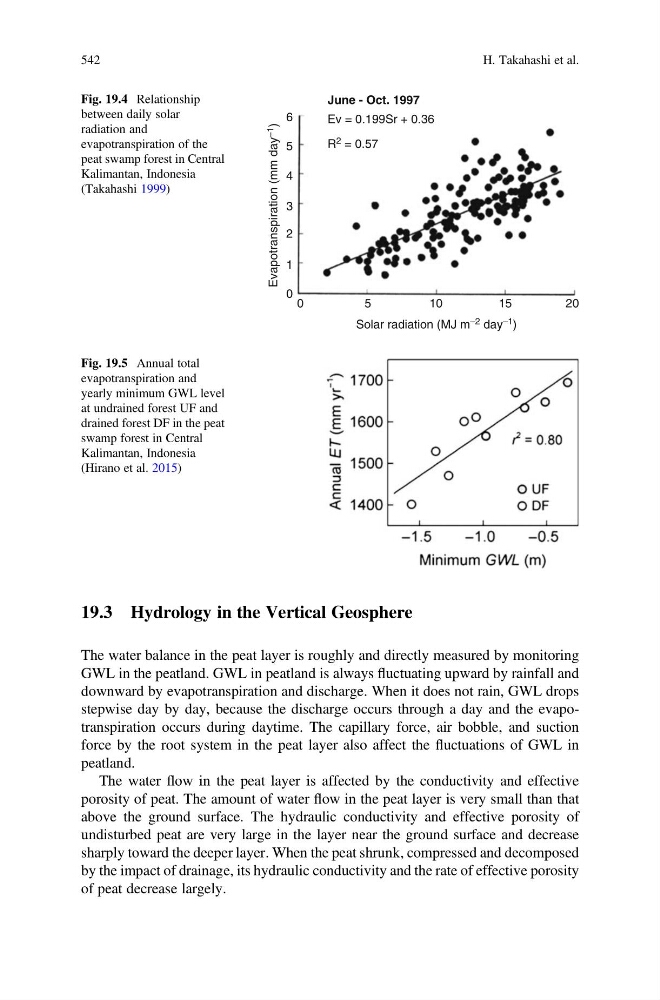
Fig. 19.4 Relationship
between daily solar
radiation and
evapotranspiration of the
peat swamp forest in Central
Kalimantan, Indonesia
(Takahashi 1999)
Fig. 19.5 Annual total
evapotranspiration and
yearly minimum GWL level
at undrained forest UF and
drained forest DF in the peat
swamp forest in Central
Kalimantan, Indonesia
(Hirano et al. 2015)
542
H. Takahashi et al.
The water balance in the peat layer is roughly and directly measured by monitoring
GWL in the peatland. GWL in peatland is always fluctuating upward by rainfall and
downward by evapotranspiration and discharge. When it does not rain, GWL drops
stepwise day by day, because the discharge occurs through a day and the evapotranspiration occurs during daytime. The capillary force, air bobble, and suction
force by the root system in the peat layer also affect the fluctuations of GWL in
peatland.
The water flow in the peat layer is affected by the conductivity and effective
porosity of peat. The amount of water flow in the peat layer is very small than that
above the ground surface. The hydraulic conductivity and effective porosity of
undisturbed peat are very large in the layer near the ground surface and decrease
sharply toward the deeper layer. When the peat shrunk, compressed and decomposed
by the impact of drainage, its hydraulic conductivity and the rate of effective porosity
of peat decrease largely.
6
June - Oct. 1997
Ev = 0.199Sr + 0.36
R 2 = 0.57
5
4
3
Evapotranspiration (mm day –1
)
2
1
0
0
5
Solar radiation (MJ m –2 day –1 )
10
15
20
Fig. 19.4 Relationship
between daily solar
radiation and
evapotranspiration of the
peat swamp forest in Central
Kalimantan, Indonesia
(Takahashi 1999)
Fig. 19.5 Annual total
evapotranspiration and
yearly minimum GWL level
at undrained forest UF and
drained forest DF in the peat
swamp forest in Central
Kalimantan, Indonesia
(Hirano et al. 2015)
542
H. Takahashi et al.