

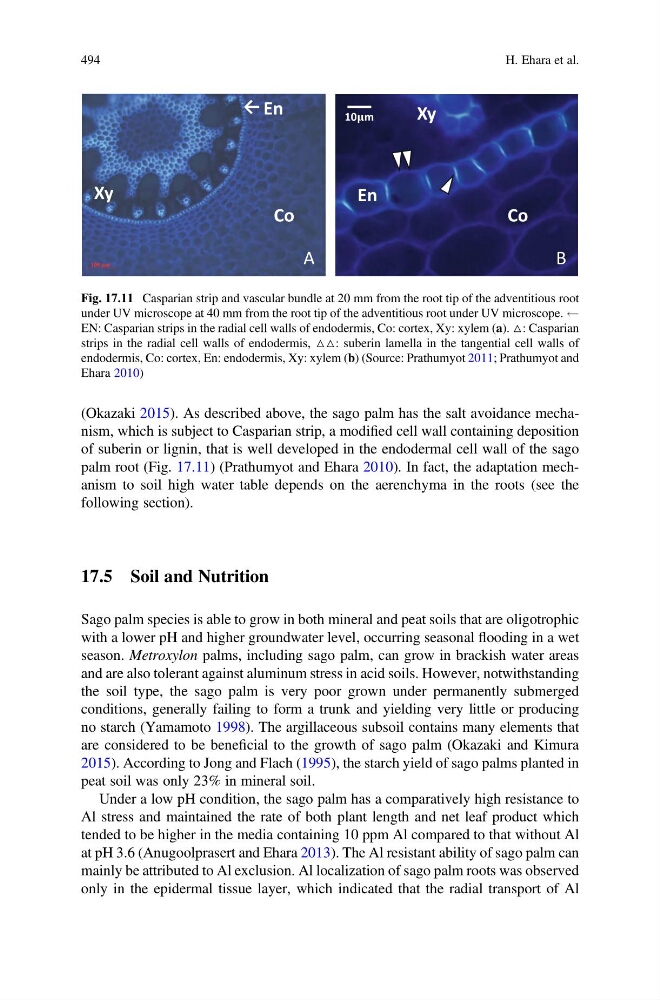
(Okazaki 2015). As described above, the sago palm has the salt avoidance mechanism, which is subject to Casparian strip, a modified cell wall containing deposition
of suberin or lignin, that is well developed in the endodermal cell wall of the sago
palm root (Fig. 17.11) (Prathumyot and Ehara 2010). In fact, the adaptation mechanism to soil high water table depends on the aerenchyma in the roots (see the
following section).
17.5 Soil and Nutrition
Sago palm species is able to grow in both mineral and peat soils that are oligotrophic
with a lower pH and higher groundwater level, occurring seasonal flooding in a wet
season. Metroxylon palms, including sago palm, can grow in brackish water areas
and are also tolerant against aluminum stress in acid soils. However, notwithstanding
the soil type, the sago palm is very poor grown under permanently submerged
conditions, generally failing to form a trunk and yielding very little or producing
no starch (Yamamoto 1998). The argillaceous subsoil contains many elements that
are considered to be beneficial to the growth of sago palm (Okazaki and Kimura
2015). According to Jong and Flach (1995), the starch yield of sago palms planted in
peat soil was only 23% in mineral soil.
Under a low pH condition, the sago palm has a comparatively high resistance to
Al stress and maintained the rate of both plant length and net leaf product which
tended to be higher in the media containing 10 ppm Al compared to that without Al
at pH 3.6 (Anugoolprasert and Ehara 2013). The Al resistant ability of sago palm can
mainly be attributed to Al exclusion. Al localization of sago palm roots was observed
only in the epidermal tissue layer, which indicated that the radial transport of Al
En
Xy
Co
En
Xy
m
Co
A
B
Fig. 17.11 Casparian strip and vascular bundle at 20 mm from the root tip of the adventitious root
under UV microscope at 40 mm from the root tip of the adventitious root under UV microscope.
EN: Casparian strips in the radial cell walls of endodermis, Co: cortex, Xy: xylem (a). △: Casparian
strips in the radial cell walls of endodermis, △△: suberin lamella in the tangential cell walls of
endodermis, Co: cortex, En: endodermis, Xy: xylem (b) (Source: Prathumyot 2011; Prathumyot and
Ehara 2010)
494
H. Ehara et al.
of suberin or lignin, that is well developed in the endodermal cell wall of the sago
palm root (Fig. 17.11) (Prathumyot and Ehara 2010). In fact, the adaptation mechanism to soil high water table depends on the aerenchyma in the roots (see the
following section).
17.5 Soil and Nutrition
Sago palm species is able to grow in both mineral and peat soils that are oligotrophic
with a lower pH and higher groundwater level, occurring seasonal flooding in a wet
season. Metroxylon palms, including sago palm, can grow in brackish water areas
and are also tolerant against aluminum stress in acid soils. However, notwithstanding
the soil type, the sago palm is very poor grown under permanently submerged
conditions, generally failing to form a trunk and yielding very little or producing
no starch (Yamamoto 1998). The argillaceous subsoil contains many elements that
are considered to be beneficial to the growth of sago palm (Okazaki and Kimura
2015). According to Jong and Flach (1995), the starch yield of sago palms planted in
peat soil was only 23% in mineral soil.
Under a low pH condition, the sago palm has a comparatively high resistance to
Al stress and maintained the rate of both plant length and net leaf product which
tended to be higher in the media containing 10 ppm Al compared to that without Al
at pH 3.6 (Anugoolprasert and Ehara 2013). The Al resistant ability of sago palm can
mainly be attributed to Al exclusion. Al localization of sago palm roots was observed
only in the epidermal tissue layer, which indicated that the radial transport of Al
En
Xy
Co
En
Xy
m
Co
A
B
Fig. 17.11 Casparian strip and vascular bundle at 20 mm from the root tip of the adventitious root
under UV microscope at 40 mm from the root tip of the adventitious root under UV microscope.
EN: Casparian strips in the radial cell walls of endodermis, Co: cortex, Xy: xylem (a). △: Casparian
strips in the radial cell walls of endodermis, △△: suberin lamella in the tangential cell walls of
endodermis, Co: cortex, En: endodermis, Xy: xylem (b) (Source: Prathumyot 2011; Prathumyot and
Ehara 2010)
494
H. Ehara et al.