

might be restricted by the development of suberin lamellae in the cell wall between
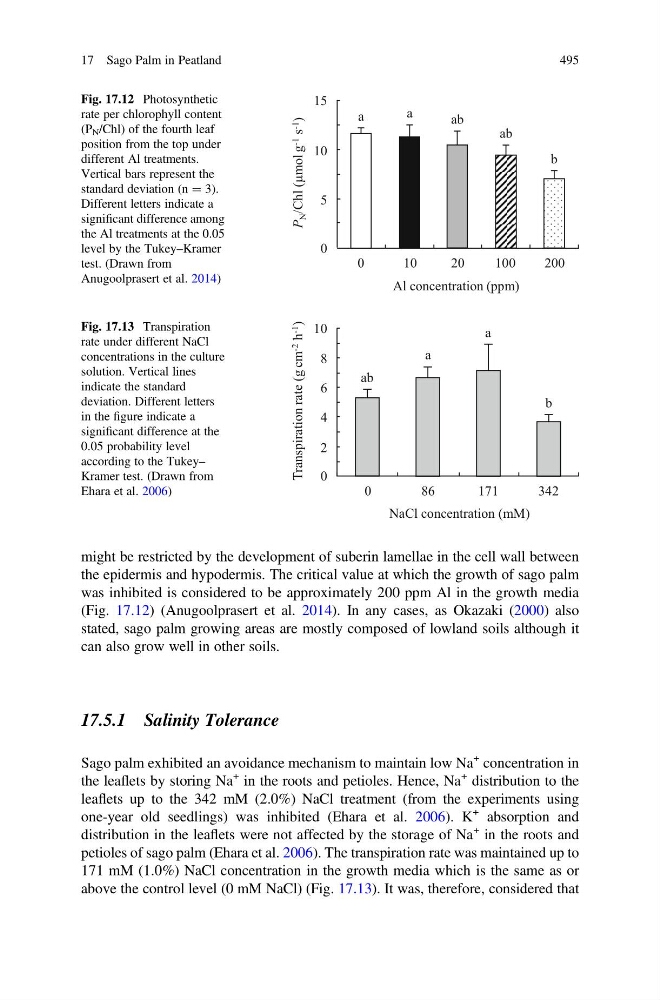
the epidermis and hypodermis. The critical value at which the growth of sago palm
was inhibited is considered to be approximately 200 ppm Al in the growth media
(Fig. 17.12) (Anugoolprasert et al. 2014). In any cases, as Okazaki (2000) also
stated, sago palm growing areas are mostly composed of lowland soils although it
can also grow well in other soils.
17.5.1 Salinity Tolerance
Sago palm exhibited an avoidance mechanism to maintain low Na
+ concentration in
the leaflets by storing Na
+ in the roots and petioles. Hence, Na
+ distribution to the
leaflets up to the 342 mM (2.0%) NaCl treatment (from the experiments using
one-year old seedlings) was inhibited (Ehara et al. 2006). K
+ absorption and
distribution in the leaflets were not affected by the storage of Na
+ in the roots and
petioles of sago palm (Ehara et al. 2006). The transpiration rate was maintained up to
171 mM (1.0%) NaCl concentration in the growth media which is the same as or
above the control level (0 mM NaCl) (Fig. 17.13). It was, therefore, considered that
15
5
0
10
P
N /Chl (μmol g -1
s -1
)
a
a
ab
b
0
10
20
200
Al concentration (ppm)
ab
100
Fig. 17.12 Photosynthetic
rate per chlorophyll content
(P N /Chl) of the fourth leaf
position from the top under
different Al treatments.
Vertical bars represent the
standard deviation (n ¼ 3).
Different letters indicate a
significant difference among
the Al treatments at the 0.05
level by the Tukey–Kramer
test. (Drawn from
Anugoolprasert et al. 2014)
10
8
4
2
0
6
Transpiration rate (g cm -2
h -1
)
ab
a
a
b
0
86
171
342
NaCl concentration (mM)
Fig. 17.13 Transpiration
rate under different NaCl
concentrations in the culture
solution. Vertical lines
indicate the standard
deviation. Different letters
in the figure indicate a
significant difference at the
0.05 probability level
according to the Tukey–
Kramer test. (Drawn from
Ehara et al. 2006)
17 Sago Palm in Peatland
495
the epidermis and hypodermis. The critical value at which the growth of sago palm
was inhibited is considered to be approximately 200 ppm Al in the growth media
(Fig. 17.12) (Anugoolprasert et al. 2014). In any cases, as Okazaki (2000) also
stated, sago palm growing areas are mostly composed of lowland soils although it
can also grow well in other soils.
17.5.1 Salinity Tolerance
Sago palm exhibited an avoidance mechanism to maintain low Na
+ concentration in
the leaflets by storing Na
+ in the roots and petioles. Hence, Na
+ distribution to the
leaflets up to the 342 mM (2.0%) NaCl treatment (from the experiments using
one-year old seedlings) was inhibited (Ehara et al. 2006). K
+ absorption and
distribution in the leaflets were not affected by the storage of Na
+ in the roots and
petioles of sago palm (Ehara et al. 2006). The transpiration rate was maintained up to
171 mM (1.0%) NaCl concentration in the growth media which is the same as or
above the control level (0 mM NaCl) (Fig. 17.13). It was, therefore, considered that
15
5
0
10
P
N /Chl (μmol g -1
s -1
)
a
a
ab
b
0
10
20
200
Al concentration (ppm)
ab
100
Fig. 17.12 Photosynthetic
rate per chlorophyll content
(P N /Chl) of the fourth leaf
position from the top under
different Al treatments.
Vertical bars represent the
standard deviation (n ¼ 3).
Different letters indicate a
significant difference among
the Al treatments at the 0.05
level by the Tukey–Kramer
test. (Drawn from
Anugoolprasert et al. 2014)
10
8
4
2
0
6
Transpiration rate (g cm -2
h -1
)
ab
a
a
b
0
86
171
342
NaCl concentration (mM)
Fig. 17.13 Transpiration
rate under different NaCl
concentrations in the culture
solution. Vertical lines
indicate the standard
deviation. Different letters
in the figure indicate a
significant difference at the
0.05 probability level
according to the Tukey–
Kramer test. (Drawn from
Ehara et al. 2006)
17 Sago Palm in Peatland
495