

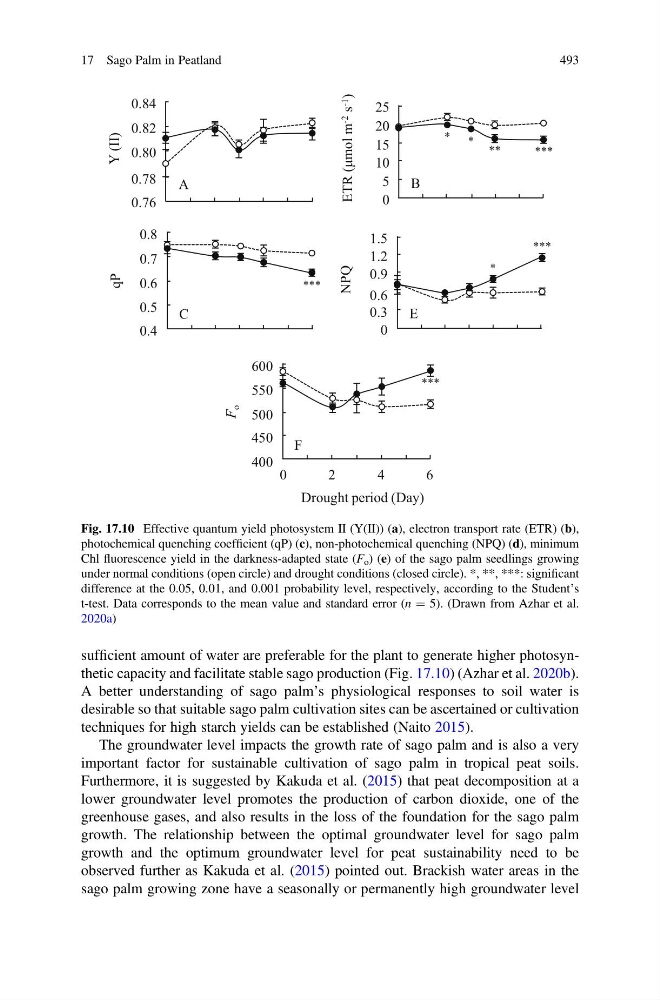
sufficient amount of water are preferable for the plant to generate higher photosynthetic capacity and facilitate stable sago production (Fig. 17.10) (Azhar et al. 2020b).
A better understanding of sago palm’s physiological responses to soil water is
desirable so that suitable sago palm cultivation sites can be ascertained or cultivation
techniques for high starch yields can be established (Naito 2015).
The groundwater level impacts the growth rate of sago palm and is also a very
important factor for sustainable cultivation of sago palm in tropical peat soils.
Furthermore, it is suggested by Kakuda et al. (2015) that peat decomposition at a
lower groundwater level promotes the production of carbon dioxide, one of the
greenhouse gases, and also results in the loss of the foundation for the sago palm
growth. The relationship between the optimal groundwater level for sago palm
growth and the optimum groundwater level for peat sustainability need to be
observed further as Kakuda et al. (2015) pointed out. Brackish water areas in the
sago palm growing zone have a seasonally or permanently high groundwater level
25
10
0
20
5
15
0.6
0.4
0.8
0.5
0.7
1.5
0.6
0
1.2
0.3
0.9
500
400
600
450
550
ETR (μmol
m -2
s -1
)
qP
NPQ
F
o
B
C
E
F
Drought period (Day)
0
2
6
4
Y (II)
0.80
0.76
0.84
0.78
0.82
A
* *
**
***
***
***
*
***
Fig. 17.10 Effective quantum yield photosystem II (Y(II)) (a), electron transport rate (ETR) (b),
photochemical quenching coefficient (qP) (c), non-photochemical quenching (NPQ) (d), minimum
Chl fluorescence yield in the darkness-adapted state (F o ) (e) of the sago palm seedlings growing
under normal conditions (open circle) and drought conditions (closed circle). *, **, ***: significant
difference at the 0.05, 0.01, and 0.001 probability level, respectively, according to the Student’s
t-test. Data corresponds to the mean value and standard error (n ¼ 5). (Drawn from Azhar et al.
2020a)
17 Sago Palm in Peatland
493
A better understanding of sago palm’s physiological responses to soil water is
desirable so that suitable sago palm cultivation sites can be ascertained or cultivation
techniques for high starch yields can be established (Naito 2015).
The groundwater level impacts the growth rate of sago palm and is also a very
important factor for sustainable cultivation of sago palm in tropical peat soils.
Furthermore, it is suggested by Kakuda et al. (2015) that peat decomposition at a
lower groundwater level promotes the production of carbon dioxide, one of the
greenhouse gases, and also results in the loss of the foundation for the sago palm
growth. The relationship between the optimal groundwater level for sago palm
growth and the optimum groundwater level for peat sustainability need to be
observed further as Kakuda et al. (2015) pointed out. Brackish water areas in the
sago palm growing zone have a seasonally or permanently high groundwater level
25
10
0
20
5
15
0.6
0.4
0.8
0.5
0.7
1.5
0.6
0
1.2
0.3
0.9
500
400
600
450
550
ETR (μmol
m -2
s -1
)
qP
NPQ
F
o
B
C
E
F
Drought period (Day)
0
2
6
4
Y (II)
0.80
0.76
0.84
0.78
0.82
A
* *
**
***
***
***
*
***
Fig. 17.10 Effective quantum yield photosystem II (Y(II)) (a), electron transport rate (ETR) (b),
photochemical quenching coefficient (qP) (c), non-photochemical quenching (NPQ) (d), minimum
Chl fluorescence yield in the darkness-adapted state (F o ) (e) of the sago palm seedlings growing
under normal conditions (open circle) and drought conditions (closed circle). *, **, ***: significant
difference at the 0.05, 0.01, and 0.001 probability level, respectively, according to the Student’s
t-test. Data corresponds to the mean value and standard error (n ¼ 5). (Drawn from Azhar et al.
2020a)
17 Sago Palm in Peatland
493