

and mucilage, which will contribute to Al accumulation and low pH (Al
3+ toxicity)
tolerance (Watanabe and Osaki 2002; Watanabe et al. 2005a, b, 2008).
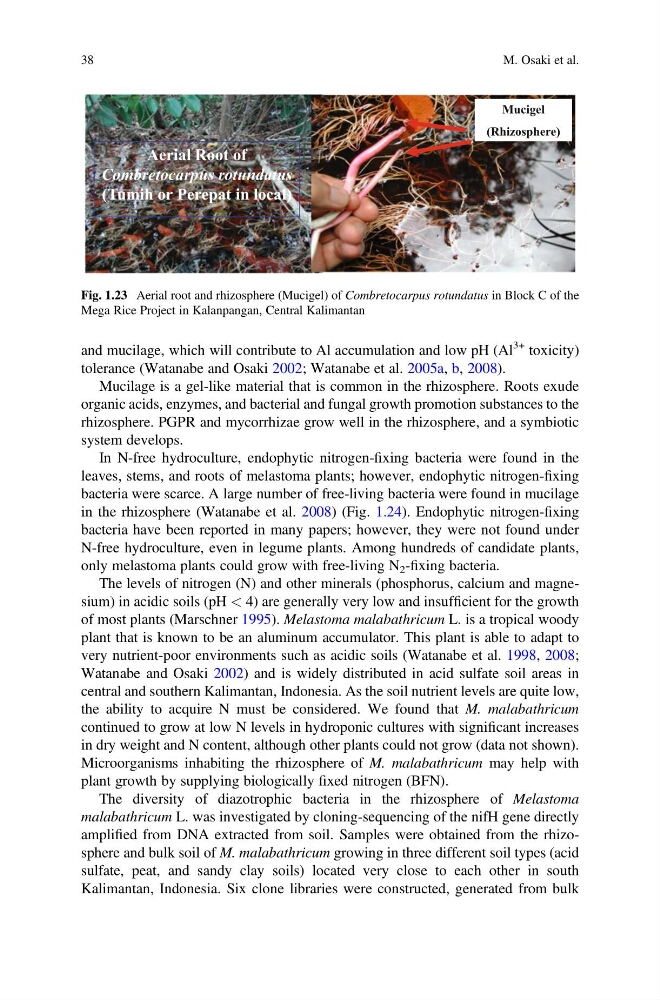
Mucilage is a gel-like material that is common in the rhizosphere. Roots exude
organic acids, enzymes, and bacterial and fungal growth promotion substances to the
rhizosphere. PGPR and mycorrhizae grow well in the rhizosphere, and a symbiotic
system develops.
In N-free hydroculture, endophytic nitrogen-fixing bacteria were found in the
leaves, stems, and roots of melastoma plants; however, endophytic nitrogen-fixing
bacteria were scarce. A large number of free-living bacteria were found in mucilage
in the rhizosphere (Watanabe et al. 2008) (Fig. 1.24). Endophytic nitrogen-fixing
bacteria have been reported in many papers; however, they were not found under
N-free hydroculture, even in legume plants. Among hundreds of candidate plants,
only melastoma plants could grow with free-living N 2 -fixing bacteria.
The levels of nitrogen (N) and other minerals (phosphorus, calcium and magnesium) in acidic soils (pH < 4) are generally very low and insufficient for the growth
of most plants (Marschner 1995). Melastoma malabathricum L. is a tropical woody
plant that is known to be an aluminum accumulator. This plant is able to adapt to
very nutrient-poor environments such as acidic soils (Watanabe et al. 1998, 2008;
Watanabe and Osaki 2002) and is widely distributed in acid sulfate soil areas in
central and southern Kalimantan, Indonesia. As the soil nutrient levels are quite low,
the ability to acquire N must be considered. We found that M. malabathricum
continued to grow at low N levels in hydroponic cultures with significant increases
in dry weight and N content, although other plants could not grow (data not shown).
Microorganisms inhabiting the rhizosphere of M. malabathricum may help with
plant growth by supplying biologically fixed nitrogen (BFN).
The diversity of diazotrophic bacteria in the rhizosphere of Melastoma
malabathricum L. was investigated by cloning-sequencing of the nifH gene directly
amplified from DNA extracted from soil. Samples were obtained from the rhizosphere and bulk soil of M. malabathricum growing in three different soil types (acid
sulfate, peat, and sandy clay soils) located very close to each other in south
Kalimantan, Indonesia. Six clone libraries were constructed, generated from bulk
Aerial Root of
Combretocarpus rotundatus
(Tumih or Perepat in local)
Mucigel
(Rhizosphere)
Fig. 1.23 Aerial root and rhizosphere (Mucigel) of Combretocarpus rotundatus in Block C of the
Mega Rice Project in Kalanpangan, Central Kalimantan
38
M. Osaki et al.
3+ toxicity)
tolerance (Watanabe and Osaki 2002; Watanabe et al. 2005a, b, 2008).
Mucilage is a gel-like material that is common in the rhizosphere. Roots exude
organic acids, enzymes, and bacterial and fungal growth promotion substances to the
rhizosphere. PGPR and mycorrhizae grow well in the rhizosphere, and a symbiotic
system develops.
In N-free hydroculture, endophytic nitrogen-fixing bacteria were found in the
leaves, stems, and roots of melastoma plants; however, endophytic nitrogen-fixing
bacteria were scarce. A large number of free-living bacteria were found in mucilage
in the rhizosphere (Watanabe et al. 2008) (Fig. 1.24). Endophytic nitrogen-fixing
bacteria have been reported in many papers; however, they were not found under
N-free hydroculture, even in legume plants. Among hundreds of candidate plants,
only melastoma plants could grow with free-living N 2 -fixing bacteria.
The levels of nitrogen (N) and other minerals (phosphorus, calcium and magnesium) in acidic soils (pH < 4) are generally very low and insufficient for the growth
of most plants (Marschner 1995). Melastoma malabathricum L. is a tropical woody
plant that is known to be an aluminum accumulator. This plant is able to adapt to
very nutrient-poor environments such as acidic soils (Watanabe et al. 1998, 2008;
Watanabe and Osaki 2002) and is widely distributed in acid sulfate soil areas in
central and southern Kalimantan, Indonesia. As the soil nutrient levels are quite low,
the ability to acquire N must be considered. We found that M. malabathricum
continued to grow at low N levels in hydroponic cultures with significant increases
in dry weight and N content, although other plants could not grow (data not shown).
Microorganisms inhabiting the rhizosphere of M. malabathricum may help with
plant growth by supplying biologically fixed nitrogen (BFN).
The diversity of diazotrophic bacteria in the rhizosphere of Melastoma
malabathricum L. was investigated by cloning-sequencing of the nifH gene directly
amplified from DNA extracted from soil. Samples were obtained from the rhizosphere and bulk soil of M. malabathricum growing in three different soil types (acid
sulfate, peat, and sandy clay soils) located very close to each other in south
Kalimantan, Indonesia. Six clone libraries were constructed, generated from bulk
Aerial Root of
Combretocarpus rotundatus
(Tumih or Perepat in local)
Mucigel
(Rhizosphere)
Fig. 1.23 Aerial root and rhizosphere (Mucigel) of Combretocarpus rotundatus in Block C of the
Mega Rice Project in Kalanpangan, Central Kalimantan
38
M. Osaki et al.