

1.9.1.2 N 2 Fixing by Combretocarpus rotundatus
As nodule formation is extremely sensitive to water, it is extremely difficult for
nodules to form even in aerated water culture. Nodules are formed above the water
level. As nitrogen fixation is an electron transportation process, micronutrients (such
as Fe, Zn, Mn, and Co) are more essential in nodule-forming plants than in
nonnodule-forming plants. Thus, when plants grow in heavily disturbed peatlands,
nutrient disorders are common. In Central Kalimantan, Combretocarpus rotundatus
is the dominant species, and this plant regenerates quickly after fire. C. rotundatus is
not a legume plant; however, data on the natural abundance of the stable isotope
15
N
(δ
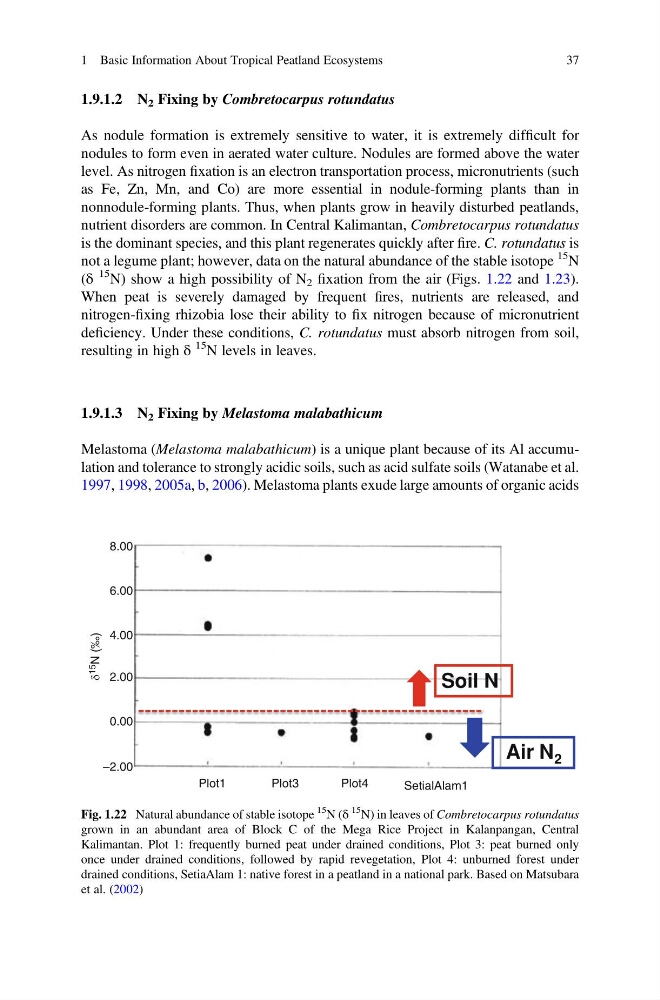
15 N) show a high possibility of N 2 fixation from the air (Figs. 1.22 and 1.23).
When peat is severely damaged by frequent fires, nutrients are released, and
nitrogen-fixing rhizobia lose their ability to fix nitrogen because of micronutrient
deficiency. Under these conditions, C. rotundatus must absorb nitrogen from soil,
resulting in high δ
15 N levels in leaves.
1.9.1.3 N 2 Fixing by Melastoma malabathicum
Melastoma (Melastoma malabathicum) is a unique plant because of its Al accumulation and tolerance to strongly acidic soils, such as acid sulfate soils (Watanabe et al.
1997, 1998, 2005a, b, 2006). Melastoma plants exude large amounts of organic acids
Soil N
Air N 2
8.00
6.00
4.00
δ 15
N (‰)
2.00
0.00
–2.00
Plot1
Plot3
Plot4
SetialAlam1
Fig. 1.22 Natural abundance of stable isotope
15
N (δ
15
N) in leaves of Combretocarpus rotundatus
grown in an abundant area of Block C of the Mega Rice Project in Kalanpangan, Central
Kalimantan. Plot 1: frequently burned peat under drained conditions, Plot 3: peat burned only
once under drained conditions, followed by rapid revegetation, Plot 4: unburned forest under
drained conditions, SetiaAlam 1: native forest in a peatland in a national park. Based on Matsubara
et al. (2002)
1 Basic Information About Tropical Peatland Ecosystems
37
As nodule formation is extremely sensitive to water, it is extremely difficult for
nodules to form even in aerated water culture. Nodules are formed above the water
level. As nitrogen fixation is an electron transportation process, micronutrients (such
as Fe, Zn, Mn, and Co) are more essential in nodule-forming plants than in
nonnodule-forming plants. Thus, when plants grow in heavily disturbed peatlands,
nutrient disorders are common. In Central Kalimantan, Combretocarpus rotundatus
is the dominant species, and this plant regenerates quickly after fire. C. rotundatus is
not a legume plant; however, data on the natural abundance of the stable isotope
15
N
(δ
15 N) show a high possibility of N 2 fixation from the air (Figs. 1.22 and 1.23).
When peat is severely damaged by frequent fires, nutrients are released, and
nitrogen-fixing rhizobia lose their ability to fix nitrogen because of micronutrient
deficiency. Under these conditions, C. rotundatus must absorb nitrogen from soil,
resulting in high δ
15 N levels in leaves.
1.9.1.3 N 2 Fixing by Melastoma malabathicum
Melastoma (Melastoma malabathicum) is a unique plant because of its Al accumulation and tolerance to strongly acidic soils, such as acid sulfate soils (Watanabe et al.
1997, 1998, 2005a, b, 2006). Melastoma plants exude large amounts of organic acids
Soil N
Air N 2
8.00
6.00
4.00
δ 15
N (‰)
2.00
0.00
–2.00
Plot1
Plot3
Plot4
SetialAlam1
Fig. 1.22 Natural abundance of stable isotope
15
N (δ
15
N) in leaves of Combretocarpus rotundatus
grown in an abundant area of Block C of the Mega Rice Project in Kalanpangan, Central
Kalimantan. Plot 1: frequently burned peat under drained conditions, Plot 3: peat burned only
once under drained conditions, followed by rapid revegetation, Plot 4: unburned forest under
drained conditions, SetiaAlam 1: native forest in a peatland in a national park. Based on Matsubara
et al. (2002)
1 Basic Information About Tropical Peatland Ecosystems
37