

denitrified through decomposition, the lighter
14 N disappears first, thus increasing
the amount of soil δ
15
N over time. As such, there is little soil absorption of nitrogen
in tropical peatlands, and the fixation of atmospheric nitrogen can be assumed to be
active in these environments.
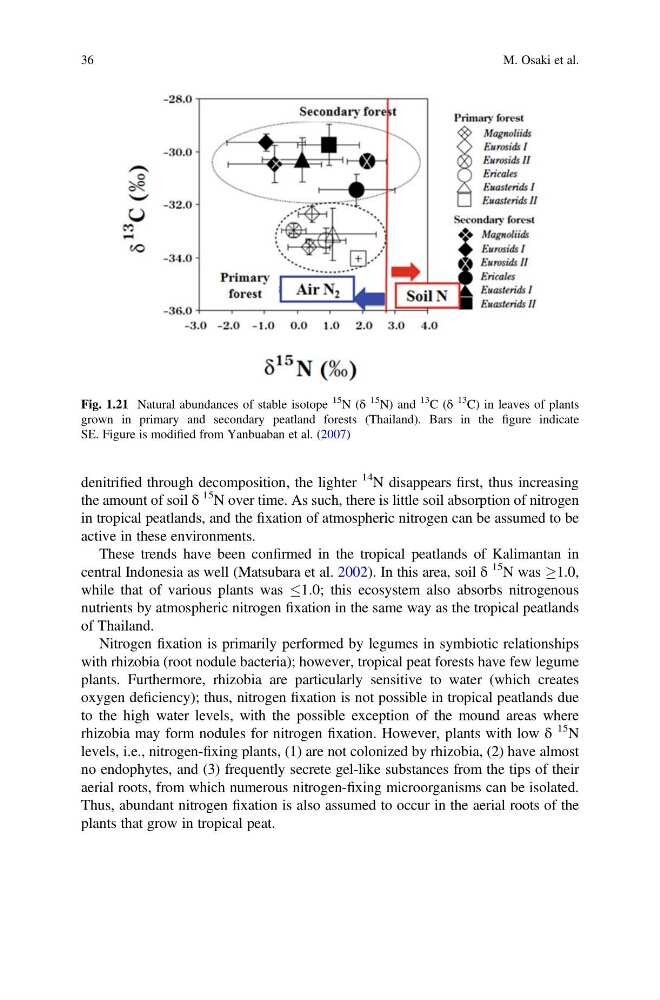
These trends have been confirmed in the tropical peatlands of Kalimantan in
central Indonesia as well (Matsubara et al. 2002). In this area, soil δ
15 N was !1.0,
while that of various plants was 1.0; this ecosystem also absorbs nitrogenous
nutrients by atmospheric nitrogen fixation in the same way as the tropical peatlands
of Thailand.
Nitrogen fixation is primarily performed by legumes in symbiotic relationships
with rhizobia (root nodule bacteria); however, tropical peat forests have few legume
plants. Furthermore, rhizobia are particularly sensitive to water (which creates
oxygen deficiency); thus, nitrogen fixation is not possible in tropical peatlands due
to the high water levels, with the possible exception of the mound areas where
rhizobia may form nodules for nitrogen fixation. However, plants with low δ
15
N
levels, i.e., nitrogen-fixing plants, (1) are not colonized by rhizobia, (2) have almost
no endophytes, and (3) frequently secrete gel-like substances from the tips of their
aerial roots, from which numerous nitrogen-fixing microorganisms can be isolated.
Thus, abundant nitrogen fixation is also assumed to occur in the aerial roots of the
plants that grow in tropical peat.
Fig. 1.21 Natural abundances of stable isotope
15
N (δ
15
N) and
13 C (δ
13
C) in leaves of plants
grown in primary and secondary peatland forests (Thailand). Bars in the figure indicate
SE. Figure is modified from Yanbuaban et al. (2007)
36
M. Osaki et al.
14 N disappears first, thus increasing
the amount of soil δ
15
N over time. As such, there is little soil absorption of nitrogen
in tropical peatlands, and the fixation of atmospheric nitrogen can be assumed to be
active in these environments.
These trends have been confirmed in the tropical peatlands of Kalimantan in
central Indonesia as well (Matsubara et al. 2002). In this area, soil δ
15 N was !1.0,
while that of various plants was 1.0; this ecosystem also absorbs nitrogenous
nutrients by atmospheric nitrogen fixation in the same way as the tropical peatlands
of Thailand.
Nitrogen fixation is primarily performed by legumes in symbiotic relationships
with rhizobia (root nodule bacteria); however, tropical peat forests have few legume
plants. Furthermore, rhizobia are particularly sensitive to water (which creates
oxygen deficiency); thus, nitrogen fixation is not possible in tropical peatlands due
to the high water levels, with the possible exception of the mound areas where
rhizobia may form nodules for nitrogen fixation. However, plants with low δ
15
N
levels, i.e., nitrogen-fixing plants, (1) are not colonized by rhizobia, (2) have almost
no endophytes, and (3) frequently secrete gel-like substances from the tips of their
aerial roots, from which numerous nitrogen-fixing microorganisms can be isolated.
Thus, abundant nitrogen fixation is also assumed to occur in the aerial roots of the
plants that grow in tropical peat.
Fig. 1.21 Natural abundances of stable isotope
15
N (δ
15
N) and
13 C (δ
13
C) in leaves of plants
grown in primary and secondary peatland forests (Thailand). Bars in the figure indicate
SE. Figure is modified from Yanbuaban et al. (2007)
36
M. Osaki et al.