

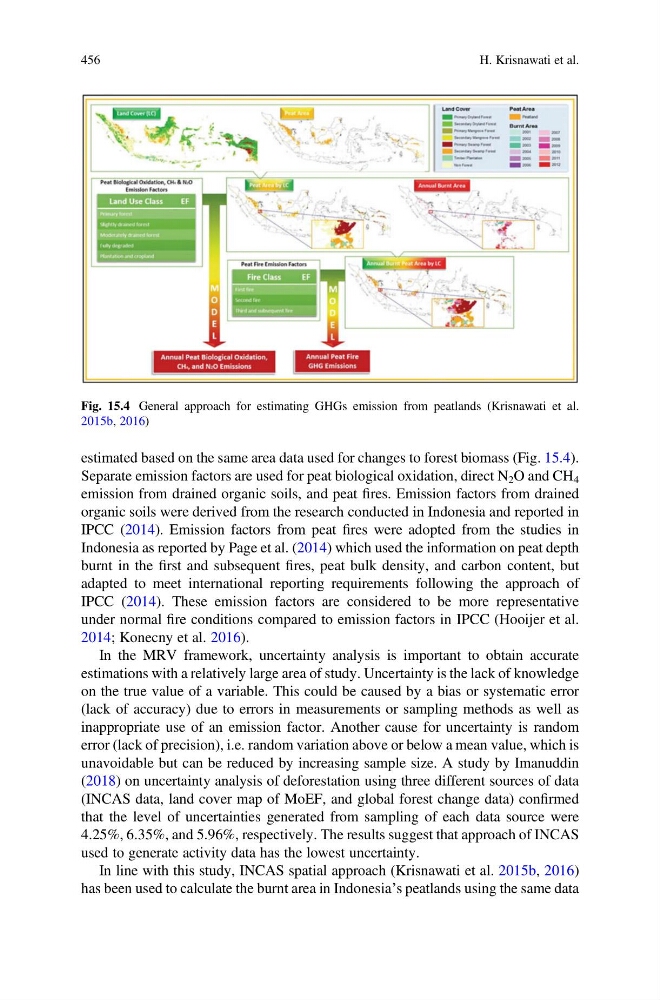
estimated based on the same area data used for changes to forest biomass (Fig. 15.4).
Separate emission factors are used for peat biological oxidation, direct N 2 O and CH 4
emission from drained organic soils, and peat fires. Emission factors from drained
organic soils were derived from the research conducted in Indonesia and reported in
IPCC (2014). Emission factors from peat fires were adopted from the studies in
Indonesia as reported by Page et al. (2014) which used the information on peat depth
burnt in the first and subsequent fires, peat bulk density, and carbon content, but
adapted to meet international reporting requirements following the approach of
IPCC (2014). These emission factors are considered to be more representative
under normal fire conditions compared to emission factors in IPCC (Hooijer et al.
2014; Konecny et al. 2016).
In the MRV framework, uncertainty analysis is important to obtain accurate
estimations with a relatively large area of study. Uncertainty is the lack of knowledge
on the true value of a variable. This could be caused by a bias or systematic error
(lack of accuracy) due to errors in measurements or sampling methods as well as
inappropriate use of an emission factor. Another cause for uncertainty is random
error (lack of precision), i.e. random variation above or below a mean value, which is
unavoidable but can be reduced by increasing sample size. A study by Imanuddin
(2018) on uncertainty analysis of deforestation using three different sources of data
(INCAS data, land cover map of MoEF, and global forest change data) confirmed
that the level of uncertainties generated from sampling of each data source were
4.25%, 6.35%, and 5.96%, respectively. The results suggest that approach of INCAS
used to generate activity data has the lowest uncertainty.
In line with this study, INCAS spatial approach (Krisnawati et al. 2015b, 2016)
has been used to calculate the burnt area in Indonesia’s peatlands using the same data
Fig. 15.4 General approach for estimating GHGs emission from peatlands (Krisnawati et al.
2015b, 2016)
456
H. Krisnawati et al.
Separate emission factors are used for peat biological oxidation, direct N 2 O and CH 4
emission from drained organic soils, and peat fires. Emission factors from drained
organic soils were derived from the research conducted in Indonesia and reported in
IPCC (2014). Emission factors from peat fires were adopted from the studies in
Indonesia as reported by Page et al. (2014) which used the information on peat depth
burnt in the first and subsequent fires, peat bulk density, and carbon content, but
adapted to meet international reporting requirements following the approach of
IPCC (2014). These emission factors are considered to be more representative
under normal fire conditions compared to emission factors in IPCC (Hooijer et al.
2014; Konecny et al. 2016).
In the MRV framework, uncertainty analysis is important to obtain accurate
estimations with a relatively large area of study. Uncertainty is the lack of knowledge
on the true value of a variable. This could be caused by a bias or systematic error
(lack of accuracy) due to errors in measurements or sampling methods as well as
inappropriate use of an emission factor. Another cause for uncertainty is random
error (lack of precision), i.e. random variation above or below a mean value, which is
unavoidable but can be reduced by increasing sample size. A study by Imanuddin
(2018) on uncertainty analysis of deforestation using three different sources of data
(INCAS data, land cover map of MoEF, and global forest change data) confirmed
that the level of uncertainties generated from sampling of each data source were
4.25%, 6.35%, and 5.96%, respectively. The results suggest that approach of INCAS
used to generate activity data has the lowest uncertainty.
In line with this study, INCAS spatial approach (Krisnawati et al. 2015b, 2016)
has been used to calculate the burnt area in Indonesia’s peatlands using the same data
Fig. 15.4 General approach for estimating GHGs emission from peatlands (Krisnawati et al.
2015b, 2016)
456
H. Krisnawati et al.