

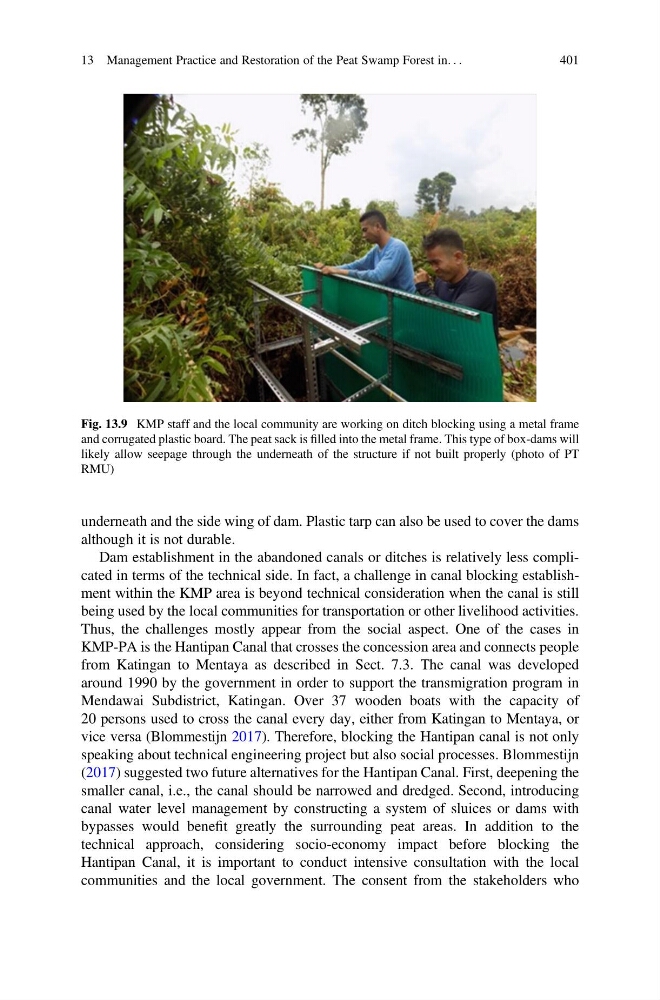
underneath and the side wing of dam. Plastic tarp can also be used to cover the dams
although it is not durable.
Dam establishment in the abandoned canals or ditches is relatively less complicated in terms of the technical side. In fact, a challenge in canal blocking establishment within the KMP area is beyond technical consideration when the canal is still
being used by the local communities for transportation or other livelihood activities.
Thus, the challenges mostly appear from the social aspect. One of the cases in
KMP-PA is the Hantipan Canal that crosses the concession area and connects people
from Katingan to Mentaya as described in Sect. 7.3. The canal was developed
around 1990 by the government in order to support the transmigration program in
Mendawai Subdistrict, Katingan. Over 37 wooden boats with the capacity of
20 persons used to cross the canal every day, either from Katingan to Mentaya, or
vice versa (Blommestijn 2017). Therefore, blocking the Hantipan canal is not only
speaking about technical engineering project but also social processes. Blommestijn
(2017) suggested two future alternatives for the Hantipan Canal. First, deepening the
smaller canal, i.e., the canal should be narrowed and dredged. Second, introducing
canal water level management by constructing a system of sluices or dams with
bypasses would benefit greatly the surrounding peat areas. In addition to the
technical approach, considering socio-economy impact before blocking the
Hantipan Canal, it is important to conduct intensive consultation with the local
communities and the local government. The consent from the stakeholders who
Fig. 13.9 KMP staff and the local community are working on ditch blocking using a metal frame
and corrugated plastic board. The peat sack is filled into the metal frame. This type of box-dams will
likely allow seepage through the underneath of the structure if not built properly (photo of PT
RMU)
13 Management Practice and Restoration of the Peat Swamp Forest in. . .
401
although it is not durable.
Dam establishment in the abandoned canals or ditches is relatively less complicated in terms of the technical side. In fact, a challenge in canal blocking establishment within the KMP area is beyond technical consideration when the canal is still
being used by the local communities for transportation or other livelihood activities.
Thus, the challenges mostly appear from the social aspect. One of the cases in
KMP-PA is the Hantipan Canal that crosses the concession area and connects people
from Katingan to Mentaya as described in Sect. 7.3. The canal was developed
around 1990 by the government in order to support the transmigration program in
Mendawai Subdistrict, Katingan. Over 37 wooden boats with the capacity of
20 persons used to cross the canal every day, either from Katingan to Mentaya, or
vice versa (Blommestijn 2017). Therefore, blocking the Hantipan canal is not only
speaking about technical engineering project but also social processes. Blommestijn
(2017) suggested two future alternatives for the Hantipan Canal. First, deepening the
smaller canal, i.e., the canal should be narrowed and dredged. Second, introducing
canal water level management by constructing a system of sluices or dams with
bypasses would benefit greatly the surrounding peat areas. In addition to the
technical approach, considering socio-economy impact before blocking the
Hantipan Canal, it is important to conduct intensive consultation with the local
communities and the local government. The consent from the stakeholders who
Fig. 13.9 KMP staff and the local community are working on ditch blocking using a metal frame
and corrugated plastic board. The peat sack is filled into the metal frame. This type of box-dams will
likely allow seepage through the underneath of the structure if not built properly (photo of PT
RMU)
13 Management Practice and Restoration of the Peat Swamp Forest in. . .
401