

implemented by blocking the canals and ditches (drainage that has smaller dimension compared to a canal and usually flows to the main canals). Most of the ditches in
KMP are around 1–2 m wide, with only 0.5–0.7 m deep since the original purpose
was only to transport logs out from the forest area.
In KMP-PA, the ditch blocking has started since 2017 and been mostly located in
the southern part of KMP-PA. Up to 2018, 33 dams have been established by the
KMP staff. Based on the materials, there are several types of dams that have been
built in the KMP area, namely wood-based dams (using Melaleuca tree, plank, and
bamboo) and corrugated plastic-based dams (polycarbonate, polyvinyl-chloride
(PVC) sheet), see Fig. 13.9. In the corrugated plastic-based dams, a metal frame to
reinforce the dams is used, instead of wood poles. In terms of design, generally most
of the dams are box-dams (Giesen and Sari 2018). Box-dam could be a wooden,
plastic, or composite structure reinforced with metal or wood poles and filled with
peat or soil in the middle of the structures. Composite structure is the combination of
wood planks and plastic sheet. If possible, we would plant native trees, i.e., pulai
(Alstonia scholaris) on top of the peat. With this box-dam design, the dams were
functioned as weirs instead of blocking the water flow (Ritzema et al. 2014). On the
other hand, although the infilling method could be more effective to block the peat
water, this method is less feasible to be implemented within KMP-PA as it requires
heavy machine for its construction.
Moreover, since the wooden-based dams were less durable, damage wooden
dams were replaced with plastic-based material and metal frame/poles. However,
the dam construction using the corrugated plastic board should be done carefully and
planted deep enough into peat layers as it is more susceptible to seepage through the
0
5
10
15
20
25
30
35
Alstonia scholaris
Melicope lunuankenda
Campnosperma coriaceum
Ficus benyamina
Melaleuca sp.
Syzygium spp.
Tetractomia obovata
Elaeocarpus acmocarpus
Macaranga pruinosa
Antidesma phanerophe
Syzygium campanulatum
Shorea teysmanniana
Sterculia rhoiidifolia
Important value index (scale 0-100)
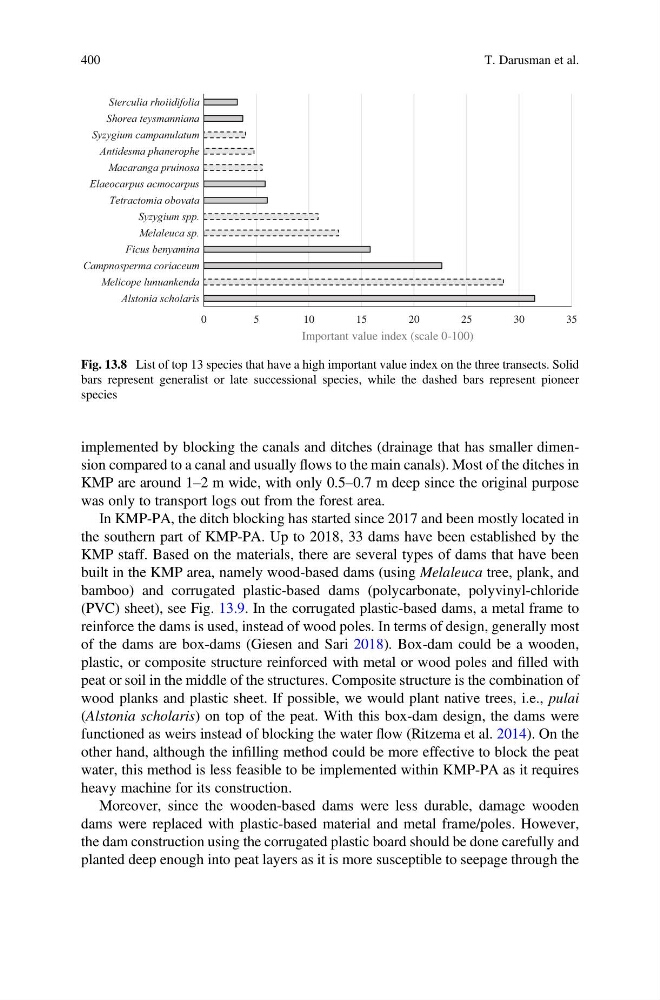
Fig. 13.8 List of top 13 species that have a high important value index on the three transects. Solid
bars represent generalist or late successional species, while the dashed bars represent pioneer
species
400
T. Darusman et al.
KMP are around 1–2 m wide, with only 0.5–0.7 m deep since the original purpose
was only to transport logs out from the forest area.
In KMP-PA, the ditch blocking has started since 2017 and been mostly located in
the southern part of KMP-PA. Up to 2018, 33 dams have been established by the
KMP staff. Based on the materials, there are several types of dams that have been
built in the KMP area, namely wood-based dams (using Melaleuca tree, plank, and
bamboo) and corrugated plastic-based dams (polycarbonate, polyvinyl-chloride
(PVC) sheet), see Fig. 13.9. In the corrugated plastic-based dams, a metal frame to
reinforce the dams is used, instead of wood poles. In terms of design, generally most
of the dams are box-dams (Giesen and Sari 2018). Box-dam could be a wooden,
plastic, or composite structure reinforced with metal or wood poles and filled with
peat or soil in the middle of the structures. Composite structure is the combination of
wood planks and plastic sheet. If possible, we would plant native trees, i.e., pulai
(Alstonia scholaris) on top of the peat. With this box-dam design, the dams were
functioned as weirs instead of blocking the water flow (Ritzema et al. 2014). On the
other hand, although the infilling method could be more effective to block the peat
water, this method is less feasible to be implemented within KMP-PA as it requires
heavy machine for its construction.
Moreover, since the wooden-based dams were less durable, damage wooden
dams were replaced with plastic-based material and metal frame/poles. However,
the dam construction using the corrugated plastic board should be done carefully and
planted deep enough into peat layers as it is more susceptible to seepage through the
0
5
10
15
20
25
30
35
Alstonia scholaris
Melicope lunuankenda
Campnosperma coriaceum
Ficus benyamina
Melaleuca sp.
Syzygium spp.
Tetractomia obovata
Elaeocarpus acmocarpus
Macaranga pruinosa
Antidesma phanerophe
Syzygium campanulatum
Shorea teysmanniana
Sterculia rhoiidifolia
Important value index (scale 0-100)
Fig. 13.8 List of top 13 species that have a high important value index on the three transects. Solid
bars represent generalist or late successional species, while the dashed bars represent pioneer
species
400
T. Darusman et al.