

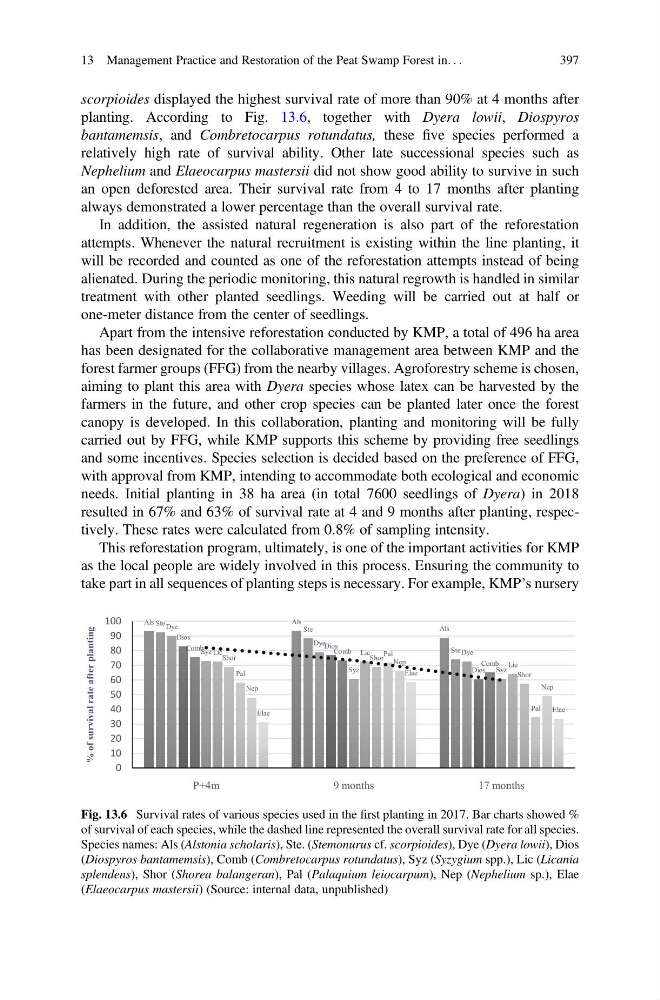
scorpioides displayed the highest survival rate of more than 90% at 4 months after
planting. According to Fig. 13.6, together with Dyera lowii, Diospyros
bantamemsis, and Combretocarpus rotundatus, these five species performed a
relatively high rate of survival ability. Other late successional species such as
Nephelium and Elaeocarpus mastersii did not show good ability to survive in such
an open deforested area. Their survival rate from 4 to 17 months after planting
always demonstrated a lower percentage than the overall survival rate.
In addition, the assisted natural regeneration is also part of the reforestation
attempts. Whenever the natural recruitment is existing within the line planting, it
will be recorded and counted as one of the reforestation attempts instead of being
alienated. During the periodic monitoring, this natural regrowth is handled in similar
treatment with other planted seedlings. Weeding will be carried out at half or
one-meter distance from the center of seedlings.
Apart from the intensive reforestation conducted by KMP, a total of 496 ha area
has been designated for the collaborative management area between KMP and the
forest farmer groups (FFG) from the nearby villages. Agroforestry scheme is chosen,
aiming to plant this area with Dyera species whose latex can be harvested by the
farmers in the future, and other crop species can be planted later once the forest
canopy is developed. In this collaboration, planting and monitoring will be fully
carried out by FFG, while KMP supports this scheme by providing free seedlings
and some incentives. Species selection is decided based on the preference of FFG,
with approval from KMP, intending to accommodate both ecological and economic
needs. Initial planting in 38 ha area (in total 7600 seedlings of Dyera) in 2018
resulted in 67% and 63% of survival rate at 4 and 9 months after planting, respectively. These rates were calculated from 0.8% of sampling intensity.
This reforestation program, ultimately, is one of the important activities for KMP
as the local people are widely involved in this process. Ensuring the community to
take part in all sequences of planting steps is necessary. For example, KMP’s nursery
Als
Als
Als
Ste
Ste
Ste
Dye
Dye
Dye
Dios
Dios
Dios
Comb
Comb
Comb
Syz
Syz
Syz
Lic
Lic
Lic
Shor
Shor
Shor
Pal
Pal
Pal
Nep
Nep
Nep
Elae
Elae
Elae
0
10
20
30
40
50
60
70
80
90
100
P+4m
9 months
17 months
% of survival rate after planting
Fig. 13.6 Survival rates of various species used in the first planting in 2017. Bar charts showed %
of survival of each species, while the dashed line represented the overall survival rate for all species.
Species names: Als (Alstonia scholaris), Ste. (Stemonurus cf. scorpioides), Dye (Dyera lowii), Dios
(Diospyros bantamemsis), Comb (Combretocarpus rotundatus), Syz (Syzygium spp.), Lic (Licania
splendens), Shor (Shorea balangeran), Pal (Palaquium leiocarpum), Nep (Nephelium sp.), Elae
(Elaeocarpus mastersii) (Source: internal data, unpublished)
13 Management Practice and Restoration of the Peat Swamp Forest in. . .
397
planting. According to Fig. 13.6, together with Dyera lowii, Diospyros
bantamemsis, and Combretocarpus rotundatus, these five species performed a
relatively high rate of survival ability. Other late successional species such as
Nephelium and Elaeocarpus mastersii did not show good ability to survive in such
an open deforested area. Their survival rate from 4 to 17 months after planting
always demonstrated a lower percentage than the overall survival rate.
In addition, the assisted natural regeneration is also part of the reforestation
attempts. Whenever the natural recruitment is existing within the line planting, it
will be recorded and counted as one of the reforestation attempts instead of being
alienated. During the periodic monitoring, this natural regrowth is handled in similar
treatment with other planted seedlings. Weeding will be carried out at half or
one-meter distance from the center of seedlings.
Apart from the intensive reforestation conducted by KMP, a total of 496 ha area
has been designated for the collaborative management area between KMP and the
forest farmer groups (FFG) from the nearby villages. Agroforestry scheme is chosen,
aiming to plant this area with Dyera species whose latex can be harvested by the
farmers in the future, and other crop species can be planted later once the forest
canopy is developed. In this collaboration, planting and monitoring will be fully
carried out by FFG, while KMP supports this scheme by providing free seedlings
and some incentives. Species selection is decided based on the preference of FFG,
with approval from KMP, intending to accommodate both ecological and economic
needs. Initial planting in 38 ha area (in total 7600 seedlings of Dyera) in 2018
resulted in 67% and 63% of survival rate at 4 and 9 months after planting, respectively. These rates were calculated from 0.8% of sampling intensity.
This reforestation program, ultimately, is one of the important activities for KMP
as the local people are widely involved in this process. Ensuring the community to
take part in all sequences of planting steps is necessary. For example, KMP’s nursery
Als
Als
Als
Ste
Ste
Ste
Dye
Dye
Dye
Dios
Dios
Dios
Comb
Comb
Comb
Syz
Syz
Syz
Lic
Lic
Lic
Shor
Shor
Shor
Pal
Pal
Pal
Nep
Nep
Nep
Elae
Elae
Elae
0
10
20
30
40
50
60
70
80
90
100
P+4m
9 months
17 months
% of survival rate after planting
Fig. 13.6 Survival rates of various species used in the first planting in 2017. Bar charts showed %
of survival of each species, while the dashed line represented the overall survival rate for all species.
Species names: Als (Alstonia scholaris), Ste. (Stemonurus cf. scorpioides), Dye (Dyera lowii), Dios
(Diospyros bantamemsis), Comb (Combretocarpus rotundatus), Syz (Syzygium spp.), Lic (Licania
splendens), Shor (Shorea balangeran), Pal (Palaquium leiocarpum), Nep (Nephelium sp.), Elae
(Elaeocarpus mastersii) (Source: internal data, unpublished)
13 Management Practice and Restoration of the Peat Swamp Forest in. . .
397