

ability to produce continuous regeneration once planted in the field should become
the main concern rather than the diversity in the use of seedling species (Hapsari
et al. 2018). It is supported by Chazdon (2008) that forest colonization is the first
need to be addressed to ensure that forest succession can move to the next stage.
In regard to this, species used for the reforestation in KMP are dominated by the
species that are not only able to survive in a harsh degraded peat environment, but
also believed to be able to regenerate after planting, to quickly commence stand
initiation (such as Syzygium spp., Alstonia, and Combretocarpus). On the other
hand, at the smaller portion, other species (mostly late successional species that
have economic values and sources of diet for orangutan) are also used to add
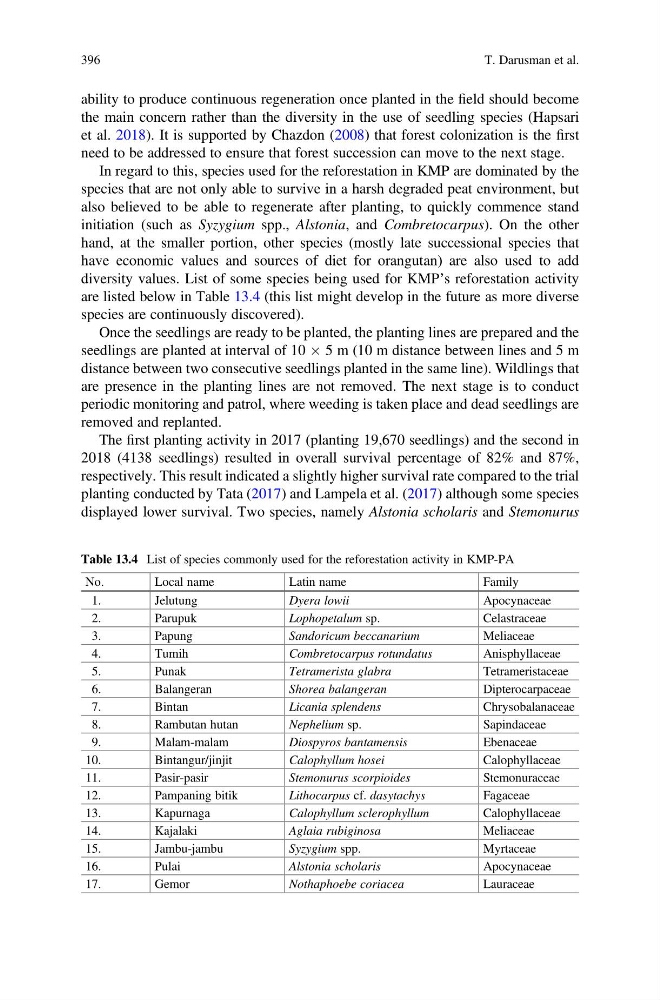
diversity values. List of some species being used for KMP’s reforestation activity
are listed below in Table 13.4 (this list might develop in the future as more diverse
species are continuously discovered).
Once the seedlings are ready to be planted, the planting lines are prepared and the
seedlings are planted at interval of 10 Â 5 m (10 m distance between lines and 5 m
distance between two consecutive seedlings planted in the same line). Wildlings that
are presence in the planting lines are not removed. The next stage is to conduct
periodic monitoring and patrol, where weeding is taken place and dead seedlings are
removed and replanted.
The first planting activity in 2017 (planting 19,670 seedlings) and the second in
2018 (4138 seedlings) resulted in overall survival percentage of 82% and 87%,
respectively. This result indicated a slightly higher survival rate compared to the trial
planting conducted by Tata (2017) and Lampela et al. (2017) although some species
displayed lower survival. Two species, namely Alstonia scholaris and Stemonurus
Table 13.4 List of species commonly used for the reforestation activity in KMP-PA
No.
Local name
Latin name
Family
1.
Jelutung
Dyera lowii
Apocynaceae
2.
Parupuk
Lophopetalum sp.
Celastraceae
3.
Papung
Sandoricum beccanarium
Meliaceae
4.
Tumih
Combretocarpus rotundatus
Anisphyllaceae
5.
Punak
Tetramerista glabra
Tetrameristaceae
6.
Balangeran
Shorea balangeran
Dipterocarpaceae
7.
Bintan
Licania splendens
Chrysobalanaceae
8.
Rambutan hutan
Nephelium sp.
Sapindaceae
9.
Malam-malam
Diospyros bantamensis
Ebenaceae
10.
Bintangur/jinjit
Calophyllum hosei
Calophyllaceae
11.
Pasir-pasir
Stemonurus scorpioides
Stemonuraceae
12.
Pampaning bitik
Lithocarpus cf. dasytachys
Fagaceae
13.
Kapurnaga
Calophyllum sclerophyllum
Calophyllaceae
14.
Kajalaki
Aglaia rubiginosa
Meliaceae
15.
Jambu-jambu
Syzygium spp.
Myrtaceae
16.
Pulai
Alstonia scholaris
Apocynaceae
17.
Gemor
Nothaphoebe coriacea
Lauraceae
396
T. Darusman et al.
the main concern rather than the diversity in the use of seedling species (Hapsari
et al. 2018). It is supported by Chazdon (2008) that forest colonization is the first
need to be addressed to ensure that forest succession can move to the next stage.
In regard to this, species used for the reforestation in KMP are dominated by the
species that are not only able to survive in a harsh degraded peat environment, but
also believed to be able to regenerate after planting, to quickly commence stand
initiation (such as Syzygium spp., Alstonia, and Combretocarpus). On the other
hand, at the smaller portion, other species (mostly late successional species that
have economic values and sources of diet for orangutan) are also used to add
diversity values. List of some species being used for KMP’s reforestation activity
are listed below in Table 13.4 (this list might develop in the future as more diverse
species are continuously discovered).
Once the seedlings are ready to be planted, the planting lines are prepared and the
seedlings are planted at interval of 10 Â 5 m (10 m distance between lines and 5 m
distance between two consecutive seedlings planted in the same line). Wildlings that
are presence in the planting lines are not removed. The next stage is to conduct
periodic monitoring and patrol, where weeding is taken place and dead seedlings are
removed and replanted.
The first planting activity in 2017 (planting 19,670 seedlings) and the second in
2018 (4138 seedlings) resulted in overall survival percentage of 82% and 87%,
respectively. This result indicated a slightly higher survival rate compared to the trial
planting conducted by Tata (2017) and Lampela et al. (2017) although some species
displayed lower survival. Two species, namely Alstonia scholaris and Stemonurus
Table 13.4 List of species commonly used for the reforestation activity in KMP-PA
No.
Local name
Latin name
Family
1.
Jelutung
Dyera lowii
Apocynaceae
2.
Parupuk
Lophopetalum sp.
Celastraceae
3.
Papung
Sandoricum beccanarium
Meliaceae
4.
Tumih
Combretocarpus rotundatus
Anisphyllaceae
5.
Punak
Tetramerista glabra
Tetrameristaceae
6.
Balangeran
Shorea balangeran
Dipterocarpaceae
7.
Bintan
Licania splendens
Chrysobalanaceae
8.
Rambutan hutan
Nephelium sp.
Sapindaceae
9.
Malam-malam
Diospyros bantamensis
Ebenaceae
10.
Bintangur/jinjit
Calophyllum hosei
Calophyllaceae
11.
Pasir-pasir
Stemonurus scorpioides
Stemonuraceae
12.
Pampaning bitik
Lithocarpus cf. dasytachys
Fagaceae
13.
Kapurnaga
Calophyllum sclerophyllum
Calophyllaceae
14.
Kajalaki
Aglaia rubiginosa
Meliaceae
15.
Jambu-jambu
Syzygium spp.
Myrtaceae
16.
Pulai
Alstonia scholaris
Apocynaceae
17.
Gemor
Nothaphoebe coriacea
Lauraceae
396
T. Darusman et al.