

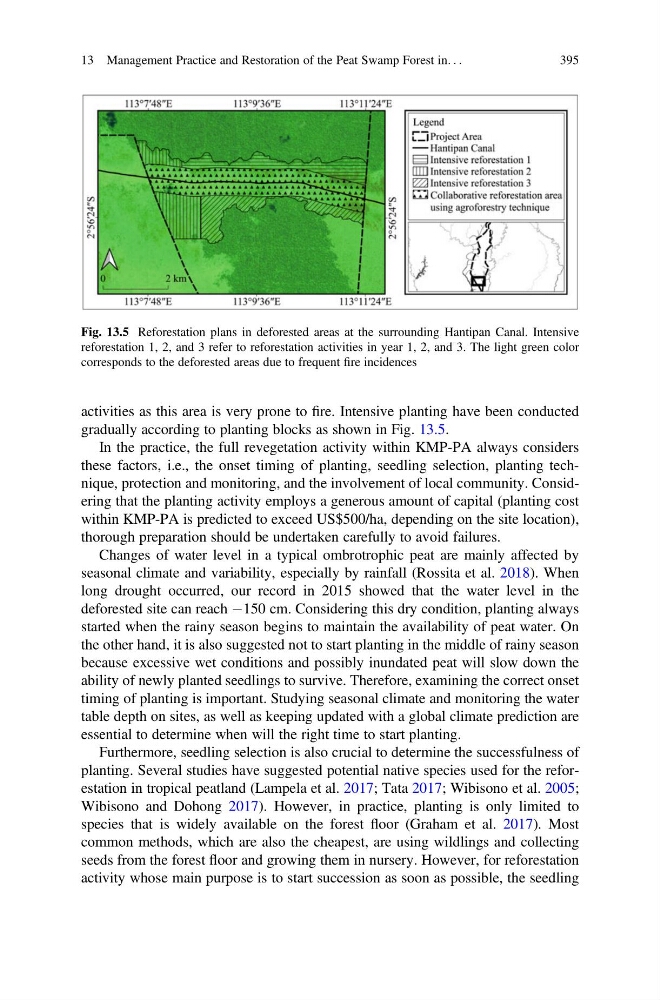
activities as this area is very prone to fire. Intensive planting have been conducted
gradually according to planting blocks as shown in Fig. 13.5.
In the practice, the full revegetation activity within KMP-PA always considers
these factors, i.e., the onset timing of planting, seedling selection, planting technique, protection and monitoring, and the involvement of local community. Considering that the planting activity employs a generous amount of capital (planting cost
within KMP-PA is predicted to exceed US$500/ha, depending on the site location),
thorough preparation should be undertaken carefully to avoid failures.
Changes of water level in a typical ombrotrophic peat are mainly affected by
seasonal climate and variability, especially by rainfall (Rossita et al. 2018). When
long drought occurred, our record in 2015 showed that the water level in the
deforested site can reach À150 cm. Considering this dry condition, planting always
started when the rainy season begins to maintain the availability of peat water. On
the other hand, it is also suggested not to start planting in the middle of rainy season
because excessive wet conditions and possibly inundated peat will slow down the
ability of newly planted seedlings to survive. Therefore, examining the correct onset
timing of planting is important. Studying seasonal climate and monitoring the water
table depth on sites, as well as keeping updated with a global climate prediction are
essential to determine when will the right time to start planting.
Furthermore, seedling selection is also crucial to determine the successfulness of
planting. Several studies have suggested potential native species used for the reforestation in tropical peatland (Lampela et al. 2017; Tata 2017; Wibisono et al. 2005;
Wibisono and Dohong 2017). However, in practice, planting is only limited to
species that is widely available on the forest floor (Graham et al. 2017). Most
common methods, which are also the cheapest, are using wildlings and collecting
seeds from the forest floor and growing them in nursery. However, for reforestation
activity whose main purpose is to start succession as soon as possible, the seedling
Fig. 13.5 Reforestation plans in deforested areas at the surrounding Hantipan Canal. Intensive
reforestation 1, 2, and 3 refer to reforestation activities in year 1, 2, and 3. The light green color
corresponds to the deforested areas due to frequent fire incidences
13 Management Practice and Restoration of the Peat Swamp Forest in. . .
395
gradually according to planting blocks as shown in Fig. 13.5.
In the practice, the full revegetation activity within KMP-PA always considers
these factors, i.e., the onset timing of planting, seedling selection, planting technique, protection and monitoring, and the involvement of local community. Considering that the planting activity employs a generous amount of capital (planting cost
within KMP-PA is predicted to exceed US$500/ha, depending on the site location),
thorough preparation should be undertaken carefully to avoid failures.
Changes of water level in a typical ombrotrophic peat are mainly affected by
seasonal climate and variability, especially by rainfall (Rossita et al. 2018). When
long drought occurred, our record in 2015 showed that the water level in the
deforested site can reach À150 cm. Considering this dry condition, planting always
started when the rainy season begins to maintain the availability of peat water. On
the other hand, it is also suggested not to start planting in the middle of rainy season
because excessive wet conditions and possibly inundated peat will slow down the
ability of newly planted seedlings to survive. Therefore, examining the correct onset
timing of planting is important. Studying seasonal climate and monitoring the water
table depth on sites, as well as keeping updated with a global climate prediction are
essential to determine when will the right time to start planting.
Furthermore, seedling selection is also crucial to determine the successfulness of
planting. Several studies have suggested potential native species used for the reforestation in tropical peatland (Lampela et al. 2017; Tata 2017; Wibisono et al. 2005;
Wibisono and Dohong 2017). However, in practice, planting is only limited to
species that is widely available on the forest floor (Graham et al. 2017). Most
common methods, which are also the cheapest, are using wildlings and collecting
seeds from the forest floor and growing them in nursery. However, for reforestation
activity whose main purpose is to start succession as soon as possible, the seedling
Fig. 13.5 Reforestation plans in deforested areas at the surrounding Hantipan Canal. Intensive
reforestation 1, 2, and 3 refer to reforestation activities in year 1, 2, and 3. The light green color
corresponds to the deforested areas due to frequent fire incidences
13 Management Practice and Restoration of the Peat Swamp Forest in. . .
395