

does not only collect seeds and seedlings from the forest, but also trains the local
people to establish what so-called a village nursery. Every year, KMP will buy the
seedlings from these village nurseries and use them for the reforestation program
(accounting for more than 28% per year from the total seedlings used for the
reforestation and can potentially increase). Recently, the local people also create
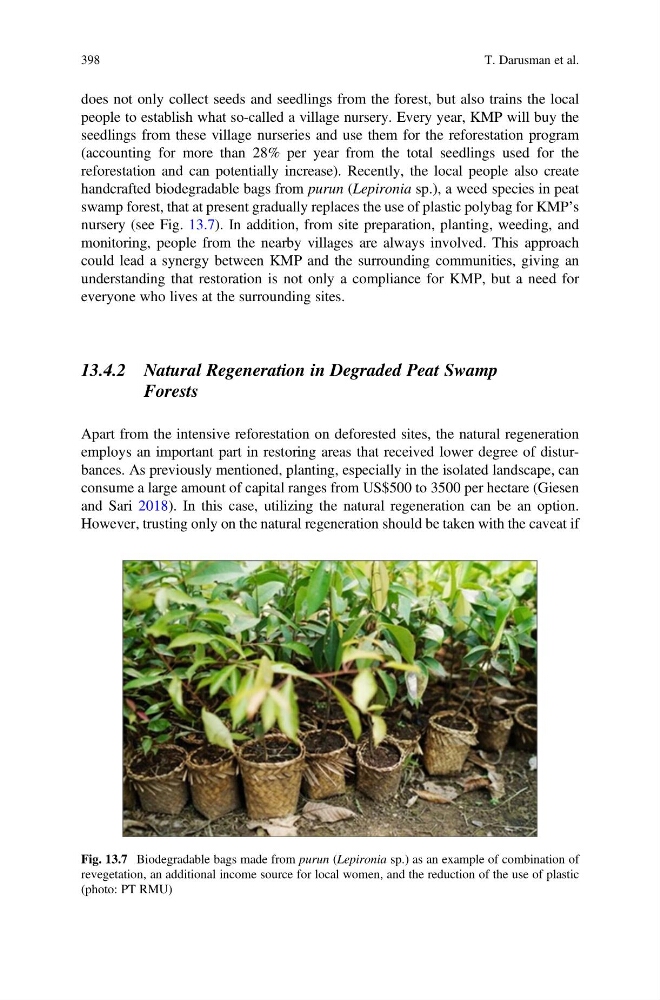
handcrafted biodegradable bags from purun (Lepironia sp.), a weed species in peat
swamp forest, that at present gradually replaces the use of plastic polybag for KMP’s
nursery (see Fig. 13.7). In addition, from site preparation, planting, weeding, and
monitoring, people from the nearby villages are always involved. This approach
could lead a synergy between KMP and the surrounding communities, giving an
understanding that restoration is not only a compliance for KMP, but a need for
everyone who lives at the surrounding sites.
13.4.2 Natural Regeneration in Degraded Peat Swamp
Forests
Apart from the intensive reforestation on deforested sites, the natural regeneration
employs an important part in restoring areas that received lower degree of disturbances. As previously mentioned, planting, especially in the isolated landscape, can
consume a large amount of capital ranges from US$500 to 3500 per hectare (Giesen
and Sari 2018). In this case, utilizing the natural regeneration can be an option.
However, trusting only on the natural regeneration should be taken with the caveat if
Fig. 13.7 Biodegradable bags made from purun (Lepironia sp.) as an example of combination of
revegetation, an additional income source for local women, and the reduction of the use of plastic
(photo: PT RMU)
398
T. Darusman et al.
people to establish what so-called a village nursery. Every year, KMP will buy the
seedlings from these village nurseries and use them for the reforestation program
(accounting for more than 28% per year from the total seedlings used for the
reforestation and can potentially increase). Recently, the local people also create
handcrafted biodegradable bags from purun (Lepironia sp.), a weed species in peat
swamp forest, that at present gradually replaces the use of plastic polybag for KMP’s
nursery (see Fig. 13.7). In addition, from site preparation, planting, weeding, and
monitoring, people from the nearby villages are always involved. This approach
could lead a synergy between KMP and the surrounding communities, giving an
understanding that restoration is not only a compliance for KMP, but a need for
everyone who lives at the surrounding sites.
13.4.2 Natural Regeneration in Degraded Peat Swamp
Forests
Apart from the intensive reforestation on deforested sites, the natural regeneration
employs an important part in restoring areas that received lower degree of disturbances. As previously mentioned, planting, especially in the isolated landscape, can
consume a large amount of capital ranges from US$500 to 3500 per hectare (Giesen
and Sari 2018). In this case, utilizing the natural regeneration can be an option.
However, trusting only on the natural regeneration should be taken with the caveat if
Fig. 13.7 Biodegradable bags made from purun (Lepironia sp.) as an example of combination of
revegetation, an additional income source for local women, and the reduction of the use of plastic
(photo: PT RMU)
398
T. Darusman et al.