

10.4 Exopolysaccharide-Producing Microbes for Peat
Aggregate
The microbe functions on soil aggregation have been studied that certain fungi such
as Aspergillus sp. and Penicillium sp. promote soil particle aggregate via mycelial
wrapping mechanism (Goenadi 2017; Santi 2014). Burkholderia cenocepacia, an
extra-polysaccharide-producing bacterium, improves soil aggregate and water holding capacity (Tables 10.2) (Santi 2014). It is hypothesized that the polysaccharides
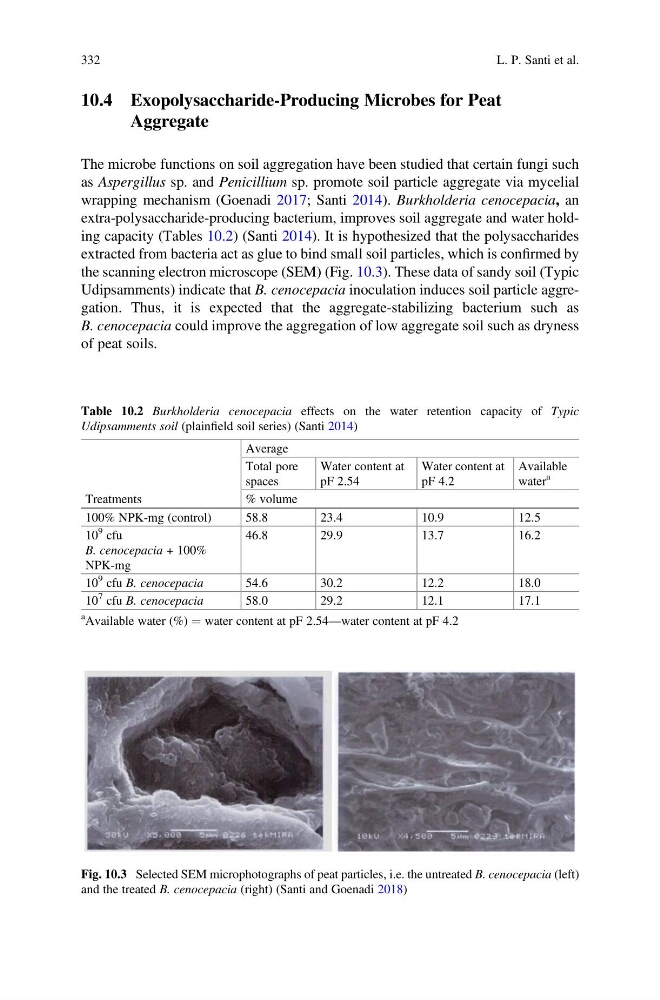
extracted from bacteria act as glue to bind small soil particles, which is confirmed by
the scanning electron microscope (SEM) (Fig. 10.3). These data of sandy soil (Typic
Udipsamments) indicate that B. cenocepacia inoculation induces soil particle aggregation. Thus, it is expected that the aggregate-stabilizing bacterium such as
B. cenocepacia could improve the aggregation of low aggregate soil such as dryness
of peat soils.
Table 10.2 Burkholderia cenocepacia effects on the water retention capacity of Typic
Udipsamments soil (plainfield soil series) (Santi 2014)
Treatments
Average
Total pore
spaces
Water content at
pF 2.54
Water content at
pF 4.2
Available
water
a
% volume
100% NPK-mg (control)
58.8
23.4
10.9
12.5
10
9 cfu
B. cenocepacia + 100%
NPK-mg
46.8
29.9
13.7
16.2
10
9 cfu B. cenocepacia
54.6
30.2
12.2
18.0
10
7 cfu B. cenocepacia
58.0
29.2
12.1
17.1
a Available water (%) ¼ water content at pF 2.54—water content at pF 4.2
Fig. 10.3 Selected SEM microphotographs of peat particles, i.e. the untreated B. cenocepacia (left)
and the treated B. cenocepacia (right) (Santi and Goenadi 2018)
332
L. P. Santi et al.
Aggregate
The microbe functions on soil aggregation have been studied that certain fungi such
as Aspergillus sp. and Penicillium sp. promote soil particle aggregate via mycelial
wrapping mechanism (Goenadi 2017; Santi 2014). Burkholderia cenocepacia, an
extra-polysaccharide-producing bacterium, improves soil aggregate and water holding capacity (Tables 10.2) (Santi 2014). It is hypothesized that the polysaccharides
extracted from bacteria act as glue to bind small soil particles, which is confirmed by
the scanning electron microscope (SEM) (Fig. 10.3). These data of sandy soil (Typic
Udipsamments) indicate that B. cenocepacia inoculation induces soil particle aggregation. Thus, it is expected that the aggregate-stabilizing bacterium such as
B. cenocepacia could improve the aggregation of low aggregate soil such as dryness
of peat soils.
Table 10.2 Burkholderia cenocepacia effects on the water retention capacity of Typic
Udipsamments soil (plainfield soil series) (Santi 2014)
Treatments
Average
Total pore
spaces
Water content at
pF 2.54
Water content at
pF 4.2
Available
water
a
% volume
100% NPK-mg (control)
58.8
23.4
10.9
12.5
10
9 cfu
B. cenocepacia + 100%
NPK-mg
46.8
29.9
13.7
16.2
10
9 cfu B. cenocepacia
54.6
30.2
12.2
18.0
10
7 cfu B. cenocepacia
58.0
29.2
12.1
17.1
a Available water (%) ¼ water content at pF 2.54—water content at pF 4.2
Fig. 10.3 Selected SEM microphotographs of peat particles, i.e. the untreated B. cenocepacia (left)
and the treated B. cenocepacia (right) (Santi and Goenadi 2018)
332
L. P. Santi et al.