

10.5 Zeolites Function on Aggregate-Stabilizing Microbes
in Peat Soils
Information on the effects of natural zeolites and aggregate-stabilizing microbes is
very limited in peat soils. Our studies provide prospective data to the use of natural
zeolites in peatland, particularly in the oil palm plantations. However, we have been
developing a specific Bayah zeolite as a carrier of some superior microbial isolation
such as B. cenocepacia for aggregate-stabilizing bacterium, and Trichoderma
polysporum for root-disease antagonist, and Pseudomonas fluorescents for humic
substances enrichment, which is called as a bio-enriched Bayah zeolite or a zeo-bio
technology. The bio-enriched Bayah zeolite improves water-related soil properties
and carbon sequestration in peatland (Santi et al. 2011; Santi and Goenadi 2013;
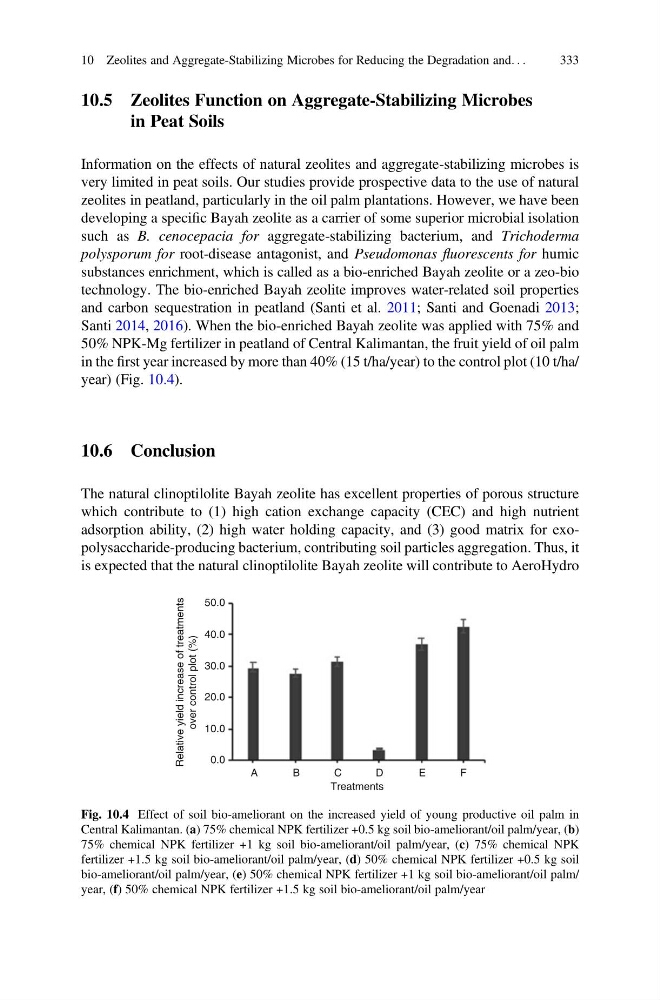
Santi 2014, 2016). When the bio-enriched Bayah zeolite was applied with 75% and
50% NPK-Mg fertilizer in peatland of Central Kalimantan, the fruit yield of oil palm
in the first year increased by more than 40% (15 t/ha/year) to the control plot (10 t/ha/
year) (Fig. 10.4).
10.6 Conclusion
The natural clinoptilolite Bayah zeolite has excellent properties of porous structure
which contribute to (1) high cation exchange capacity (CEC) and high nutrient
adsorption ability, (2) high water holding capacity, and (3) good matrix for exopolysaccharide-producing bacterium, contributing soil particles aggregation. Thus, it
is expected that the natural clinoptilolite Bayah zeolite will contribute to AeroHydro
50.0
40.0
30.0
20.0
10.0
Relative yield increase of treatments
over control plot (%)
0.0
A
B
C
Treatments
D
E
F
Fig. 10.4 Effect of soil bio-ameliorant on the increased yield of young productive oil palm in
Central Kalimantan. (a) 75% chemical NPK fertilizer +0.5 kg soil bio-ameliorant/oil palm/year, (b)
75% chemical NPK fertilizer +1 kg soil bio-ameliorant/oil palm/year, (c) 75% chemical NPK
fertilizer +1.5 kg soil bio-ameliorant/oil palm/year, (d) 50% chemical NPK fertilizer +0.5 kg soil
bio-ameliorant/oil palm/year, (e) 50% chemical NPK fertilizer +1 kg soil bio-ameliorant/oil palm/
year, (f) 50% chemical NPK fertilizer +1.5 kg soil bio-ameliorant/oil palm/year
10 Zeolites and Aggregate-Stabilizing Microbes for Reducing the Degradation and. . .
333
in Peat Soils
Information on the effects of natural zeolites and aggregate-stabilizing microbes is
very limited in peat soils. Our studies provide prospective data to the use of natural
zeolites in peatland, particularly in the oil palm plantations. However, we have been
developing a specific Bayah zeolite as a carrier of some superior microbial isolation
such as B. cenocepacia for aggregate-stabilizing bacterium, and Trichoderma
polysporum for root-disease antagonist, and Pseudomonas fluorescents for humic
substances enrichment, which is called as a bio-enriched Bayah zeolite or a zeo-bio
technology. The bio-enriched Bayah zeolite improves water-related soil properties
and carbon sequestration in peatland (Santi et al. 2011; Santi and Goenadi 2013;
Santi 2014, 2016). When the bio-enriched Bayah zeolite was applied with 75% and
50% NPK-Mg fertilizer in peatland of Central Kalimantan, the fruit yield of oil palm
in the first year increased by more than 40% (15 t/ha/year) to the control plot (10 t/ha/
year) (Fig. 10.4).
10.6 Conclusion
The natural clinoptilolite Bayah zeolite has excellent properties of porous structure
which contribute to (1) high cation exchange capacity (CEC) and high nutrient
adsorption ability, (2) high water holding capacity, and (3) good matrix for exopolysaccharide-producing bacterium, contributing soil particles aggregation. Thus, it
is expected that the natural clinoptilolite Bayah zeolite will contribute to AeroHydro
50.0
40.0
30.0
20.0
10.0
Relative yield increase of treatments
over control plot (%)
0.0
A
B
C
Treatments
D
E
F
Fig. 10.4 Effect of soil bio-ameliorant on the increased yield of young productive oil palm in
Central Kalimantan. (a) 75% chemical NPK fertilizer +0.5 kg soil bio-ameliorant/oil palm/year, (b)
75% chemical NPK fertilizer +1 kg soil bio-ameliorant/oil palm/year, (c) 75% chemical NPK
fertilizer +1.5 kg soil bio-ameliorant/oil palm/year, (d) 50% chemical NPK fertilizer +0.5 kg soil
bio-ameliorant/oil palm/year, (e) 50% chemical NPK fertilizer +1 kg soil bio-ameliorant/oil palm/
year, (f) 50% chemical NPK fertilizer +1.5 kg soil bio-ameliorant/oil palm/year
10 Zeolites and Aggregate-Stabilizing Microbes for Reducing the Degradation and. . .
333