

of cattle or chicken are applied. Water is sprinkled to keep high moisture. This piling
process should repeat until the pile is about 1.5 m high. This piling windrow is
covered by black plastic film.
The temperature of the compost pile is monitored by inserting a thermometer. In
general, the temperature reaches 60–70
C after 7–10 days of incubation. When the
temperature is started to decrease, the pile (compost) should be turned back. Aeration
of the composting pile is achieved by frequent turning back. Sometimes the temperature of the composting is used as a turning back indicator so that the piling
windrows are overturned when a certain temperature range (usually 55–60
C) is
reached (Kumar 2011). The height, width, and length of piling windrows depend on
the nature of the input material and the type of equipment used for turning back. The
mature compost can be achieved after 2 times turning back and mixing, and it needs
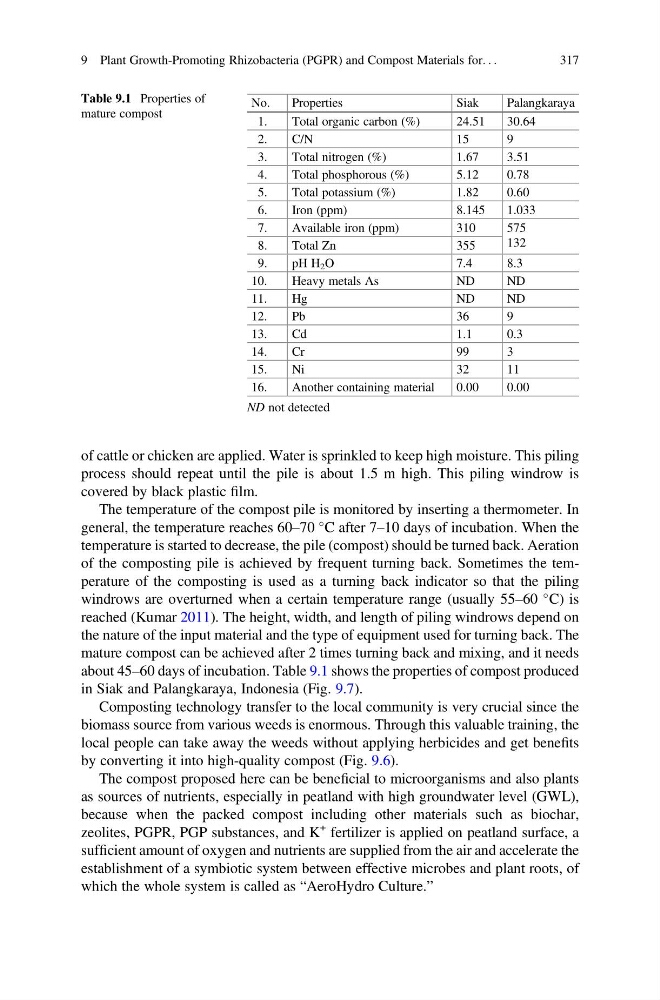
about 45–60 days of incubation. Table 9.1 shows the properties of compost produced
in Siak and Palangkaraya, Indonesia (Fig. 9.7).
Composting technology transfer to the local community is very crucial since the
biomass source from various weeds is enormous. Through this valuable training, the
local people can take away the weeds without applying herbicides and get benefits
by converting it into high-quality compost (Fig. 9.6).
The compost proposed here can be beneficial to microorganisms and also plants
as sources of nutrients, especially in peatland with high groundwater level (GWL),
because when the packed compost including other materials such as biochar,
zeolites, PGPR, PGP substances, and K
+ fertilizer is applied on peatland surface, a
sufficient amount of oxygen and nutrients are supplied from the air and accelerate the
establishment of a symbiotic system between effective microbes and plant roots, of
which the whole system is called as “AeroHydro Culture.”
Table 9.1 Properties of
mature compost
No.
Properties
Siak
Palangkaraya
1.
Total organic carbon (%)
24.51
30.64
2.
C/N
15
9
3.
Total nitrogen (%)
1.67
3.51
4.
Total phosphorous (%)
5.12
0.78
5.
Total potassium (%)
1.82
0.60
6.
Iron (ppm)
8.145
1.033
7.
Available iron (ppm)
310
575
132
8.
Total Zn
355
9.
pH H 2 O
7.4
8.3
10.
Heavy metals As
ND
ND
11.
Hg
ND
ND
12.
Pb
36
9
13.
Cd
1.1
0.3
14.
Cr
99
3
15.
Ni
32
11
16.
Another containing material
0.00
0.00
ND not detected
9 Plant Growth-Promoting Rhizobacteria (PGPR) and Compost Materials for. . .
317
process should repeat until the pile is about 1.5 m high. This piling windrow is
covered by black plastic film.
The temperature of the compost pile is monitored by inserting a thermometer. In
general, the temperature reaches 60–70
C after 7–10 days of incubation. When the
temperature is started to decrease, the pile (compost) should be turned back. Aeration
of the composting pile is achieved by frequent turning back. Sometimes the temperature of the composting is used as a turning back indicator so that the piling
windrows are overturned when a certain temperature range (usually 55–60
C) is
reached (Kumar 2011). The height, width, and length of piling windrows depend on
the nature of the input material and the type of equipment used for turning back. The
mature compost can be achieved after 2 times turning back and mixing, and it needs
about 45–60 days of incubation. Table 9.1 shows the properties of compost produced
in Siak and Palangkaraya, Indonesia (Fig. 9.7).
Composting technology transfer to the local community is very crucial since the
biomass source from various weeds is enormous. Through this valuable training, the
local people can take away the weeds without applying herbicides and get benefits
by converting it into high-quality compost (Fig. 9.6).
The compost proposed here can be beneficial to microorganisms and also plants
as sources of nutrients, especially in peatland with high groundwater level (GWL),
because when the packed compost including other materials such as biochar,
zeolites, PGPR, PGP substances, and K
+ fertilizer is applied on peatland surface, a
sufficient amount of oxygen and nutrients are supplied from the air and accelerate the
establishment of a symbiotic system between effective microbes and plant roots, of
which the whole system is called as “AeroHydro Culture.”
Table 9.1 Properties of
mature compost
No.
Properties
Siak
Palangkaraya
1.
Total organic carbon (%)
24.51
30.64
2.
C/N
15
9
3.
Total nitrogen (%)
1.67
3.51
4.
Total phosphorous (%)
5.12
0.78
5.
Total potassium (%)
1.82
0.60
6.
Iron (ppm)
8.145
1.033
7.
Available iron (ppm)
310
575
132
8.
Total Zn
355
9.
pH H 2 O
7.4
8.3
10.
Heavy metals As
ND
ND
11.
Hg
ND
ND
12.
Pb
36
9
13.
Cd
1.1
0.3
14.
Cr
99
3
15.
Ni
32
11
16.
Another containing material
0.00
0.00
ND not detected
9 Plant Growth-Promoting Rhizobacteria (PGPR) and Compost Materials for. . .
317