

inoculation of decomposer culture plays dominant roles to decompose organic
matters (Wu et al. 2020).
Many varieties of weeds, tree pruning, shrubs, and litter are growing in the
cultivated peatland, which is a good organic material. The organic waste, for
example, agro-waste and livestock waste (manure), is also useful. The animal
waste, especially from the ruminants, is a source of N because urine is usually
mixed with it. Chicken manure also contains a lot of N and P, according to the feed
given. As composting is a natural process, the fermentation of organic matters occurs
naturally by the role of bacteria, fungi, and other microorganisms. However, to
accelerate biodegradability, it is better to inoculate several functional species of
decomposer microbes into compost heaps, improving the transformation of nitrogen,
humification levels, and compost maturity (Wan et al. 2019).
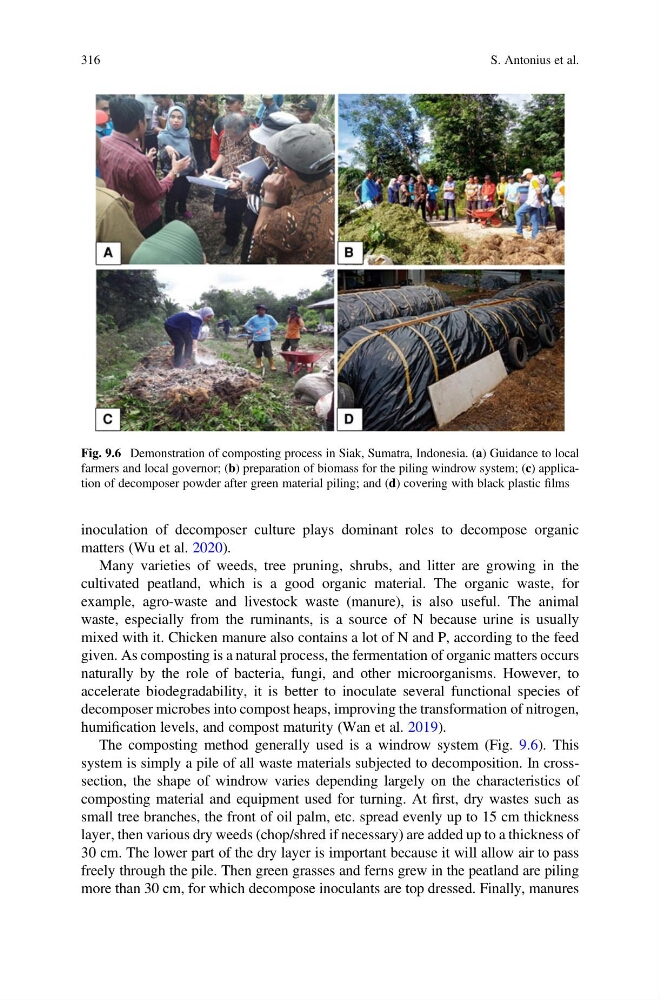
The composting method generally used is a windrow system (Fig. 9.6). This
system is simply a pile of all waste materials subjected to decomposition. In crosssection, the shape of windrow varies depending largely on the characteristics of
composting material and equipment used for turning. At first, dry wastes such as
small tree branches, the front of oil palm, etc. spread evenly up to 15 cm thickness
layer, then various dry weeds (chop/shred if necessary) are added up to a thickness of
30 cm. The lower part of the dry layer is important because it will allow air to pass
freely through the pile. Then green grasses and ferns grew in the peatland are piling
more than 30 cm, for which decompose inoculants are top dressed. Finally, manures
Fig. 9.6 Demonstration of composting process in Siak, Sumatra, Indonesia. (a) Guidance to local
farmers and local governor; (b) preparation of biomass for the piling windrow system; (c) application of decomposer powder after green material piling; and (d) covering with black plastic films
316
S. Antonius et al.
matters (Wu et al. 2020).
Many varieties of weeds, tree pruning, shrubs, and litter are growing in the
cultivated peatland, which is a good organic material. The organic waste, for
example, agro-waste and livestock waste (manure), is also useful. The animal
waste, especially from the ruminants, is a source of N because urine is usually
mixed with it. Chicken manure also contains a lot of N and P, according to the feed
given. As composting is a natural process, the fermentation of organic matters occurs
naturally by the role of bacteria, fungi, and other microorganisms. However, to
accelerate biodegradability, it is better to inoculate several functional species of
decomposer microbes into compost heaps, improving the transformation of nitrogen,
humification levels, and compost maturity (Wan et al. 2019).
The composting method generally used is a windrow system (Fig. 9.6). This
system is simply a pile of all waste materials subjected to decomposition. In crosssection, the shape of windrow varies depending largely on the characteristics of
composting material and equipment used for turning. At first, dry wastes such as
small tree branches, the front of oil palm, etc. spread evenly up to 15 cm thickness
layer, then various dry weeds (chop/shred if necessary) are added up to a thickness of
30 cm. The lower part of the dry layer is important because it will allow air to pass
freely through the pile. Then green grasses and ferns grew in the peatland are piling
more than 30 cm, for which decompose inoculants are top dressed. Finally, manures
Fig. 9.6 Demonstration of composting process in Siak, Sumatra, Indonesia. (a) Guidance to local
farmers and local governor; (b) preparation of biomass for the piling windrow system; (c) application of decomposer powder after green material piling; and (d) covering with black plastic films
316
S. Antonius et al.