

growth regulator secretion, because of focus on increasing agricultural production.
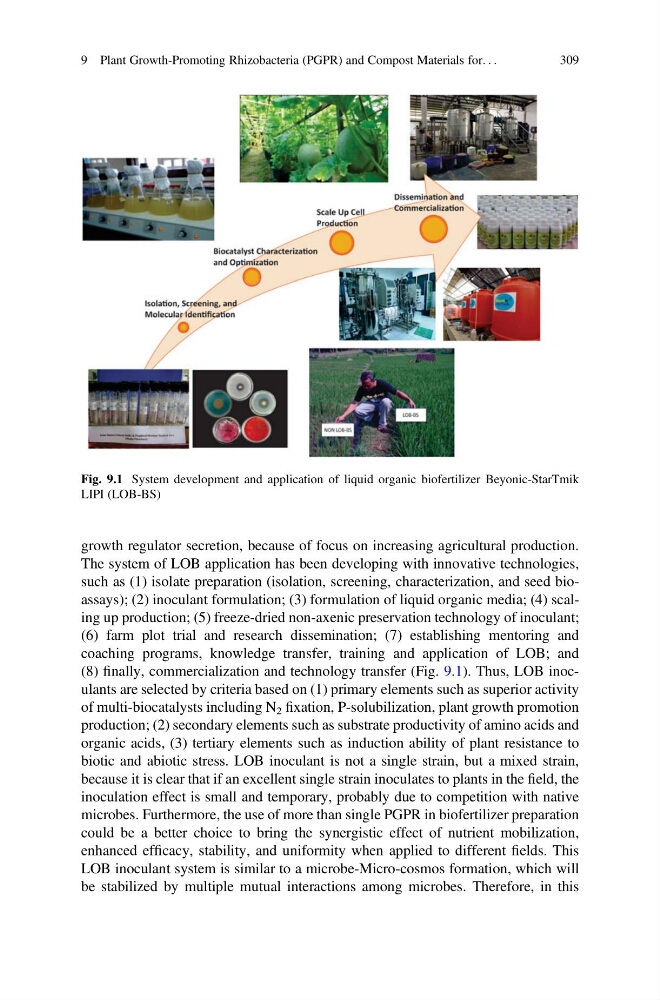
The system of LOB application has been developing with innovative technologies,
such as (1) isolate preparation (isolation, screening, characterization, and seed bioassays); (2) inoculant formulation; (3) formulation of liquid organic media; (4) scaling up production; (5) freeze-dried non-axenic preservation technology of inoculant;
(6) farm plot trial and research dissemination; (7) establishing mentoring and
coaching programs, knowledge transfer, training and application of LOB; and
(8) finally, commercialization and technology transfer (Fig. 9.1). Thus, LOB inoculants are selected by criteria based on (1) primary elements such as superior activity
of multi-biocatalysts including N 2 fixation, P-solubilization, plant growth promotion
production; (2) secondary elements such as substrate productivity of amino acids and
organic acids, (3) tertiary elements such as induction ability of plant resistance to
biotic and abiotic stress. LOB inoculant is not a single strain, but a mixed strain,
because it is clear that if an excellent single strain inoculates to plants in the field, the
inoculation effect is small and temporary, probably due to competition with native
microbes. Furthermore, the use of more than single PGPR in biofertilizer preparation
could be a better choice to bring the synergistic effect of nutrient mobilization,
enhanced efficacy, stability, and uniformity when applied to different fields. This
LOB inoculant system is similar to a microbe-Micro-cosmos formation, which will
be stabilized by multiple mutual interactions among microbes. Therefore, in this
Fig. 9.1 System development and application of liquid organic biofertilizer Beyonic-StarTmik
LIPI (LOB-BS)
9 Plant Growth-Promoting Rhizobacteria (PGPR) and Compost Materials for. . .
309
The system of LOB application has been developing with innovative technologies,
such as (1) isolate preparation (isolation, screening, characterization, and seed bioassays); (2) inoculant formulation; (3) formulation of liquid organic media; (4) scaling up production; (5) freeze-dried non-axenic preservation technology of inoculant;
(6) farm plot trial and research dissemination; (7) establishing mentoring and
coaching programs, knowledge transfer, training and application of LOB; and
(8) finally, commercialization and technology transfer (Fig. 9.1). Thus, LOB inoculants are selected by criteria based on (1) primary elements such as superior activity
of multi-biocatalysts including N 2 fixation, P-solubilization, plant growth promotion
production; (2) secondary elements such as substrate productivity of amino acids and
organic acids, (3) tertiary elements such as induction ability of plant resistance to
biotic and abiotic stress. LOB inoculant is not a single strain, but a mixed strain,
because it is clear that if an excellent single strain inoculates to plants in the field, the
inoculation effect is small and temporary, probably due to competition with native
microbes. Furthermore, the use of more than single PGPR in biofertilizer preparation
could be a better choice to bring the synergistic effect of nutrient mobilization,
enhanced efficacy, stability, and uniformity when applied to different fields. This
LOB inoculant system is similar to a microbe-Micro-cosmos formation, which will
be stabilized by multiple mutual interactions among microbes. Therefore, in this
Fig. 9.1 System development and application of liquid organic biofertilizer Beyonic-StarTmik
LIPI (LOB-BS)
9 Plant Growth-Promoting Rhizobacteria (PGPR) and Compost Materials for. . .
309