

requires a bio-stimulant to stimulate the growth of roots of forest trees where
conditions are very limited and the growth of peat is inundated at a minimum
GWL at 40 cm from the surface of peatland.
Some local tree species from peatland are dependent to ECM fungi, i.e. Shorea
spp., Hopea spp., Anisoptera spp., Dryobalanops spp., and other dipterocarp members (Lee 1998). Some indigenous ECM fungi have been collected from TPE of
Sumatra and Kalimantan (Fig. 8.4). The ECM fungi are easy to isolate and can grow
well in an agar medium. However, some ECM species could not be isolated. We can
apply all fruitbodies of ECM to inoculate in a nursery. This is just blending and
crushing of ECM fruitbody mixed with water, which are then inoculated to young
seedlings. ECM fungi species have the potential to be edible mycorrhizal mushrooms and they could be introduced in TPE restoration. This application can give
benefits to forest communities about the role and benefit of ECM fungi, i.e. not only
as a stimulant for the growth of forest plants in a biological way, but also to provide
incentives in the form of edible mushrooms of high economic value. However, it is a
well-known fact that many types of ECM fungi are categorized as edible mushrooms, including the species of fungi that are slow to colonize the host, so that
appropriate techniques are needed when the inoculation process can be done at the
field level. It is also possible that some edible mycorrhizal mushroom inoculants can
be included in an AeroHydro culture system. Another benefit of the introduction of
a
b
c
d
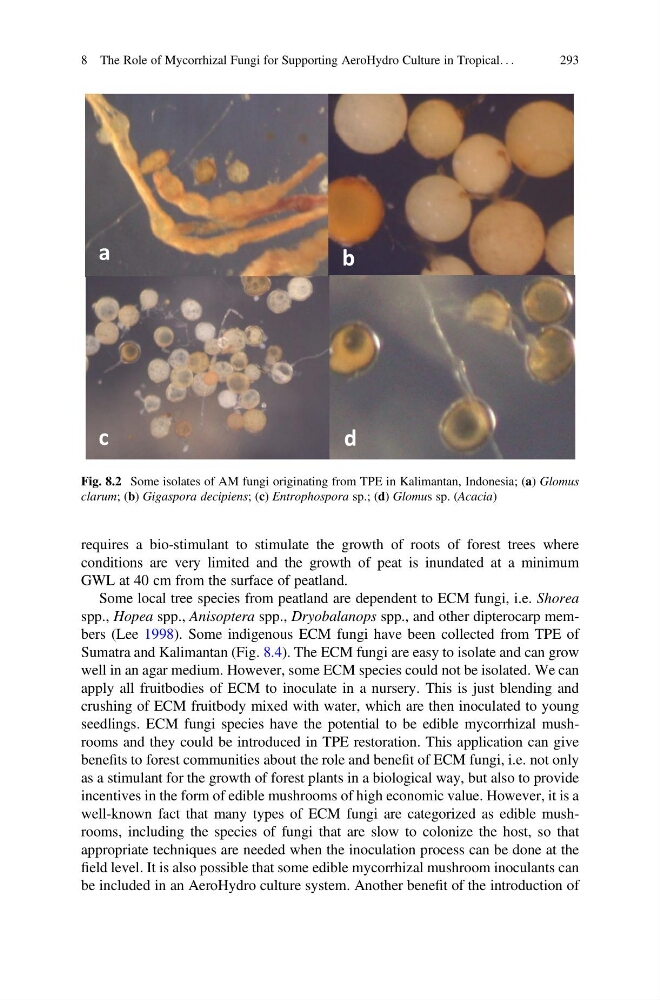
Fig. 8.2 Some isolates of AM fungi originating from TPE in Kalimantan, Indonesia; (a) Glomus
clarum; (b) Gigaspora decipiens; (c) Entrophospora sp.; (d) Glomus sp. (Acacia)
8 The Role of Mycorrhizal Fungi for Supporting AeroHydro Culture in Tropical. . .
293
conditions are very limited and the growth of peat is inundated at a minimum
GWL at 40 cm from the surface of peatland.
Some local tree species from peatland are dependent to ECM fungi, i.e. Shorea
spp., Hopea spp., Anisoptera spp., Dryobalanops spp., and other dipterocarp members (Lee 1998). Some indigenous ECM fungi have been collected from TPE of
Sumatra and Kalimantan (Fig. 8.4). The ECM fungi are easy to isolate and can grow
well in an agar medium. However, some ECM species could not be isolated. We can
apply all fruitbodies of ECM to inoculate in a nursery. This is just blending and
crushing of ECM fruitbody mixed with water, which are then inoculated to young
seedlings. ECM fungi species have the potential to be edible mycorrhizal mushrooms and they could be introduced in TPE restoration. This application can give
benefits to forest communities about the role and benefit of ECM fungi, i.e. not only
as a stimulant for the growth of forest plants in a biological way, but also to provide
incentives in the form of edible mushrooms of high economic value. However, it is a
well-known fact that many types of ECM fungi are categorized as edible mushrooms, including the species of fungi that are slow to colonize the host, so that
appropriate techniques are needed when the inoculation process can be done at the
field level. It is also possible that some edible mycorrhizal mushroom inoculants can
be included in an AeroHydro culture system. Another benefit of the introduction of
a
b
c
d
Fig. 8.2 Some isolates of AM fungi originating from TPE in Kalimantan, Indonesia; (a) Glomus
clarum; (b) Gigaspora decipiens; (c) Entrophospora sp.; (d) Glomus sp. (Acacia)
8 The Role of Mycorrhizal Fungi for Supporting AeroHydro Culture in Tropical. . .
293