

In Central Kalimantan, Combretocarpus rotundatus is a dominant fast-growing
tree species that regenerates quickly after fire. Combretocarpus rotundatus forms a
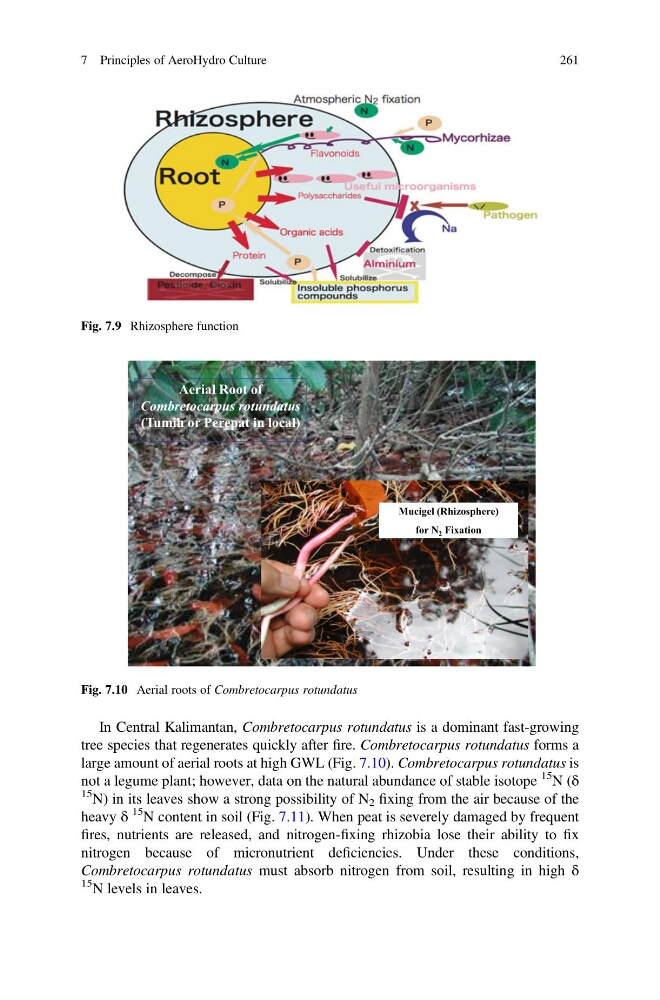
large amount of aerial roots at high GWL (Fig. 7.10). Combretocarpus rotundatus is
not a legume plant; however, data on the natural abundance of stable isotope
15 N (δ
15 N) in its leaves show a strong possibility of N 2 fixing from the air because of the
heavy δ
15 N content in soil (Fig. 7.11). When peat is severely damaged by frequent
fires, nutrients are released, and nitrogen-fixing rhizobia lose their ability to fix
nitrogen because of micronutrient deficiencies. Under these conditions,
Combretocarpus rotundatus must absorb nitrogen from soil, resulting in high δ
15 N levels in leaves.
Fig. 7.9 Rhizosphere function
Aerial Root of
Combretocarpus rotundatus
(Tumih or Perepat in local)
Mucigel (Rhizosphere)
for N 2 Fixation
Fig. 7.10 Aerial roots of Combretocarpus rotundatus
7 Principles of AeroHydro Culture
261
tree species that regenerates quickly after fire. Combretocarpus rotundatus forms a
large amount of aerial roots at high GWL (Fig. 7.10). Combretocarpus rotundatus is
not a legume plant; however, data on the natural abundance of stable isotope
15 N (δ
15 N) in its leaves show a strong possibility of N 2 fixing from the air because of the
heavy δ
15 N content in soil (Fig. 7.11). When peat is severely damaged by frequent
fires, nutrients are released, and nitrogen-fixing rhizobia lose their ability to fix
nitrogen because of micronutrient deficiencies. Under these conditions,
Combretocarpus rotundatus must absorb nitrogen from soil, resulting in high δ
15 N levels in leaves.
Fig. 7.9 Rhizosphere function
Aerial Root of
Combretocarpus rotundatus
(Tumih or Perepat in local)
Mucigel (Rhizosphere)
for N 2 Fixation
Fig. 7.10 Aerial roots of Combretocarpus rotundatus
7 Principles of AeroHydro Culture
261