

7.4 Rhizosphere Function in AeroHydro Culture
Plant roots exude polysaccharides, which delineate the rhizosphere. The rhizosphere
is matrix for microorganisms. Then, roots exude several compounds to improve
rhizospheric function:
• Protein (enzymes): acid phosphatase, phytase for phosphorus solubilization.
• Organic acids: Al
3+ detoxification, ol-P and Fe-P solubilization, and energy for
microorganisms.
• Polysaccharides: rhizosphere matrix for rhizobia.
• Flavonoids: stimulation of symbiosis with microorganisms (Fig. 7.9).
7.4.1 N 2 -Fixing Bacteria
Nitrogen is the key element among plant nutrients; however, the nitrogen content in
peat is extremely low. Therefore, it is hypothesized that plants adapted to tropical
peatlands can fix nitrogen. In tropical peatlands, several plants develop aerial roots at
high GWL. The mucilage (polysaccharides) that is normally found at the tip of aerial
roots is an important part of the rhizosphere. As N 2 -fixing bacteria can be isolated
easily from the rhizosphere, it is hypothesized that free living N 2 -fixing bacteria in
the rhizosphere can fix N 2 .
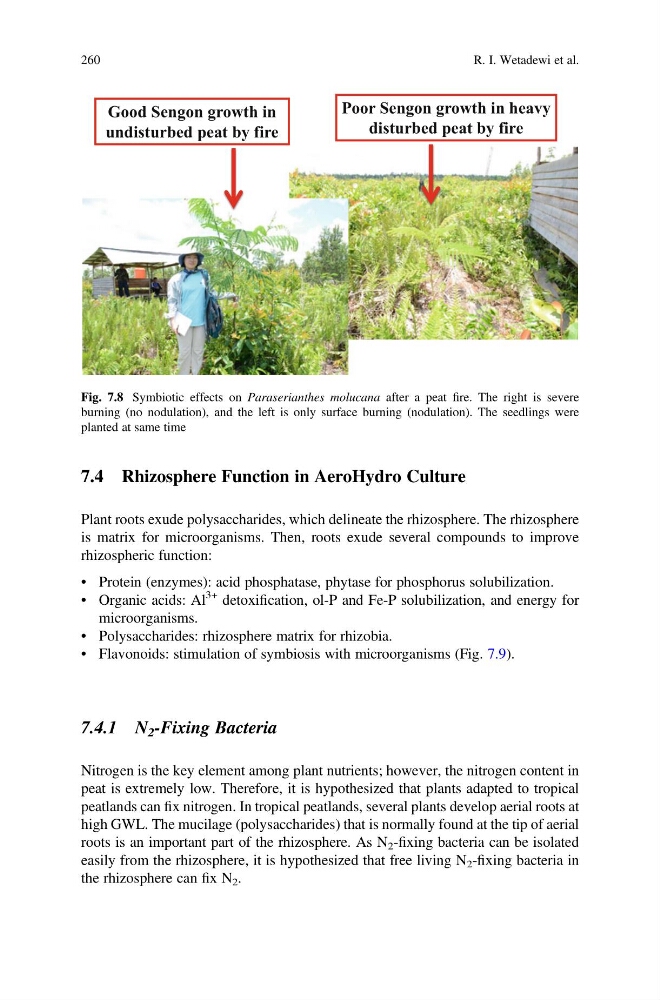
Good Sengon growth in
undisturbed peat by fire
Poor Sengon growth in heavy
disturbed peat by fire
Fig. 7.8 Symbiotic effects on Paraserianthes molucana after a peat fire. The right is severe
burning (no nodulation), and the left is only surface burning (nodulation). The seedlings were
planted at same time
260
R. I. Wetadewi et al.
Plant roots exude polysaccharides, which delineate the rhizosphere. The rhizosphere
is matrix for microorganisms. Then, roots exude several compounds to improve
rhizospheric function:
• Protein (enzymes): acid phosphatase, phytase for phosphorus solubilization.
• Organic acids: Al
3+ detoxification, ol-P and Fe-P solubilization, and energy for
microorganisms.
• Polysaccharides: rhizosphere matrix for rhizobia.
• Flavonoids: stimulation of symbiosis with microorganisms (Fig. 7.9).
7.4.1 N 2 -Fixing Bacteria
Nitrogen is the key element among plant nutrients; however, the nitrogen content in
peat is extremely low. Therefore, it is hypothesized that plants adapted to tropical
peatlands can fix nitrogen. In tropical peatlands, several plants develop aerial roots at
high GWL. The mucilage (polysaccharides) that is normally found at the tip of aerial
roots is an important part of the rhizosphere. As N 2 -fixing bacteria can be isolated
easily from the rhizosphere, it is hypothesized that free living N 2 -fixing bacteria in
the rhizosphere can fix N 2 .
Good Sengon growth in
undisturbed peat by fire
Poor Sengon growth in heavy
disturbed peat by fire
Fig. 7.8 Symbiotic effects on Paraserianthes molucana after a peat fire. The right is severe
burning (no nodulation), and the left is only surface burning (nodulation). The seedlings were
planted at same time
260
R. I. Wetadewi et al.