

growth performance of Shorea spp. improved rapidly within six months after
planting in a field in South Kalimantan, Indonesia (Fig. 7.6) (Turjaman et al. 2011,
2009).
Applying symbiotic microbes from fast-growing tropical tree species is very
important and useful for rehabilitation activities in postmining land in Indonesia.
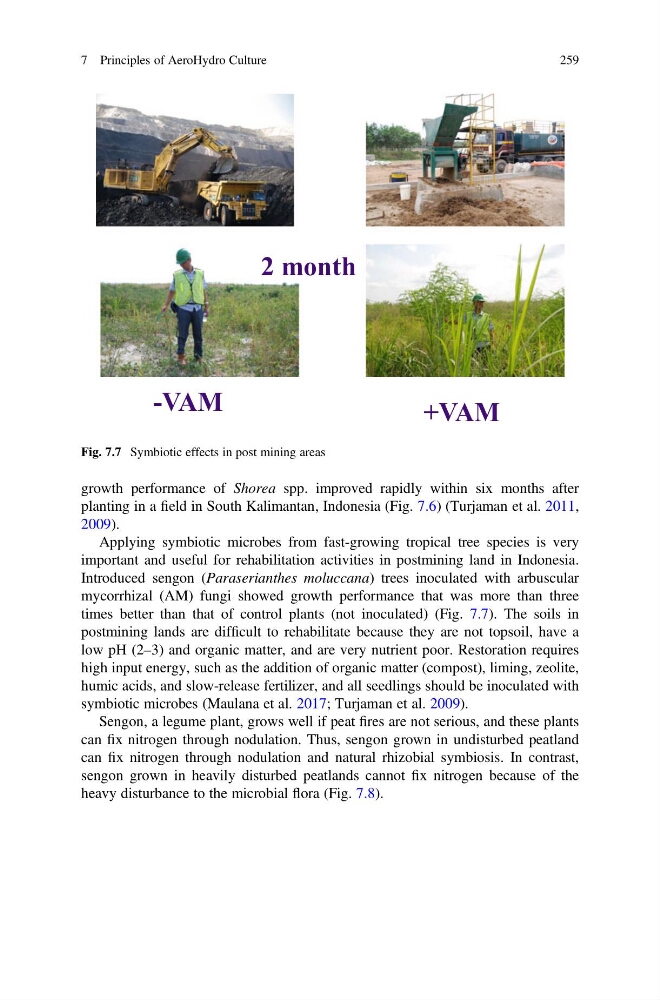
Introduced sengon (Paraserianthes moluccana) trees inoculated with arbuscular
mycorrhizal (AM) fungi showed growth performance that was more than three
times better than that of control plants (not inoculated) (Fig. 7.7). The soils in
postmining lands are difficult to rehabilitate because they are not topsoil, have a
low pH (2–3) and organic matter, and are very nutrient poor. Restoration requires
high input energy, such as the addition of organic matter (compost), liming, zeolite,
humic acids, and slow-release fertilizer, and all seedlings should be inoculated with
symbiotic microbes (Maulana et al. 2017; Turjaman et al. 2009).
Sengon, a legume plant, grows well if peat fires are not serious, and these plants
can fix nitrogen through nodulation. Thus, sengon grown in undisturbed peatland
can fix nitrogen through nodulation and natural rhizobial symbiosis. In contrast,
sengon grown in heavily disturbed peatlands cannot fix nitrogen because of the
heavy disturbance to the microbial flora (Fig. 7.8).
+VAM
-VAM
2 month
Fig. 7.7 Symbiotic effects in post mining areas
7 Principles of AeroHydro Culture
259
planting in a field in South Kalimantan, Indonesia (Fig. 7.6) (Turjaman et al. 2011,
2009).
Applying symbiotic microbes from fast-growing tropical tree species is very
important and useful for rehabilitation activities in postmining land in Indonesia.
Introduced sengon (Paraserianthes moluccana) trees inoculated with arbuscular
mycorrhizal (AM) fungi showed growth performance that was more than three
times better than that of control plants (not inoculated) (Fig. 7.7). The soils in
postmining lands are difficult to rehabilitate because they are not topsoil, have a
low pH (2–3) and organic matter, and are very nutrient poor. Restoration requires
high input energy, such as the addition of organic matter (compost), liming, zeolite,
humic acids, and slow-release fertilizer, and all seedlings should be inoculated with
symbiotic microbes (Maulana et al. 2017; Turjaman et al. 2009).
Sengon, a legume plant, grows well if peat fires are not serious, and these plants
can fix nitrogen through nodulation. Thus, sengon grown in undisturbed peatland
can fix nitrogen through nodulation and natural rhizobial symbiosis. In contrast,
sengon grown in heavily disturbed peatlands cannot fix nitrogen because of the
heavy disturbance to the microbial flora (Fig. 7.8).
+VAM
-VAM
2 month
Fig. 7.7 Symbiotic effects in post mining areas
7 Principles of AeroHydro Culture
259