

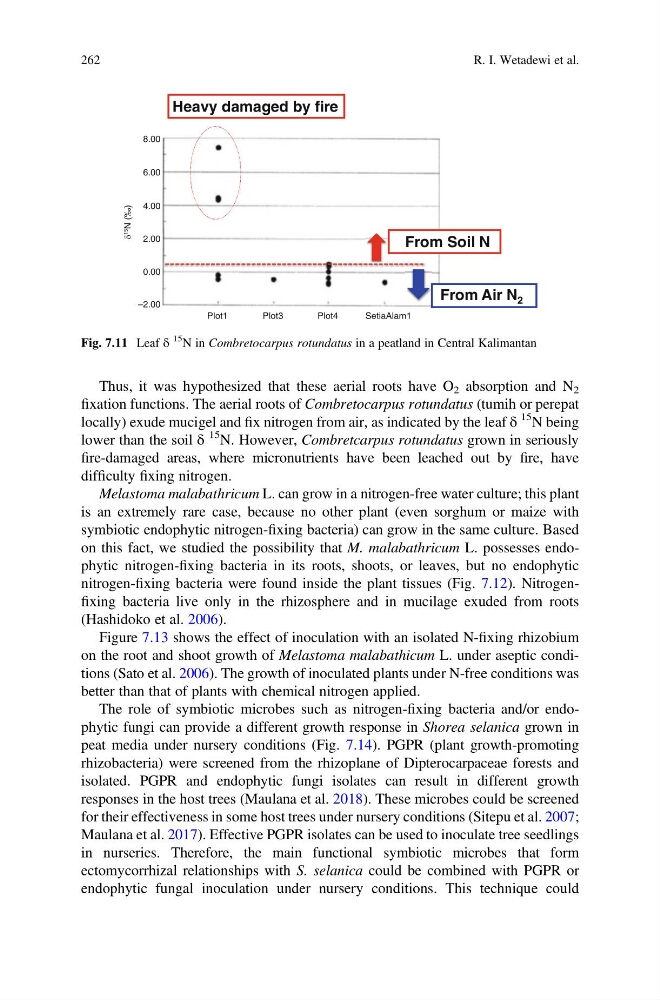
Thus, it was hypothesized that these aerial roots have O 2 absorption and N 2
fixation functions. The aerial roots of Combretocarpus rotundatus (tumih or perepat
locally) exude mucigel and fix nitrogen from air, as indicated by the leaf δ
15 N being
lower than the soil δ
15
N. However, Combretcarpus rotundatus grown in seriously
fire-damaged areas, where micronutrients have been leached out by fire, have
difficulty fixing nitrogen.
Melastoma malabathricum L. can grow in a nitrogen-free water culture; this plant
is an extremely rare case, because no other plant (even sorghum or maize with
symbiotic endophytic nitrogen-fixing bacteria) can grow in the same culture. Based
on this fact, we studied the possibility that M. malabathricum L. possesses endophytic nitrogen-fixing bacteria in its roots, shoots, or leaves, but no endophytic
nitrogen-fixing bacteria were found inside the plant tissues (Fig. 7.12). Nitrogenfixing bacteria live only in the rhizosphere and in mucilage exuded from roots
(Hashidoko et al. 2006).
Figure 7.13 shows the effect of inoculation with an isolated N-fixing rhizobium
on the root and shoot growth of Melastoma malabathicum L. under aseptic conditions (Sato et al. 2006). The growth of inoculated plants under N-free conditions was
better than that of plants with chemical nitrogen applied.
The role of symbiotic microbes such as nitrogen-fixing bacteria and/or endophytic fungi can provide a different growth response in Shorea selanica grown in
peat media under nursery conditions (Fig. 7.14). PGPR (plant growth-promoting
rhizobacteria) were screened from the rhizoplane of Dipterocarpaceae forests and
isolated. PGPR and endophytic fungi isolates can result in different growth
responses in the host trees (Maulana et al. 2018). These microbes could be screened
for their effectiveness in some host trees under nursery conditions (Sitepu et al. 2007;
Maulana et al. 2017). Effective PGPR isolates can be used to inoculate tree seedlings
in nurseries. Therefore, the main functional symbiotic microbes that form
ectomycorrhizal relationships with S. selanica could be combined with PGPR or
endophytic fungal inoculation under nursery conditions. This technique could
From Soil N
From Air N 2
Heavy damaged by fire
SetiaAlam1
Plot4
Plot3
Plot1
–2.00
0.00
2.00
15
N (‰)
4.00
6.00
8.00
Fig. 7.11 Leaf δ
15
N in Combretocarpus rotundatus in a peatland in Central Kalimantan
262
R. I. Wetadewi et al.
fixation functions. The aerial roots of Combretocarpus rotundatus (tumih or perepat
locally) exude mucigel and fix nitrogen from air, as indicated by the leaf δ
15 N being
lower than the soil δ
15
N. However, Combretcarpus rotundatus grown in seriously
fire-damaged areas, where micronutrients have been leached out by fire, have
difficulty fixing nitrogen.
Melastoma malabathricum L. can grow in a nitrogen-free water culture; this plant
is an extremely rare case, because no other plant (even sorghum or maize with
symbiotic endophytic nitrogen-fixing bacteria) can grow in the same culture. Based
on this fact, we studied the possibility that M. malabathricum L. possesses endophytic nitrogen-fixing bacteria in its roots, shoots, or leaves, but no endophytic
nitrogen-fixing bacteria were found inside the plant tissues (Fig. 7.12). Nitrogenfixing bacteria live only in the rhizosphere and in mucilage exuded from roots
(Hashidoko et al. 2006).
Figure 7.13 shows the effect of inoculation with an isolated N-fixing rhizobium
on the root and shoot growth of Melastoma malabathicum L. under aseptic conditions (Sato et al. 2006). The growth of inoculated plants under N-free conditions was
better than that of plants with chemical nitrogen applied.
The role of symbiotic microbes such as nitrogen-fixing bacteria and/or endophytic fungi can provide a different growth response in Shorea selanica grown in
peat media under nursery conditions (Fig. 7.14). PGPR (plant growth-promoting
rhizobacteria) were screened from the rhizoplane of Dipterocarpaceae forests and
isolated. PGPR and endophytic fungi isolates can result in different growth
responses in the host trees (Maulana et al. 2018). These microbes could be screened
for their effectiveness in some host trees under nursery conditions (Sitepu et al. 2007;
Maulana et al. 2017). Effective PGPR isolates can be used to inoculate tree seedlings
in nurseries. Therefore, the main functional symbiotic microbes that form
ectomycorrhizal relationships with S. selanica could be combined with PGPR or
endophytic fungal inoculation under nursery conditions. This technique could
From Soil N
From Air N 2
Heavy damaged by fire
SetiaAlam1
Plot4
Plot3
Plot1
–2.00
0.00
2.00
15
N (‰)
4.00
6.00
8.00
Fig. 7.11 Leaf δ
15
N in Combretocarpus rotundatus in a peatland in Central Kalimantan
262
R. I. Wetadewi et al.