

Data from a follow-up survey were used to calculate production rates from the
individual growth and recruitment of trees in the aboveground biomass; similarly,
death rates were calculated from data obtained on withering trees. The production
rate due to individual tree growth was reported to be approximately 40% of the net
aboveground primary production rate, which includes the production rate of shortlived leaves (Malhi et al. 2004, 2006; Takyu et al. 2005). As a result, the two
low-wetland forest types were revealed to 1.5 to 2 times higher biomass turnover
rates than the mixed dipterocarp forest. The turnover rate of the number of individuals was also higher than that in the mixed dipterocarp forest. In low wetlands, while
the oligotrophic conditions result in high canopy tree mortality, there is sufficient
light and nutrient supply to support replacement individuals, culminating in high
biomass production rates.
1.5 Key Components of Tropical Peatlands
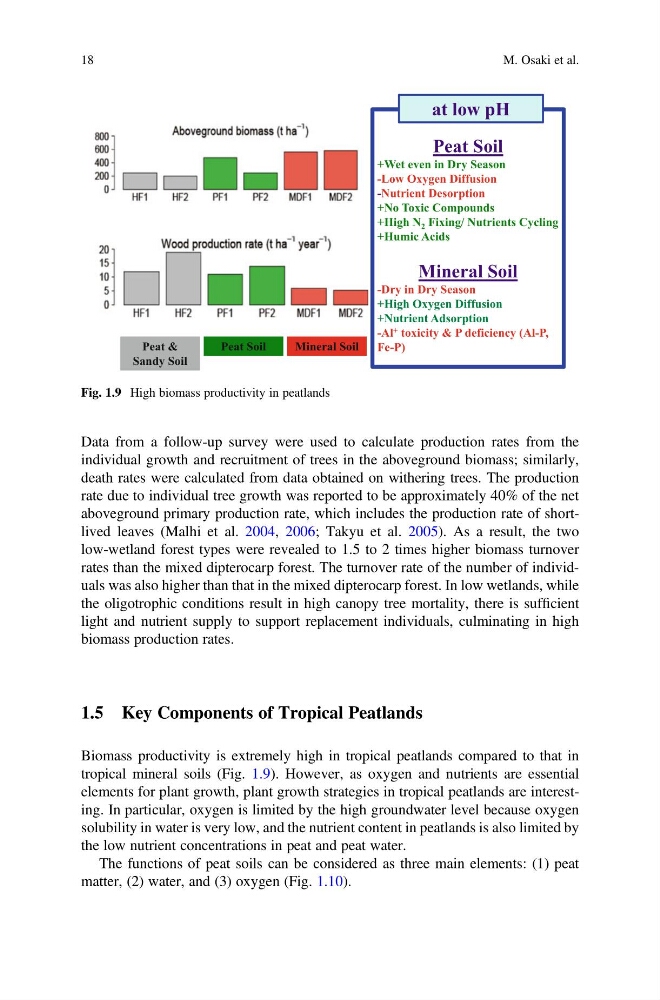
Biomass productivity is extremely high in tropical peatlands compared to that in
tropical mineral soils (Fig. 1.9). However, as oxygen and nutrients are essential
elements for plant growth, plant growth strategies in tropical peatlands are interesting. In particular, oxygen is limited by the high groundwater level because oxygen
solubility in water is very low, and the nutrient content in peatlands is also limited by
the low nutrient concentrations in peat and peat water.
The functions of peat soils can be considered as three main elements: (1) peat
matter, (2) water, and (3) oxygen (Fig. 1.10).
Peat Soil
+Wet even in Dry Season
-Low Oxygen Diffusion
-Nutrient Desorption
+No Toxic Compounds
+High N 2 Fixing/ Nutrients Cycling
+Humic Acids
Mineral Soil
-Dry in Dry Season
+High Oxygen Diffusion
+Nutrient Adsorption
-Al + toxicity & P deficiency (Al-P,
Fe-P)
at low pH
Mineral Soil
Peat Soil
Peat &
Sandy Soil
Fig. 1.9 High biomass productivity in peatlands
18
M. Osaki et al.
individual growth and recruitment of trees in the aboveground biomass; similarly,
death rates were calculated from data obtained on withering trees. The production
rate due to individual tree growth was reported to be approximately 40% of the net
aboveground primary production rate, which includes the production rate of shortlived leaves (Malhi et al. 2004, 2006; Takyu et al. 2005). As a result, the two
low-wetland forest types were revealed to 1.5 to 2 times higher biomass turnover
rates than the mixed dipterocarp forest. The turnover rate of the number of individuals was also higher than that in the mixed dipterocarp forest. In low wetlands, while
the oligotrophic conditions result in high canopy tree mortality, there is sufficient
light and nutrient supply to support replacement individuals, culminating in high
biomass production rates.
1.5 Key Components of Tropical Peatlands
Biomass productivity is extremely high in tropical peatlands compared to that in
tropical mineral soils (Fig. 1.9). However, as oxygen and nutrients are essential
elements for plant growth, plant growth strategies in tropical peatlands are interesting. In particular, oxygen is limited by the high groundwater level because oxygen
solubility in water is very low, and the nutrient content in peatlands is also limited by
the low nutrient concentrations in peat and peat water.
The functions of peat soils can be considered as three main elements: (1) peat
matter, (2) water, and (3) oxygen (Fig. 1.10).
Peat Soil
+Wet even in Dry Season
-Low Oxygen Diffusion
-Nutrient Desorption
+No Toxic Compounds
+High N 2 Fixing/ Nutrients Cycling
+Humic Acids
Mineral Soil
-Dry in Dry Season
+High Oxygen Diffusion
+Nutrient Adsorption
-Al + toxicity & P deficiency (Al-P,
Fe-P)
at low pH
Mineral Soil
Peat Soil
Peat &
Sandy Soil
Fig. 1.9 High biomass productivity in peatlands
18
M. Osaki et al.