

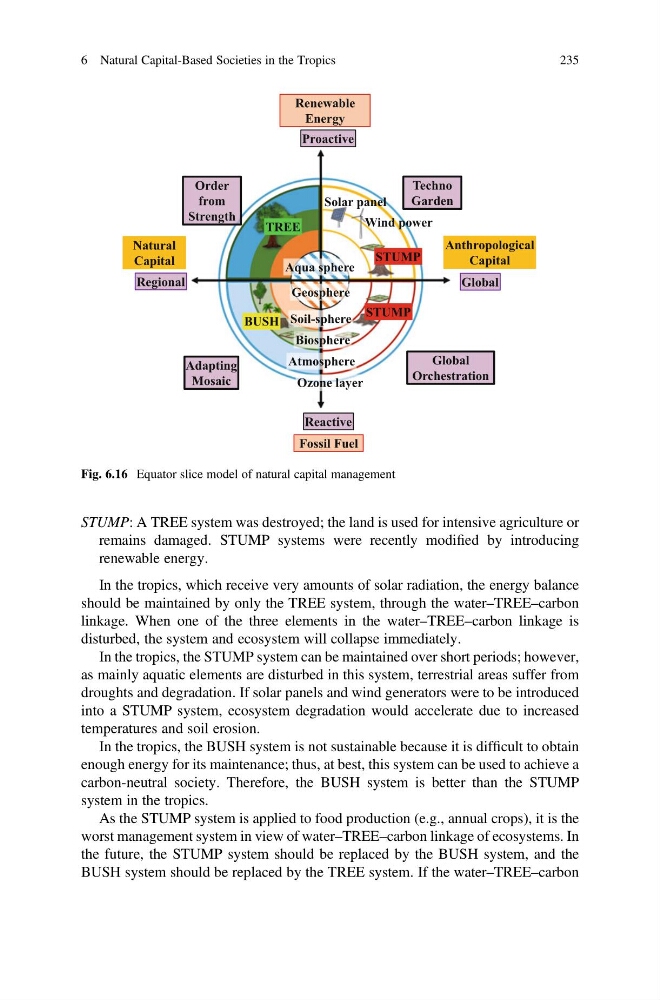
STUMP: A TREE system was destroyed; the land is used for intensive agriculture or
remains damaged. STUMP systems were recently modified by introducing
renewable energy.
In the tropics, which receive very amounts of solar radiation, the energy balance
should be maintained by only the TREE system, through the water–TREE–carbon
linkage. When one of the three elements in the water–TREE–carbon linkage is
disturbed, the system and ecosystem will collapse immediately.
In the tropics, the STUMP system can be maintained over short periods; however,
as mainly aquatic elements are disturbed in this system, terrestrial areas suffer from
droughts and degradation. If solar panels and wind generators were to be introduced
into a STUMP system, ecosystem degradation would accelerate due to increased
temperatures and soil erosion.
In the tropics, the BUSH system is not sustainable because it is difficult to obtain
enough energy for its maintenance; thus, at best, this system can be used to achieve a
carbon-neutral society. Therefore, the BUSH system is better than the STUMP
system in the tropics.
As the STUMP system is applied to food production (e.g., annual crops), it is the
worst management system in view of water–TREE–carbon linkage of ecosystems. In
the future, the STUMP system should be replaced by the BUSH system, and the
BUSH system should be replaced by the TREE system. If the water–TREE–carbon
TREE
Solar panel
Wind power
Reactive
Proactive
Natural
Capital
Anthropological
Capital
Fossil Fuel
Renewable
Energy
BUSH
Aqua sphere
Geosphere
Ozone layer
Atmosphere
Biosphere
Soil-sphere
Global
Regional
Adapting
Mosaic
Global
Orchestration
Techno
Garden
Order
from
Strength
STUMP
STUMP
Fig. 6.16 Equator slice model of natural capital management
6 Natural Capital-Based Societies in the Tropics
235
remains damaged. STUMP systems were recently modified by introducing
renewable energy.
In the tropics, which receive very amounts of solar radiation, the energy balance
should be maintained by only the TREE system, through the water–TREE–carbon
linkage. When one of the three elements in the water–TREE–carbon linkage is
disturbed, the system and ecosystem will collapse immediately.
In the tropics, the STUMP system can be maintained over short periods; however,
as mainly aquatic elements are disturbed in this system, terrestrial areas suffer from
droughts and degradation. If solar panels and wind generators were to be introduced
into a STUMP system, ecosystem degradation would accelerate due to increased
temperatures and soil erosion.
In the tropics, the BUSH system is not sustainable because it is difficult to obtain
enough energy for its maintenance; thus, at best, this system can be used to achieve a
carbon-neutral society. Therefore, the BUSH system is better than the STUMP
system in the tropics.
As the STUMP system is applied to food production (e.g., annual crops), it is the
worst management system in view of water–TREE–carbon linkage of ecosystems. In
the future, the STUMP system should be replaced by the BUSH system, and the
BUSH system should be replaced by the TREE system. If the water–TREE–carbon
TREE
Solar panel
Wind power
Reactive
Proactive
Natural
Capital
Anthropological
Capital
Fossil Fuel
Renewable
Energy
BUSH
Aqua sphere
Geosphere
Ozone layer
Atmosphere
Biosphere
Soil-sphere
Global
Regional
Adapting
Mosaic
Global
Orchestration
Techno
Garden
Order
from
Strength
STUMP
STUMP
Fig. 6.16 Equator slice model of natural capital management
6 Natural Capital-Based Societies in the Tropics
235