

encourage decision-makers to consider some positive and negative implications of
the different development trajectories (Millennium Ecosystem Assessment 2005).
The Millennium Ecosystem Assessment model can be applied globally; however,
if it is applied to the tropics, there will be variation in vulnerability (along the x-axis)
and resilience (along the y-axis) (Fig. 6.13). The Order from Strength scenario is
most difficult to apply in the tropics; however, the highest potential for the development of Harvesting Sun Societies in the tropics comes from this scenario. Because
land development can be minimal (native forest) or maximal (devasted land) in this
scenario, there is a high possibility for establishing new sun harvesting practices,
leading to a carbon-negative society. In the other scenarios, the goal of carbon
neutrality is barely achieved. In the tropics, as solar radiation is very high, the
water–TREE–carbon linkage should be maintained.
Figure 6.13 describes the design of the future tropical land management model,
following the Millennium Ecosystem Assessment (2005), and applying indicators of
balance between resilience and vulnerability.
• Order from Strength: native and disturbed forests in Africa.
• Adapting Mosaic: mixed cropping with rice, fruits, vegetables, and trees in rice
terraces with water management (irrigation systems) in Indonesia.
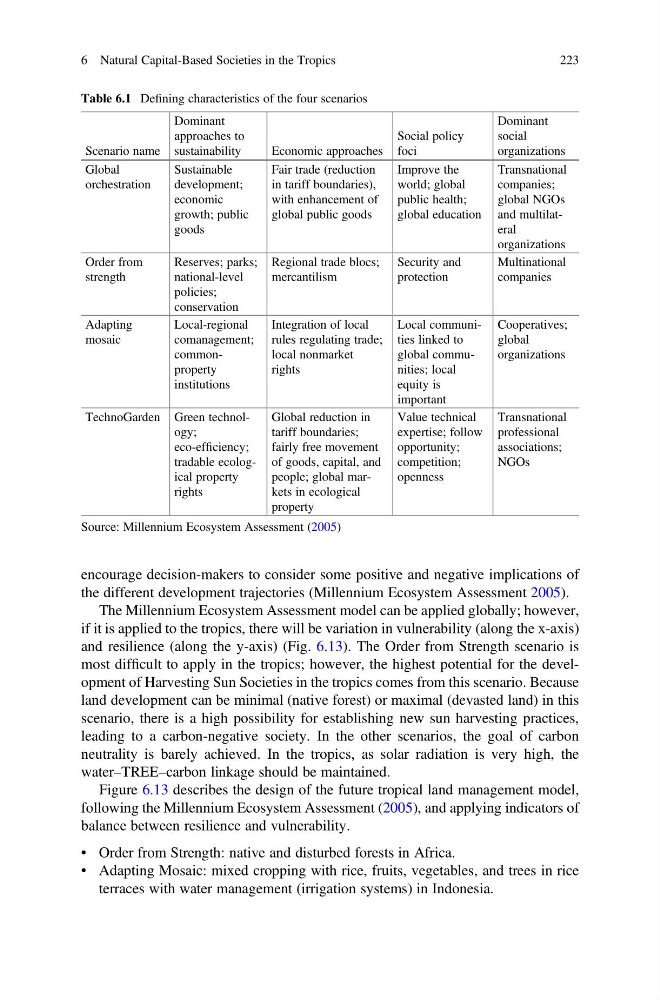
Table 6.1 Defining characteristics of the four scenarios
Scenario name
Dominant
approaches to
sustainability
Economic approaches
Social policy
foci
Dominant
social
organizations
Global
orchestration
Sustainable
development;
economic
growth; public
goods
Fair trade (reduction
in tariff boundaries),
with enhancement of
global public goods
Improve the
world; global
public health;
global education
Transnational
companies;
global NGOs
and multilateral
organizations
Order from
strength
Reserves; parks;
national-level
policies;
conservation
Regional trade blocs;
mercantilism
Security and
protection
Multinational
companies
Adapting
mosaic
Local-regional
comanagement;
commonproperty
institutions
Integration of local
rules regulating trade;
local nonmarket
rights
Local communities linked to
global communities; local
equity is
important
Cooperatives;
global
organizations
TechnoGarden Green technology;
eco-efficiency;
tradable ecological property
rights
Global reduction in
tariff boundaries;
fairly free movement
of goods, capital, and
people; global markets in ecological
property
Value technical
expertise; follow
opportunity;
competition;
openness
Transnational
professional
associations;
NGOs
Source: Millennium Ecosystem Assessment (2005)
6 Natural Capital-Based Societies in the Tropics
223
the different development trajectories (Millennium Ecosystem Assessment 2005).
The Millennium Ecosystem Assessment model can be applied globally; however,
if it is applied to the tropics, there will be variation in vulnerability (along the x-axis)
and resilience (along the y-axis) (Fig. 6.13). The Order from Strength scenario is
most difficult to apply in the tropics; however, the highest potential for the development of Harvesting Sun Societies in the tropics comes from this scenario. Because
land development can be minimal (native forest) or maximal (devasted land) in this
scenario, there is a high possibility for establishing new sun harvesting practices,
leading to a carbon-negative society. In the other scenarios, the goal of carbon
neutrality is barely achieved. In the tropics, as solar radiation is very high, the
water–TREE–carbon linkage should be maintained.
Figure 6.13 describes the design of the future tropical land management model,
following the Millennium Ecosystem Assessment (2005), and applying indicators of
balance between resilience and vulnerability.
• Order from Strength: native and disturbed forests in Africa.
• Adapting Mosaic: mixed cropping with rice, fruits, vegetables, and trees in rice
terraces with water management (irrigation systems) in Indonesia.
Table 6.1 Defining characteristics of the four scenarios
Scenario name
Dominant
approaches to
sustainability
Economic approaches
Social policy
foci
Dominant
social
organizations
Global
orchestration
Sustainable
development;
economic
growth; public
goods
Fair trade (reduction
in tariff boundaries),
with enhancement of
global public goods
Improve the
world; global
public health;
global education
Transnational
companies;
global NGOs
and multilateral
organizations
Order from
strength
Reserves; parks;
national-level
policies;
conservation
Regional trade blocs;
mercantilism
Security and
protection
Multinational
companies
Adapting
mosaic
Local-regional
comanagement;
commonproperty
institutions
Integration of local
rules regulating trade;
local nonmarket
rights
Local communities linked to
global communities; local
equity is
important
Cooperatives;
global
organizations
TechnoGarden Green technology;
eco-efficiency;
tradable ecological property
rights
Global reduction in
tariff boundaries;
fairly free movement
of goods, capital, and
people; global markets in ecological
property
Value technical
expertise; follow
opportunity;
competition;
openness
Transnational
professional
associations;
NGOs
Source: Millennium Ecosystem Assessment (2005)
6 Natural Capital-Based Societies in the Tropics
223