

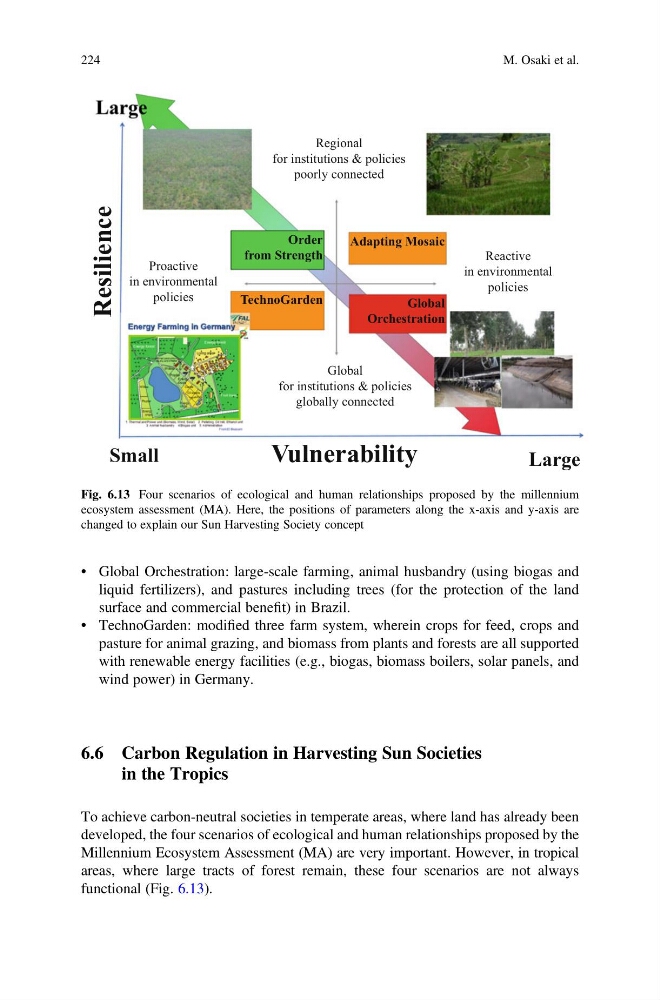
• Global Orchestration: large-scale farming, animal husbandry (using biogas and
liquid fertilizers), and pastures including trees (for the protection of the land
surface and commercial benefit) in Brazil.
• TechnoGarden: modified three farm system, wherein crops for feed, crops and
pasture for animal grazing, and biomass from plants and forests are all supported
with renewable energy facilities (e.g., biogas, biomass boilers, solar panels, and
wind power) in Germany.
6.6 Carbon Regulation in Harvesting Sun Societies
in the Tropics
To achieve carbon-neutral societies in temperate areas, where land has already been
developed, the four scenarios of ecological and human relationships proposed by the
Millennium Ecosystem Assessment (MA) are very important. However, in tropical
areas, where large tracts of forest remain, these four scenarios are not always
functional (Fig. 6.13).
Reactive
in environmental
policies
Proactive
in environmental
policies
Global
for institutions & policies
globally connected
Regional
for institutions & policies
poorly connected
Global
Orchestration
Order
from Strength
TechnoGarden
Adapting Mosaic
Resilience
Vulnerability
Large
Small
Fig. 6.13 Four scenarios of ecological and human relationships proposed by the millennium
ecosystem assessment (MA). Here, the positions of parameters along the x-axis and y-axis are
changed to explain our Sun Harvesting Society concept
224
M. Osaki et al.
liquid fertilizers), and pastures including trees (for the protection of the land
surface and commercial benefit) in Brazil.
• TechnoGarden: modified three farm system, wherein crops for feed, crops and
pasture for animal grazing, and biomass from plants and forests are all supported
with renewable energy facilities (e.g., biogas, biomass boilers, solar panels, and
wind power) in Germany.
6.6 Carbon Regulation in Harvesting Sun Societies
in the Tropics
To achieve carbon-neutral societies in temperate areas, where land has already been
developed, the four scenarios of ecological and human relationships proposed by the
Millennium Ecosystem Assessment (MA) are very important. However, in tropical
areas, where large tracts of forest remain, these four scenarios are not always
functional (Fig. 6.13).
Reactive
in environmental
policies
Proactive
in environmental
policies
Global
for institutions & policies
globally connected
Regional
for institutions & policies
poorly connected
Global
Orchestration
Order
from Strength
TechnoGarden
Adapting Mosaic
Resilience
Vulnerability
Large
Small
Fig. 6.13 Four scenarios of ecological and human relationships proposed by the millennium
ecosystem assessment (MA). Here, the positions of parameters along the x-axis and y-axis are
changed to explain our Sun Harvesting Society concept
224
M. Osaki et al.