

6.2.1 TREE Model in the Tropics
What methods can be used to collect moderately dense solar energy? One method is
micro-hydropower, which relies on the circulation of water driven by solar energy;
this method is abundant in the tropical zone.
What are the best instruments to convert diffuse and concentrated solar energy
into dense energy resources? The only candidate is biomass. A new concept related
to eco-renewable energy that is compatible with renewable production, natural
capital conservation or enhancement, and carbon-negative systems is proposed
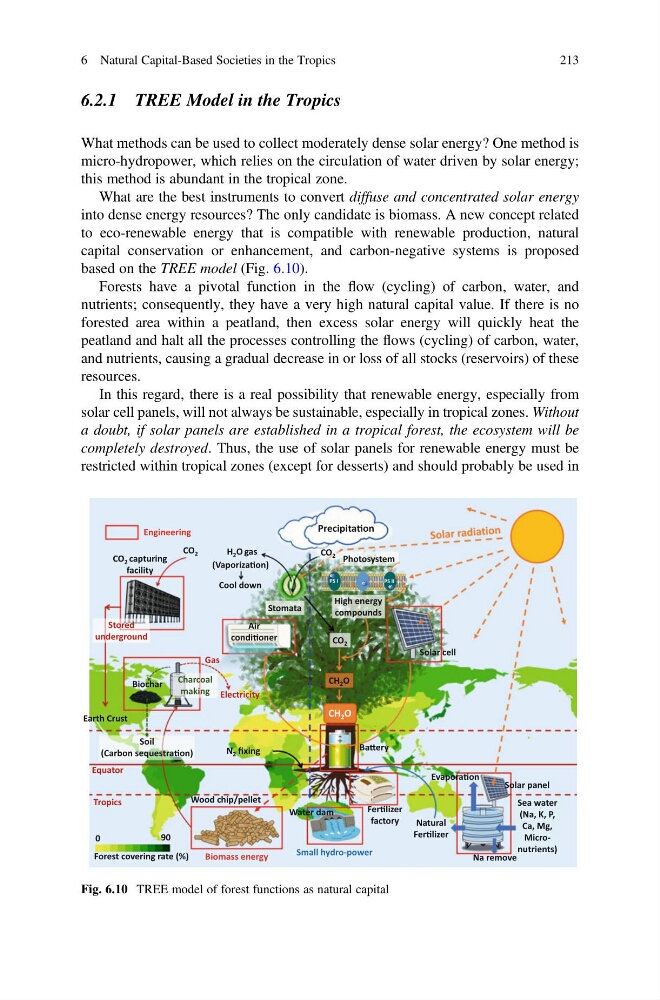
based on the TREE model (Fig. 6.10).
Forests have a pivotal function in the flow (cycling) of carbon, water, and
nutrients; consequently, they have a very high natural capital value. If there is no
forested area within a peatland, then excess solar energy will quickly heat the
peatland and halt all the processes controlling the flows (cycling) of carbon, water,
and nutrients, causing a gradual decrease in or loss of all stocks (reservoirs) of these
resources.
In this regard, there is a real possibility that renewable energy, especially from
solar cell panels, will not always be sustainable, especially in tropical zones. Without
a doubt, if solar panels are established in a tropical forest, the ecosystem will be
completely destroyed. Thus, the use of solar panels for renewable energy must be
restricted within tropical zones (except for desserts) and should probably be used in
Equator
Tropics
CH 2 O
PrecipitaƟon
Sea water
(Na, K, P,
Ca, Mg,
Micronutrients)
Na remove
Natural
FerƟlizer
Forest covering rate (%)
0
90
Solar cell
Air
condiƟoner
N 2 fixing
BaƩery
H 2 O gas
FerƟlizer
factory
CO 2
CH 2 O
High energy
compounds
(VaporizaƟon)
Cool down
Engineering
Stomata
Photosystem
e -
PS I
e -
e -
PS II
CO 2
Wood chip/pellet
Water dam
Biomass energy
Small hydro-power
Solar panel
EvaporaƟon
CO 2
Electricity
CO 2 capturing
facility
Biochar
Soil
(Carbon sequestraƟon)
Stored
underground
Charcoal
making
Gas
Earth Crust
Fig. 6.10 TREE model of forest functions as natural capital
6 Natural Capital-Based Societies in the Tropics
213
What methods can be used to collect moderately dense solar energy? One method is
micro-hydropower, which relies on the circulation of water driven by solar energy;
this method is abundant in the tropical zone.
What are the best instruments to convert diffuse and concentrated solar energy
into dense energy resources? The only candidate is biomass. A new concept related
to eco-renewable energy that is compatible with renewable production, natural
capital conservation or enhancement, and carbon-negative systems is proposed
based on the TREE model (Fig. 6.10).
Forests have a pivotal function in the flow (cycling) of carbon, water, and
nutrients; consequently, they have a very high natural capital value. If there is no
forested area within a peatland, then excess solar energy will quickly heat the
peatland and halt all the processes controlling the flows (cycling) of carbon, water,
and nutrients, causing a gradual decrease in or loss of all stocks (reservoirs) of these
resources.
In this regard, there is a real possibility that renewable energy, especially from
solar cell panels, will not always be sustainable, especially in tropical zones. Without
a doubt, if solar panels are established in a tropical forest, the ecosystem will be
completely destroyed. Thus, the use of solar panels for renewable energy must be
restricted within tropical zones (except for desserts) and should probably be used in
Equator
Tropics
CH 2 O
PrecipitaƟon
Sea water
(Na, K, P,
Ca, Mg,
Micronutrients)
Na remove
Natural
FerƟlizer
Forest covering rate (%)
0
90
Solar cell
Air
condiƟoner
N 2 fixing
BaƩery
H 2 O gas
FerƟlizer
factory
CO 2
CH 2 O
High energy
compounds
(VaporizaƟon)
Cool down
Engineering
Stomata
Photosystem
e -
PS I
e -
e -
PS II
CO 2
Wood chip/pellet
Water dam
Biomass energy
Small hydro-power
Solar panel
EvaporaƟon
CO 2
Electricity
CO 2 capturing
facility
Biochar
Soil
(Carbon sequestraƟon)
Stored
underground
Charcoal
making
Gas
Earth Crust
Fig. 6.10 TREE model of forest functions as natural capital
6 Natural Capital-Based Societies in the Tropics
213